---
title: "The Sell-By-Chat Playbook"
author: "Seven Figure Creators"
url: "https://library.sevenfigurecreators.com/3/the-sell-by-chat-playbook"
---
BEFORE YOU START
License Agreement
=================
Learn more about the **Seven Figure Creators** licensing model. Have a question? Get in touch and we'll help you out.
Introduction
------------
**Seven Figure Creators** is a trading name of **Betterline IO Pty Ltd**. Throughout this license agreement, **Seven Figure Creators** represents **Betterline IO Pty Ltd**.
Digital Product Definition
--------------------------
### Digital Product:
The specific digital good provided by **Seven Figure Creators** after purchase or through an opt-in process, which may include:
- Courses
- Templates
- Modules
- Resources
- Recorded videos
- Figma kits
- Website templates
- Google Docs
- Notion docs
- Any other digital material
This license applies to the **Digital Product** you have purchased from us, received through an opt-in, or otherwise obtained, and its specific content and inclusions.
Personal License
----------------
**Seven Figure Creators** grants you an ongoing, non-exclusive license to use the **Digital Product** you have purchased, received through an opt-in, or otherwise obtained.
The license grants permission to **one individual** (the **Licensee**) to access and use the specific **Digital Product**.
### You can:
- Use the **Digital Product** to enhance your personal knowledge and skills.
- Modify the **Digital Product** for personal use. These modifications are subject to this license.
- Use the knowledge and resources from the **Digital Product** to create unlimited **End Products** for your personal use.
- Implement strategies and techniques learned from the **Digital Product** in your own work.
- Use any templates or resources included in the **Digital Product** to develop materials for your own business.
### You cannot:
- Share, redistribute, or resell the **Digital Product** or any derivatives thereof.
- Grant access to the **Digital Product** to any other individual.
- Use the **Digital Product** to create courses, workshops, or training materials that compete with **Seven Figure Creators**.
- Publish or make available any portion of the **Digital Product** publicly, including but not limited to:
- Online platforms
- Social media
- File-sharing services
- Use the **Digital Product** to produce anything that may be deemed by **Seven Figure Creators**, at their sole discretion, to be competitive or in conflict with their business.
Example Usage
-------------
### Allowed:
- Studying the purchased or opted-in course materials to improve your own **LinkedIn lead generation strategies**.
- Using templates and resources from the **Digital Product** to create marketing materials for your personal business.
- Applying learned techniques from the **Digital Product** to enhance your **content creation and audience building efforts**.
- Implementing **CRM setups and automations** in your own business operations using knowledge gained from the **Digital Product**.
### Not Allowed:
- Sharing the course videos, templates, or materials from the **Digital Product** with friends, colleagues, or the public.
- Uploading any part of the **Digital Product** to websites, forums, or social media.
- Incorporating parts of the **Digital Product** into your own courses or training programs.
- Reselling or distributing the **Digital Product** or any derivatives to third parties.
- Creating a **competitive course, template, or product** based on the content of the **Digital Product**.
In simple terms, use the **Digital Product** you've purchased, received through an opt-in, or otherwise obtained from **Seven Figure Creators** to advance your own skills and business, but **do not share, resell, or compete** with **Seven Figure Creators** using these materials.
Personal License Definitions
----------------------------
- **Licensee**: The individual who has purchased, received through an opt-in, or otherwise obtained a **Personal License**.
- **Digital Product**: The specific digital good you have purchased, received through an opt-in, or otherwise obtained from **Seven Figure Creators**.
- **End Product**: Any work created by the **Licensee** that incorporates elements of the **Digital Product** for personal use.
Enforcement
-----------
The copyright of the **Digital Product** is owned by **Seven Figure Creators** (**Betterline IO Pty Ltd**). You are granted only the permissions described in this license; **all other rights are reserved**. **Seven Figure Creators** reserves the right to pursue legal remedies for any **unauthorized use** of the **Digital Product** outside the scope of this license.
Liability
---------
**Seven Figure Creators**' liability to you for costs, damages, or other losses arising from your use of the **Digital Product**---including third-party claims against you---**is limited to a refund of your license fee**. **Seven Figure Creators** is **not liable for any consequential damages** related to your use of the **Digital Product**.
This Agreement is governed by the laws of **New South Wales, Australia**. Legal proceedings related to this Agreement may only be brought in the courts of **New South Wales**. You agree to **service of process** at the email address on your original order.
Questions?
----------
Unsure which license you need or if your use case is covered by our licenses?
**Contact us at:** with your questions.
# A Faster, Easier Way to Results...
Before we dive in, let me be upfront...
What you're about to learn works. It's a proven process for turning LinkedIn DMs into cash.
But here's the thing–it's only one piece of what goes into building a 7-figure business.
The real transformation happens when you plug into the full system.
That means:
- The complete step-by-step framework for lead generation & content creation.
- 100s of hours of course content, resources, templates & more.
- Hands-on guidance & coaching from experts.
- Access to a community of 500+ creators.
This guide will give you a great start, but if you want the full program, [sevenfigurecreators.com](http://sevenfigurecreators.com) is where you'll find it.
👉 **Want a faster, easier way to results?** Work with us. Lock in a time to chat [here](https://sevenfigurecreators.com/six-figure-creators/). Let's explore what's possible for your business.
Now, let's get to work.
# Disclaimer
The strategies and tactics outlined in this book are based on practices and insights at the time of writing. LinkedIn and sales strategies are constantly evolving, and what works today may not work tomorrow.
Please note: these teachings, tools, and methods are shared for informational purposes only. It is your responsibility to ensure compliance with LinkedIn’s terms of service, any third-party terms, and your local laws or regulations. By using this content, you accept full responsibility for your actions and their outcomes.
Seven Figure Creators, and this book is provided as-is, without guarantees. Use it wisely—and at your own risk.
# Preface
Let’s get one thing straight: **selling doesn’t work**.
Not the way most people do it, anyway.
Spamming, pitching strangers, or rattling off benefits like a robot—none of that gets people to buy.
You know what does? Actually helping. Showing up with real solutions, putting the other person first, and genuinely helping them.
That’s what sell-by-chat is all about.
It’s the simplest, most scalable way to start meaningful conversations, build trust, and close deals.
No ads. No fancy funnels. Just you, your LinkedIn account, and the magic of being genuinely helpful.
Is it easy? Hell no. It takes work. But it’s the kind of work that pays off, because it’s built on serving, not selling. And when you get this right, selling stops feeling awkward and starts feeling...natural.
This isn’t another “hack.” It’s the smart way to turn effort into results. All you need is a willingness to act, a bit of dedication, and this playbook in your hands.
Ready?
Let’s turn your DMs into cash on LinkedIn.
# Why LinkedIn?
Sales have come a long way—from door-to-door pitches to cold calls, and now, to conversations in your LinkedIn inbox.
Nobody wants to be sold to, and nobody enjoys pushing for a sale. What works now is having real conversations that build trust and naturally turn into deals.
LinkedIn is the perfect platform for this. It's where professionals go to network, learn, and grow. That means your ideal clients are already there, waiting for the right conversation.
Not a pitch, but a chat.
That's what this playbook is about—mastering sell-by-chat. It's the fastest and (arguably) most cost-effective way to sell online today.
# How to Use This Playbook
This isn’t just a bunch of random tips. It’s a process.
Start at the beginning. Each chapter builds on the one before it.
Skipping ahead? Bad idea. Master the basics first. Get them working.
When the basics click, add the advanced tactics from the ‘Scale Edition’ of this playbook.
Follow the steps. Put in the work. Get results. Then scale.
## Ready to Scale?
If you’re reading the ‘Scale Edition,’ chances are you’re gearing up to build a team for sell-by-chat.
Good news—this playbook doubles as a training guide.
Make it part of your onboarding process so your team understands, respects, and lives the sell-by-chat philosophy.
This ensures consistency, efficiency, and results.
#The Prerequisites
Listen, if you’ve got the kahunas to start sliding into DMs without polishing your LinkedIn profile or even knowing exactly what you’re selling, you’re probably already on the path to success.
Why? Because if you just start talking to the people you want to work with, they’ll tell you their problems. And if you listen, they’ll hand you the blueprint for what to sell them.
So, technically, there are no prerequisites other than a LinkedIn account to use this playbook. You can dive in and build your business as you go.
But let’s be real—most people aren’t comfortable with this approach. It feels unnatural, maybe even downright weird. We get it.
If you want to feel more confident and come across as a total pro from day one, we recommend completing **The 101 Module** from the **[www.sevenfigurecreators.com](www.sevenfigurecreators.com)** program.
The 101 Module will guide you to:
- Find, create or improve your offer.
- Optimise your LinkedIn profile & content for trust.
- Set you up with everything you need to sell more and faster.
Not a member? Click **[here](https://sevenfigurecreators.com/six-figure-creators/)** to join.
So, are you jumping in raw? Or taking a moment to polish up? Either way, there’s no wrong answer.
Let’s get to it.
Part 1: Sell-By-Chat 101
# Understand Sell-by-Chat 101 or Don’t Even Bother
If you skip Part 1: Sell-By-Chat 101, nothing else in this book will work.
It’s not optional.
This section gives you the foundation—the mindset, the principles, and the understanding you need to actually succeed with sell-by-chat.
You can’t just copy tactics and hope for the best. If you don’t get the why behind the approach, your chats will fall flat, your leads will ghost you, and you’ll waste your time.
Start here. Take it seriously.
Chapter 1: Mindset Shifts for Effective Sell-By-Chat
# Serving vs. Selling: The New Paradigm
If there's one mindset shift that will flip your sales game, it's this:
**Stop selling. Start serving.**
Chat-based selling works not because you're trying to shove your offer down someone's throat but because you're solving their problems—problems they've already told you about.
People hate being sold to, but they love being helped. When you focus on serving, selling happens naturally.
Think about it like this: every chat is an opportunity to make someone's day better. Maybe you'll share a tip that changes how they approach their business. Maybe you'll point them to a resource that saves them hours of frustration. And maybe, just maybe, you'll uncover a problem you can help solve for them directly.
The sale? That's the side effect of being genuinely helpful.
# Overcoming Common Excuses and Misconceptions
Let's tackle the biggest excuses you've probably told yourself about sell-by-chat.
**1. _"It feels too salesy"_**
Sure, if you're spamming canned pitches to random strangers, it's salesy—and gross. But if you're showing up like a real human, listening, and responding to what people actually need, it won't feel salesy at all. It'll feel like a conversation between two people who respect each other.
**2. _"It takes too long"_**
Here's the truth: chatting is a time investment, but it's also the fastest path to results. Done right, it beats cold calls, email sequences, or lots of zoom calls. And if you follow this playbook, you'll know exactly what to say, when to say it, and how to move people forward without wasting time.
**3. _"Leads go cold"_**
Most leads don't go cold. They're just waiting for you to follow up. The magic is in the follow-ups—those fifth, sixth, or even seventh touches. Don't write someone off because they didn't respond right away. Be persistent but respectful, and you'll resurrect plenty of "dead" leads.
**4. _"Outsourcing doesn't work"_**
You can hand off chat sales to someone else—but only if your process is rock solid. Stick with this playbook start to finish, and you’ll have the structure to make it work. Leads won’t feel like they’re talking to a robot; they’ll feel like they’re talking to you. And then you'll be selling all day. Every day.
* * * * *
Chapter 2: Measuring What Matters
# Measuring Your Chat-to-Contract Ratio
Numbers don't lie.
The easiest way to know if your chats are working is to measure your Chat-to-Contract Ratio.
- **Chats:** How many people are you starting conversations with?
- **Contracts:** How many of those conversations turn into paying clients?
---
### Here's how the math breaks down:
1. Chats Started: 100 people
2. Reply Rate (30%): 30 replies
3. Engagement Rate (50%): 15 meaningful conversations
4. Call Booking Rate (20%): 3 booked calls
5. Show-Up Rate (80%): 2.4 calls attended
6. Close Rate (50%): 1.2 closed sales
## Overall Conversion Rate: ~1%
---
So, for every 100 people you reach out to, you should expect to close at least 1 deal, with potential for more as you refine your process.
# Understanding Key Metrics
### What you should be tracking:
- Reply Rate (30%): Of 100 people you message, how many respond?
- Engagement Rate (50%): Of those who reply, how many continue a meaningful conversation?
- Call Booking Rate (20%): Of meaningful conversations, how many book a call?
- Show-Up Rate (80%): Of calls booked, how many actually show up?
- Close Rate (50%): Of calls attended, how many result in a sale?
---
It's simple. Don't make it complicated.
# Setting Realistic Expectations
The truth…
You need to make sell-by-chat a daily habit to see results.
The mistakes we see?
1. People going all in, sending 1000 DMs, getting overwhelmed and never doing it again.
2. People are too scared to even try. If that’s you, the '[Prerequisites](https://library.sevenfigurecreators.com/books/3/pages/26/)' and '[Common Excuses](https://library.sevenfigurecreators.com/3/the-sell-by-chat-playbook/33/overcoming-common-excuses-and-misconceptions)' sections are there to help you push past it.
And remember...
Some people just won’t want to chat with you. Some will ignore you. Others might outright reject you. And guess what? That’s perfectly fine.
You're not going to close every single person you chat with. That's not the goal. The goal is to build relationships, provide value, and let the right people self-select into working with you.
Here's a baseline to aim for:
- **Contacts per Day:** Start with 25-30.
- **Reply Rate (30%):** 7-9 replies.
- **Engagement Rate (50%):** 3-5 conversations.
- **Call Booking Rate (20%):** 1 call booked.
- **Show-Up Rate (80%):** 0.8 calls attended.
- **Close Rate (50%):** 0.4 sales/day.
---
## At this rate, you'd make 1-2 sales per week working just 5 days.
As your skills improve and your reply rates climb, so will your results.
So ditch the excuses. Shift your mindset. And start chatting your way to sales...
Chapter 3: Code of Conduct for Chat Interactions
# Introduction: The Rules of Chat Conduct
Sell-by-chat is more than typing messages—it’s a skill. And like any skill, it comes with rules that separate the pros from the noise.
In this chapter, we’re focusing on the fundamentals of how to approach chat interactions the right way. You’ll learn why keeping things human matters more than clever tactics, how to make people feel noticed before they’ve even replied, and why the smallest details—like breaking up your messages or asking just one great question at a time—can make all the difference.
These aren’t gimmicks or hacks—they’re (timeless?) principles.
They’re about building trust, showing up with value, and leading conversations that don’t just sell but connect. Master these, and you’ll have a strong foundation for everything else that follows.
# Rule 1: Be Human, Not Robotic
People respond to authenticity, not copy-paste jobs.
Write like you’re talking to a friend. Use short sentences, line breaks, and a conversational tone. Match their pace, add personal touches, and avoid sounding scripted. Keep it real—it builds trust.
# Rule 2: Make Them Feel Seen
When people feel noticed, they open up.
From your opener to your replies, show them they’re not just another prospect. Mention their recent post, a detail about their business, or something unique you’ve noticed. People open up when they feel you’ve taken the time to truly see them.
# Rule 3: Prioritise Empathy
When someone feels heard, trust follows. And trust is everything.
Listen first, respond second. Show genuine care for their challenges, not just your agenda. Reflect their concerns back to them and acknowledge their perspective. Trust grows when they feel you’re in their corner.
# Rule 4: Keep Messages Short
Shorter messages get faster replies.
Instead of a wall of text, send 3–4 short, clear messages. Keep it conversational and easy to digest. Let them respond before you overload the chat.
# Rule 5: One Question at a Time
Ask good questions, then actually listen. Let their answers guide the conversation.
Keep it focused. Ask one clear question per message to avoid overwhelming them. Let their response guide the flow. This shows you’re listening and genuinely interested.
# Rule 6: Match Their Pace
Don’t rush it. Conversations build momentum over time.
Follow their rhythm. If they’re quick to respond, keep up. If they’re slower, give them space. Respecting their timing builds trust and keeps the conversation comfortable.
# Rule 7: Give Before You Ask
Don’t ask for something—until you give value first.
Offer a helpful insight, resource, or tip that speaks to their challenges. Prove you’re here to help, not just to sell.
# Rule 8: Follow Up with Purpose
If they go quiet, don’t panic—life happens.
Follow up thoughtfully, not 'pushy'. Show you care by referencing your last exchange or offering something useful. Make each message count.
# Rule 9: Personalise Every Message
Make every message feel like it was written just for them.
Reference their posts, a shared connection, or something they’ve said before. Show you get their problems, not just trying to sell them something.
# Rule 10: Own the Outcome
Not every chat will close a deal, and that’s fine.
Always wrap up with a clear next step—like a resource, a meeting, or keeping the door open for the future. Show you’re here for the long haul, not just a quick win.
# Closing Thoughts: Test and Adapt
Sell-by-chat isn’t static.
What works for one person may not work for another. Stay flexible, experiment with different approaches, and adjust your tone, style, and messaging based on what gets results.
If something resonates, do more of it. If it doesn’t, tweak it and try again. Every conversation is a chance to refine your process and learn what works best for your audience.
The goal isn’t perfection—it’s progress. Build trust, stay human, and adapt as you go. Over time, you’ll develop a style that feels natural, delivers value, and creates real connections.
Chapter 4: Mastering the Art of Conversation
# Read First: Your Conversation Strategy
Most people think chatting is just about saying the right thing.
But here’s the truth: it’s how you say it, when you say it, and why it resonates that matters.
Turning LinkedIn chats into cash isn’t about a perfect script—it’s about mastering the nuances of connection. Every word, pause, and question matters. Let’s dive into how to rethink and refine your chat game.
Before diving into scripts and how to customise them, let’s focus on something even more important: the strategies behind every message you send. Scripts are great starting points, but success in sell-by-chat isn’t about copying and pasting. It’s about understanding the core principles that make every interaction count.
In [Chapter 2](https://library.sevenfigurecreators.com/books/3/sections/44/), we touched on the chat metrics that matter most:
- Response Rates: How often people engage with your messages.
- Reply Depth: How meaningful the conversations become.
- Follow-Up Success: How often your persistence turns into replies.This chapter is all about applying the strategies that move those numbers. Every message, every follow-up, and every response is a chance to serve value—and a chance to learn.
What you'll find in this chapter are the foundational principles that guide every great conversation.
These aren’t scripts—they’re the playbook. Use them to shape your tone, timing, and approach, so when it’s time to personalise your scripts, you’ll know how to make them work for you.
Master these, and you’ll have the tools to not only write killer messages but to consistently turn chats into trust, trust into action, and action into results.
# Openers That Work
Openers aren’t icebreakers—they’re invitations. They’re the crack in the door that makes someone lean in.
The secret? The opener isn’t about you.
---
### 1. Make It About Them
People don’t care how clever you are. They care that you’ve noticed them.
### 2. Keep It Short
The shorter your opener, the more weight each word carries. Use that to your advantage.
### 3. Serve, Don’t Take
Lead with a genuine observation, a helpful question, or a thoughtful comment. Make them think, “This person gets it.”
# Flatter With Precision
Flattery is often misunderstood.
The goal isn't to butter them up; it's to show you truly understand their world.
People light up when they're recognised for what matters to them—and when they feel you *get it.*
What precision flattery looks like:
**Call Out the Specifics**:
> "Your approach to [topic] is EPIC because..."
This shows you've actually paid attention.
**Respect Their Work**: Instead of just praising the outcome, acknowledge the effort, thought, or expertise behind it.
**Show You're Listening**: Reference something niche—something only someone who really understands would notice.
Precision flattery isn't about empty praise; it's about making them feel seen. When people feel understood, trust follows.
# Genuine Personalisation
Personalisation isn't about dropping their name into a message.
It's about proving you've stepped into their world and truly see them. The deeper you go, the stronger the pull.
Here's how to make it unmissable:
**Their LinkedIn Activity**: Reference their recent posts, comments, or even something they liked. Align your message with what's clearly on their mind.
**Spot Their Problems**: Whether they share them outright or you uncover them through their activity, their challenges are your golden entry point. Show them you're not just paying attention—you're ready to help.
**Mirror Their Language**: Match their tone and phrasing. Use their vocabulary to make the conversation feel familiar and natural. It's subtle, but it works.
**Leverage Shared Connections**: Highlight mutual contacts or clients. A quick mention builds trust without you having to say much.
**Tie It to Their Work**: Call out specific projects, results, or even their client focus. Show you've done more than skim their profile—you understand what matters to them.
When your messages feel tailored to *them,* they'll know you're not just another copy-paste pitch.
Personalisation isn't optional—it's the difference between being ignored and starting a conversation that leads somewhere.
# Pattern Interrupts: Unexpected, Yet Relevant
Most chats are predictable. Same lines. Same pitch. And they get ignored.
A pattern interrupt is something totally unexpected—but totally appropriate.
It's the twist that grabs attention because it shows you understand their world better than most.
Here's what makes a pattern interrupt work:
**Be Specific**: Speak their language. Reference a niche detail only someone in their shoes would notice. Done right, it feels personal—like you really "get it."
**Create an Emotional Hook**: People respond to emotion, not logic. Share a sharp analogy, a quick observation, or even a GIF that sums up their situation perfectly. It's not about being funny; it's about being relatable.
**Surprise Them, But Stay Relevant**: Don't throw in randomness for the sake of it. Your interrupt should be unexpected *and* tied to the conversation or their challenges. If it's just weird, you've missed the point.
When you nail it, a pattern interrupt proves:
- You're paying attention to what matters to them.
- You're different from every other generic pitch.
- You're someone worth replying to.
Most people stick to predictable messages and wonder why they're ignored. Don't be like them.
Surprise them—relevantly—and they'll want to keep talking.
# Ask the Right Questions
The right questions don't just fill the silence—they uncover what really matters and move the conversation toward a meaningful outcome.
Great questions keep the conversation alive, show you care, and guide the other person to open up naturally.
Done right, they feel effortless—but they're packed with intention.
### 1. One at a Time
Avoid question overload. When you ask just one question, you make it easy for them to reply.
**Instead of this:**
> "How's business? What's been challenging? What's your growth strategy?"
**Try this:**
> "What's been your biggest focus this week?"
It's casual, relatable, and gives them space to answer without feeling bombarded.
### 2. Make It Specific
Vague questions kill momentum. A focused question shows you've been paying attention.
**Instead of this:**
> "What's the biggest challenge in your business?"
**Try this:**
> "Your post about [specific topic] stuck with me—what's been the hardest part about solving [problem] so far?"
It's direct, meaningful, and sets you apart from generic, surface-level conversations.
### 3. Dig Into Problems
The key is to frame your question so it feels like you're genuinely curious—not prying.
**Instead of this:**
> "What's holding you back?"
**Try this:**
> "When you mentioned [specific challenge], was it more about [option 1] or [option 2]?"
This approach makes it easy for them to answer while subtly steering the conversation toward deeper insights.
### 4. Respond Like You're Listening
A question isn't just something you send—it's something you build on. Show you care by connecting your next question to what they've shared.
**If they say:**
> "We’re spending a lot of time chasing leads, but they aren’t converting."
**You respond with:**
> "Got it. Does it feel like the challenge is in the follow-up process or the leads themselves not being the right fit?"
It keeps the flow natural, makes them feel heard, and positions you as someone who understands their world.
# Timing and Pacing
Timing is everything in a conversation.
It's not just about when you reply---it's about syncing with their rhythm, respecting their silence, and knowing when to nudge.
A perfectly timed message can build trust, keep the momentum alive, and lead the chat toward the outcomes you want.
* * * * *
### Match Their Tempo
The pace of their replies tells you how engaged they are. Quick replies signal interest---respond with equal energy. Slow replies? Take it easy and match their rhythm. Pushing too fast can kill the vibes.
#### Quick Tempo Example:
- **Them:** "That sounds interesting. How does it work?"
- **You (fast):** "Let me break it down quickly---[brief explanation]. What's the dream outcome you're hoping for from [the product/solution]?"
Why It Works: You respond with clarity and purpose while keeping the conversation moving. The question opens a door for them to share their priorities.
#### Slower Tempo Example:
- **Them (earlier):** "We're looking into solutions for [problem]."
- *[Silence for a day]*
- **You:** "Busy week? One of my clients had a similar challenge recently---it made me think of you. Want me to share what worked for them?"
Why It Works: It respects their slower pace, giving them space while subtly keeping the conversation alive.
* * * * *
#### Silence Doesn't Mean "No"
When they go quiet, don't assume you've lost them. Silence is often just life getting in the way. Your job is to re-engage with relevance---not desperation.
#### Example:
- **You:** "Hey [Name], just circling back. I was thinking about our last chat and came across [specific resource]. Would it be helpful if I shared it?"
Why It Works: Instead of repeating what you've already said, you bring fresh value to the table, keeping the conversation about their needs, not your pitch.
* * * * *
#### Follow Up with Purpose
Every follow-up should add something new to the conversation. A fresh angle, a timely observation, or a nudge tied to their world keeps your messages relevant and welcome.
#### **Example 1:** Tied to Their Problem
- **You:** "Hi [Name], I remember you mentioned [specific challenge]. I just helped another client with a similar issue and thought of you. Want me to share what worked for them?"
Why It Works: You're not just following up---you're creating value while keeping the focus on their unique challenge.
#### **Example 2:** Light and Casual
- **You:** "Hey [Name], just saw [specific industry news/event] and thought of you. It hits right on [their challenge or goal]. If it's still something you're working on, I've got an idea that might help---want me to share?"
Why It Works: This casual check-in feels natural and conversational, not like a hard sell.
* * * * *
### Know When to Let Go (Temporarily)
If follow-ups don't land, don't force it. Sometimes they're just not ready. Leave the door open and come back when the timing is right.
#### Example:
- **You: **"I know timing might not be perfect right now---totally get it. I'll check back in a few weeks. If anything changes before then, just let me know!"
Why It Works: It shows empathy while leaving a positive impression. You're respecting their space without losing the connection entirely.
* * * * *
### The Key to Timing: Precision and Patience
Timing and pacing aren't about spamming quick replies or sitting on your hands---it's about reading the room.
Match their energy, add fresh value when you follow up, and leave space when needed.
Mastering these nuances doesn't just improve your reply rates; it makes your messages feel natural, human, and worth replying to.
Every message is an opportunity to build trust, and trust leads to action. Nail the timing, and the rest will follow.
# Guiding the Conversation
Conversations lose momentum when you let them drift. Your role is to keep things purposeful and engaging, without feeling pushy.
It's about creating a natural flow where every message builds toward the next step.
* * * * *
#### **Follow Up Every Step**
Don't leave them hanging. If you send a link, resource, or suggestion, make sure you check back. Keep the conversation alive and moving forward.
- **You:** "Did the link work for you?"
- **Them:** "Yeah, got it."
- **You:** "Great—what stood out the most for you?"
- **You:** "Hey, just following up—did [resource] help you with [their challenge]?"
Follow-ups aren't about chasing—they're about showing you care and keeping the chat relevant.
* * * * *
#### Transition with Value
When they share something, don't just acknowledge it—use it to guide the next move. Keep the conversation focused without making it feel transactional.
- **Them:** "I'm struggling to generate quality leads."
- **You:** "That's frustrating—and common for [their industry]. What's been the most successful tactic so far? I might have an idea to tweak it."
Why it works: You're validating their struggle, showing empathy, and positioning yourself as a partner in solving their problem.
* * * * *
#### Use Silence as a Signal
Silence isn't rejection—it's often a pause to reflect or get distracted. Break it thoughtfully by referencing something fresh or meaningful.
**Example:**
"Hey [Name], just circling back—did [resource or suggestion] help at all with [their challenge]? I had another idea pop up that could be worth sharing."
Why it works: It re-engages them without pressure and adds new value, making the conversation feel alive again.
* * * * *
#### **Sell the Next Step with Value, Make It Effortless**
When the moment feels right, guide them toward the next step. Offer something valuable and easy to act on, paired with genuine enthusiasm.
- **You:** "I've got an idea that might make [their challenge] easier. Want to chat for 15 minutes to see if it could work for you?"
Keep it simple, keep it clear, and keep the commitment small. Each step should feel like a natural progression—not a leap.
* * * * *
Staying in control doesn't mean dominating the chat.
It means leading with intention and always leaving the door open for what's next. When you guide the conversation thoughtfully, they'll feel confident taking the next step with you.
# Effortless Micro-Commitments
Micro-commitments are about creating a path of least resistance, where each step feels so easy and logical that saying "yes" becomes the natural choice.
By keeping your requests small and tying them to clear value, you build emotional investment while keeping momentum strong.
Here's how to use them effectively:
* * * * *
#### 1. Make It Feel Easy
Simplify the 'ask' so it's hard to say no. Instead of a big leap, frame the next step as quick and effortless:
> "Let's lock in a quick 10-minute call to see if this aligns with what you're trying to achieve. Does [specific day/time] work?"
Why It Works: The specific, low-effort proposal removes friction and keeps the reply simple—just "yes" or suggesting another time.
* * * * *
#### 2. Build Emotional Momentum
Position the next step as though it's already in motion, creating a sense of investment:
> "Excited to move this forward. I've already started mapping out a few ideas we've used to solve [specific challenge] for others. How does [day/time] sound to finalise things?"
Why It Works: You're showing that effort is already underway on their behalf, making it harder for them to back out.
* * * * *
#### 3. Link to Tangible Outcomes
Frame the action you're requesting as a quick win that moves them closer to their goal:
> "Let's jump on a quick call to confirm, and I'll share how [specific benefit] can be up and running for you this week. Does [day/time] work?"
Why It Works: By tying the ask to a concrete, immediate result, you make the next step feel like progress they can't afford to miss.
* * * * *
#### 4. Break Big Decisions into Bite-Sized Steps
Instead of pushing for a major commitment, guide them with smaller asks that lead to trust and progress:
> "Why don't I send over the [offer details]? Once you've looked it over, we can discuss. Sound good?"
Why It Works: This approach removes the pressure to commit upfront while keeping the conversation active and collaborative.
* * * * *
#### 5. Always Tie Back to Value
Connect every micro-commitment to the results they're aiming for, so it feels essential to their progress:
> "Once we lock this in, you'll [specific result] in motion for [quick win]. Does [day/time] work to confirm the next step?"
Why It Works: By directly linking the action to their desired results, you keep the conversation outcome-focused and naturally forward-moving.
* * * * *
### The Key: Keep the Chat Moving
Each example is designed to create an easy reply, avoiding friction or overthinking. By focusing on small, value-driven steps, you make it effortless for them to say "yes" and stay engaged.
# Handling Objections: No Buts
Objections aren't a door closing—they're an invitation to listen, understand, and guide. Every hesitation is a chance to connect deeper and prove value.
* * * * *
#### **Acknowledge Their Concerns**
Show them you're paying attention and respect their perspective.
- **You:** "I hear you. Timing is always tricky when it comes to [their hesitation]."
- **You:** "Totally get why [their concern] might feel like a hurdle—it's a valid point."
Acknowledgment disarms defenses and opens the door for a real conversation.
* * * * *
#### **Ask for Context**
Dig into the "why" behind their objection. The more you know, the better you can help.
- **You:** "What's your biggest concern about [the issue] right now?"
- **You:** "What would need to change for this to feel like the right step for you?"
- **You:** "When you say [objection], what's the underlying worry you're thinking about?"
Asking questions positions you as curious, not pushy, and keeps the dialogue flowing.
* * * * *
#### **Provide Reassurance**
Once you understand the concern, offer something relevant that eases their hesitation.
- **You:** "One of my clients felt the same way about [their concern]. After [specific action], they saw [specific result]. I think it could work for you too."
- **You:** "You're not alone in that worry. Here's how I've seen [challenge] get tackled before."
- **You:** "Totally fair point. Here's what others in your position have done to make it work."
Reassurance isn't about dismissing their concern; it's about giving them a reason to feel confident moving forward.
* * * * *
### **No BUTs**
The word "but" negates everything positive that comes before it, making you sound dismissive. Instead, pivot with "and" or reframe entirely.
- **Instead of:** "I understand your concern, but this could solve it."
- **Try:** "I understand your concern, and I think this approach could make things easier."
- **Instead of:** "That makes sense, but here's why it's worth it."
- **Try:** "That makes sense. Here's why I believe it's worth considering."
* * * * *
### **Why This Works**
1. **Empathy First:** You're showing you care about their perspective, not just closing a deal.
2. **Positive Framing:** Removing "but" keeps the tone constructive and optimistic.
3. **Dialogue Over Debate:** Objections become conversations, not battles.
By handling objections with curiosity and care, you're not just addressing concerns—you're building trust. That's what transforms "I'm not sure" into "Let's do this."
# Next Steps: Closing the Loop
### Closing the Loop: Ending Every Chat with Intention
A strong conversation doesn't fade into ambiguity—it ends with clear direction and purpose.
Whether you're booking a call, sharing a resource, or leaving the door open for the future, every chat should feel intentional and easy for the other person.
* * * * *
#### 1. **Be Clear About Next Steps**
A vague ending kills momentum. Every conversation should naturally lead to a specific and actionable next step that feels easy to say yes to.
**Example:**
"Listen, I know how much it means to you to [solve their specific challenge]. I'd love to share a quick framework that's helped others in your position. How does [day/time] for a short 15-minute call sound?"
**Why It Works:**
You're tying the 'ask' directly to their challenge and proposing a simple, low-commitment next step, which feels natural and useful.
* * * * *
#### 2. **Make It Effortless**
Remove all friction. Instead of leaving the ball in their court, guide them by offering clear options or even making the choice for them.
**Example:**
"I know time's tight, so I've penciled in [specific day/time] for us to call. If that doesn't work, let me know, and I'll adjust."
**Why It Works:**
By suggesting a specific time, you eliminate decision fatigue and make it easy for them to confirm or tweak.
**Pro Tip:** People hate booking tools. Skip the calendar link and handle the scheduling directly.
* * * * *
#### 3. **Play the Long Game**
Sometimes the timing isn't right, and that's okay. When you sense hesitation, end on a positive note that keeps the relationship warm and leaves the door open for future conversations.
**Example:**
"Totally understand it's not the best time. I'll check back in [specific time frame], but feel free to reach out if things change sooner. Hope you crush [specific project or goal]."
**Why It Works:**
You're showing respect for their time while maintaining a relationship and signalling your long-term commitment.
* * * * *
#### 4. **Circle Back with Value**
If they've shown interest but haven't committed, summarise the conversation to reinforce their trust in your value and make the next step irresistible.
**Example:**
"Here's a quick recap: [highlight their challenge and the solution you proposed]. Let's connect for [specific next step]—I know it will help with [their specific outcome]. Sound good?"
**Why It Works:**
By reminding them of the value tied to their goals and offering an effortless way forward, you reduce resistance and keep momentum alive.
* * * * *
### Why Closing the Loop Matters
Clear next steps turn conversations into results. When you're intentional, considerate, and strategic, even a casual chat can evolve into a meaningful action or opportunity down the line.
# Strategies for Calendar Invites
Getting a meeting booked is just the start—what matters is making it easy, exciting, and hard for them to back out.
Here's how to set the stage for a meeting they'll want to show up for.
#### **Keep It Close**
Offer times within the next three business days. People lose interest fast, so keep the momentum going while their enthusiasm is still fresh. The closer the meeting, the fewer chances for them to forget or rethink.
#### **Use Micro-Commitments**
Small steps build big buy-in. The key is to make the process feel effortless while tying it to their goals. Here's how:
- **Take the Effort Off Them:** Don't just drop a calendar link. Propose specific, easy options: "Would Tuesday at 11 AM or Wednesday at 2 PM work for you?" They just pick and you book it in.
- **Make It Feel Casual:** Frame the meeting as a low-pressure, easy step: "a 15-minute brainstorm" or "a quick strategy session".
- **Reinforce Their Why:** Tie the meeting to a result they care about: "This quick chat will help us map out how to [specific outcome]."
- **Create Emotional Commitment:** Speak as though the next step is already in motion: "I've looped in the team and we've already started tweaking ideas that worked for another client similar to you. Excited to share this with you. Any questions or requests before we meet?"
#### **Boost Attendance Rates**
- **Time It Right**:
Send reminders at key moments—24 hours and 1 hour before—to stay top of mind.
"Hey [Name], just a quick reminder about our chat tomorrow at [time]! Can't wait to dive into what's working right now to tackle [their challenge]. Here's the link: [insert link]. See you then!"
- **Pull Emotional Triggers**
Show the effort and value already in motion, and hint at their potential success.
"Hey [Name], I've been digging into your situation and pulled together insights from similar clients who nailed [desired result]. Based on what we've prepped, I think you'll see results even faster. Excited to share tomorrow!"
- **Make It Easy to Commit**
Remove barriers by making everything straightforward and clear.
"We'll meet via [link]. It's just 20 minutes to dive into [specific result]. Let me know if there's anything you want me to cover before we meet."
- **Build Anticipation**
Tease what's coming to get them excited about the possibilities.
"Before we meet, here's a quick win from another client in a similar spot. Thought it might spark some ideas for our chat tomorrow: [link]. Looking forward to seeing what's possible for you!"
These strategies not only remind them but also make the meeting feel valuable and too good to miss.
---
#### **Example Follow-Up Message to Boost Attendance**
**Subject:** Excited for tomorrow
##### Body:
"Hey [Name],
Looking forward to our chat tomorrow at [time]!
I’ve looped in the team, and we’ve been working on ideas to help with [their challenge].
Here’s the link: [insert link]. Let me know if there’s anything you’d like to add before we meet.
See you then!"
--
_This approach doesn't just remind—it builds excitement, reinforces the value, and creates a sense of momentum they won't want to lose._
# Conclusion: Mastering Conversations That Convert
### The Real Goal of Chat Conversations
It's not about the close—it's about connection.
**Why?**
Because real connection builds trust. And trust is what turns a lead into someone ready to say yes.
### What Top Chat Sellers Get Right
- They focus on understanding, not pitching.
- They let silence do some of the work.
Chat selling isn't about forcing the "yes."
It's about **earning trust, creating curiosity, and building a connection** that feels easy and real. When you guide the conversation with purpose and value, the close happens naturally.
### How to Stand Out in the Inbox
- Ask questions that show you're listening.
- Respect their pace—no pressure, no pushing.
- Lead with value, so they feel understood and supported.
### Balance Is Everything
- **Guide without forcing.**
- **Add value without dumping too much at once.**
- **Keep it simple, clear, and focused.**
Every word counts. Every pause has a purpose.
When you focus on making the conversation feel effortless and helpful, you're not just another message in their inbox—you're the one they actually want to reply to.
Chapter 5: LinkedIn Leads: Cold Tactics & Warm Signals
# Introduction: Prioritising LinkedIn Leads
Not all LinkedIn leads are created equal.
Some come from cold outreach—where you’re starting the conversation.
Others are warm—people who’ve already shown interest by engaging with your profile or content.
Both play a role, but how you handle them depends on where you’re at and how much time you’ve got.
When you’re just getting started, cold tactics can help you get runs on the board. They’re a numbers game—reliable only in volume—but they build momentum.
Warm signals, on the other hand, come from people showing intent. These are your self-qualified leads, and when they’re there, they should always take priority.
This chapter breaks down how to spot and act on the signals—whether cold or warm. You’ll learn how to balance them, when to prioritise, and how to keep building momentum regardless of where you’re starting.
Let’s dive into the tactics, signals, and practical strategies to make LinkedIn work for you.
# Cold Lead Tactics to Build Momentum
When you're just getting started, your focus should be on building a network and putting yourself out there. This accelerates understanding what problems your customers have, iterating on your offer and making money.
Cold tactics are essential here.
**1. Send Connection Requests to Your Ideal Customer Profile (ICP)**
- Identify key decision-makers or roles that match your ideal customer profile (ICP).
- Send up to 200 connection requests per week
- Personalise your connection requests. Example:
> "Hey [Name] - great to connect! Did you [[pattern interrupt](https://library.sevenfigurecreators.com/books/3/pages/56/)]?"
**2. Engage Dormant Connections**
- Reach out to old connections who haven't engaged with you recently.
*Example*:
"It’s been ages since we connected—back when [[pattern interrupt](https://library.sevenfigurecreators.com/books/3/pages/56/)]. I feel a bit awkward messaging out of the blue, but I’ve recently started [brief, clear offer description] to help [specific audience] with [specific problem]. Not sure if it’s something you’d need, but if you know anyone who might benefit, I’d love to send over the details. Would you let me know?"
**3. Strategic Comments**
- Comment meaningfully on posts that your ICP is likely to read to build visibility, inbound connection requests and start conversations.
**4. Start Sharing Value-Led Content**
- Post relevant content or insights to build credibility. Even with a small audience, sharing helpful information positions you as a trusted voice.
# Prioritising Warm Signals as They Appear
### **Prioritising Warm Signals as They Appear**
When someone engages with your LinkedIn profile, posts, or sends a connection request, it's a great opportunity to start a chat. The sooner, the better.
Use these warm signals to start chatting in a way that feels natural and relevant.
* * * * *
**1. Profile Views**
- Respond thoughtfully to those who've shown interest by visiting your profile:
*Example*:
"Hey [Name], I noticed you checked out my profile. Just curious—are you looking for [desired outcome] or just enjoying my content?
* * * * *
**2. Post Engagement**
- Reach out to those who interact with your posts by acknowledging their interest and inviting a response:
*Example for Likes*:
"Hi [Name], thanks for liking my post on [topic]. Are you trying to solve [related challenge or solution], or just liked what I had to say?"
*Example for Comments*:
"Hey [Name], I loved your comment on my post about [topic]. Are you working on a [related challenge or solution]?"
*Example for Reposts*:
"Hi [Name], noticed you reposted my post about [topic]. Thank you! Is [related challenge or solution] your focus at the moment?"
* * * * *
**3. New Connection Requests**
- Welcome new connections while encouraging them to share their intentions:
*Example*:
"Hi [Name], thanks for connecting! Are you here to learn more about [specific challenges or solutions] or just checking out content? Either way, great to connect!"
* * * * *
### Why These Work:
1. **Two Clear Paths:** Offering specific options like "exploring ideas" or "working on a challenge" gives them a simple way to engage, reducing decision friction.
2. **Acknowledging Their Intent:** Directly referencing their interaction (view, like, comment, etc.) makes your message feel personal and timely.
3. **Conversation Starters:** These examples don't just acknowledge warm signals—they're designed to elicit responses and open dialogue.
By using these examples, you're not just replying to warm signals—you're turning them into actionable conversations that build trust and momentum.
# Conclusion: Balancing Cold and Warm Approaches
Cold outreach is your foundation—it’s consistent, scalable, and gets you moving when you don’t have much engagement yet.
Warm signals, on the other hand, are where the magic happens. These are people already showing interest, and focusing on them can turn casual interactions into meaningful conversations—and sales.
Once your network and content begin driving more engagement, your approach should shift. Warm signals take priority, but cold tactics remain a tool for consistent growth.
* * * * *
### **Evolving to Momentum: When Warm Takes Over**
Over time, as your audience grows and your content gains traction, your focus should naturally shift toward warm leads. Here's how to transition effectively:
1. **Act on Signals Immediately**: Warm leads are time-sensitive. Respond promptly to show you value their interest.
2. **Nurture Connections**: Keep your name top of mind by consistently engaging with your audience's content.
3. **Scale Content Production**: Regularly post high-value content that encourages engagement, making warm leads more frequent.
---
### **Tracking Progress and Staying Consistent**
As you grow, maintaining a steady rhythm is key. Balance daily efforts between:
- **Warm Engagements**: Prioritise these to capitalise on people already interested.
- **Cold Outreach**: Maintain consistency to expand your network.
Track your efforts to see what works:
- Which warm signals are converting into conversations?
- Which cold tactics are creating new opportunities?
Chapter 6: Qualifying Prospects Through Chat
# What is Qualifying?
Most people think qualifying is about finding the perfect buyer. It’s not. Qualifying is about figuring out if, and how, you can truly help someone. Done well, it brings clarity—for you and for them. Done poorly, it’s just noise.
This chapter will show you how to guide conversations in a way that naturally reveals if the person is a good fit, without wasting anyone’s time. No ticking boxes or robotic scripts—just practical, value-centric strategies to move conversations forward.
# Matt Lakajev's LVQ Framework: Lube, Value, Question
Qualifying isn't rigid—it's a natural rhythm. The LVQ Framework helps you keep things flowing:
- **Lube**: Respond thoughtfully and acknowledge what they've shared to keep the conversation friction-free. A simple, "That makes sense" or "Got it" builds trust.
- **Value**: At every stage, share an insight, tip, or resource that's genuinely useful. Give them a reason to keep engaging.
- **Question**: Ask open-ended questions that guide them deeper. Questions help uncover their problems and goals, creating clarity for both of you.
This framework isn't a checklist—it's the rhythm of a productive conversation.
# The A—B Method: Finding the Gap
The A—B Method is about figuring out two key points:
1. **Point A**: Where are they now? What's their biggest challenge?
2. **Point B**: Where do they want to be? What's the ideal outcome?
The space between A and B is the gap—your opportunity to show how you can help.
The trick? Stretch the gap.
The bigger it feels, the more they'll see the need for a solution. Use thoughtful questions to help them articulate their struggle and visualise what success looks like.
# Ask the Right Questions at the Right Time
Questions drive discovery, but timing is everything. Ask too much too soon, and it feels like an interrogation. Hold back, and the conversation stalls.
Here's how to sequence your questions:
1. Start Easy: Open with broad, simple questions that let them share without overthinking.
2. Go Deeper: Once they're comfortable, explore their challenges. "What's holding you back?"
Gauge Commitment: Use micro-commitments to test their readiness. "Does this sound like something you'd want to fix?"
# Sell the Next Step
People don’t buy because they’re sold—they buy because they’re ready. Your job? Help them get there.
Every step should feel effortless, like it’s the next natural move. Frame the value, make it easy, and guide them:
> “This sounds like something we can fix together. How about I put together a quick plan to show you how?”
The easier you make the decision, the more likely they are to take it.
# Mistakes When Qualifying
### Avoid this...
The biggest mistakes in qualifying aren't obvious—they're subtle missteps that erode trust:
- **Overloading Early:** Don't try to qualify someone too quickly. Start light, then build.
- **Skipping the Gap:** If you don't make the problem feel real, they won't feel urgency.
- **Talking More Than Listening:** If you're doing most of the talking, you're doing it wrong.
Chapter 7: Delivering Preloaded Value
# An Introduction to Preloaded Value
The fastest way to build trust in a chat isn't to tell someone how you can help them—it's to show them.
That's where the preloaded value comes in. By sharing the right insights at the right time, you turn skepticism into curiosity and curiosity into action.
But let's be clear: preloaded value isn't about overwhelming people with everything you know. It's about being so specific, so targeted, that they feel like you've cracked the code on their exact problem.
# Why Preloaded Value Works
People don't care about what you sell; they care about whether you can solve their problem. Preloaded value proves you can, without asking for anything in return.
It does three things:
1. **Builds Trust Instantly**: When you give them something useful, you show you're not just another pitch.
2. **Activates Reciprocity**: Help them, and they'll feel compelled to keep the conversation going.
3. **Position You as the Guide**: Instead of convincing them you're the expert, you let your insight do the talking.
# The Rules of Preloaded Value
#### 1. Be Specific
Broad advice is forgettable. Zero in on their world—reference their industry, role, or even something they've posted about recently. The more tailored your insight, the more it lands.
#### 2. Make It Ungated
Don't throw up barriers like sign-ups or downloads. Share your value openly. It feels generous, and generosity builds trust.
#### 3. Keep It Actionable
Nobody remembers fluff. Give them something they can act on right away—a checklist, a framework, or even a single insight that flips how they think.
#### 4. Tie It to the Next Step
Your value should naturally lead to the next conversation. If you help them solve one piece of the puzzle, they'll come back for the rest.
# How Reciprocity Changes the Game
When you deliver preloaded value, you’re doing more than helping them—you’re creating a sense of obligation.
It’s human nature to return favours, and when someone feels like you’ve genuinely helped them, they want to repay that by engaging further.
**Here’s the shift:** instead of you chasing the sale, they start chasing the solution.
# What to Share: High-Impact Resources
Your resources should feel like they've been picked just for them. That's where most people go wrong—they share generic PDFs or canned templates.
Instead, focus on:
- **Relevance:** Reference industry challenges or the problems they've mentioned.
- **Bite-Sized Wins:** Share something they can digest and use immediately.
- **Proof of Expertise:** Make it clear this isn't random advice—it's insight based on experience and results.
# Building Trust with Proof and Social Proof
Your value isn't just in the resources you share—it's in the results you've delivered.
Social proof adds weight to everything you say.
Here's how to use it:
- **Quick Wins:** Highlight specific, measurable results you've helped others achieve.
- **Peer Relevance:** Share stories from clients in similar circumstances or with similar problems.
- **Authenticity:** Don't overhype. Understated wins often feel more believable and relatable.
When done right, social proof turns your value into undeniable credibility.
# Improve Meeting Attendance with Preloaded Value
Pre-meeting resources are a game-changer.
Most people show up to calls guarded, wondering if it's worth their time. But when you preload value, you flip that script.
Here's how:
1. **Set the Frame:** Let them know exactly what they'll get out of the call. "We'll dive into your [specific challenge] and map out a plan."
2. **Prime with Proof:** Share a quick win or case study to build anticipation.
3. **Seed Curiosity:** Offer a teaser—something they'll want to know more about when you speak.
By the time they join the call, they're ready to listen—not evaluate.
# The True Power of Preloaded Value
Delivering preloaded value isn’t a tactic—it’s a mindset.
It’s about showing up to serve, not sell.
When you lead with generosity, you stand out from so much noise.
Prospects stop seeing you as someone trying to get their money—and start seeing you as someone they want to listen to.
That’s how trust is built. That’s how conversations turn into clients. And that’s why the preloaded value isn’t just optional—it’s essential.
Let’s keep going.
Chapter 8: The Follow-Up
# Please Don’t Skip The Follow-Up
Follow-ups are where most people drop the ball—and also where the magic happens.
If you’re not following up, you’re leaving opportunities (and money) on the table.
And you've worked so hard only to let it slip away!
The truth is, 80% of sales happen after the fifth touchpoint, yet most people give up long before then. Why? Because they don’t know how to follow up without feeling pushy or awkward.
Let’s fix that.
Follow-ups aren’t about nagging—they’re about persistence with purpose.
When done right, they become a natural part of the conversation, adding value and building trust.
### **Why Follow-Ups Matter**
Follow-ups are where momentum is built. They're not just reminders—they're proof that you're serious about helping. A well-timed, thoughtful message shows persistence and builds trust.
- **The Opportunity Zone:** Life is busy. Your follow-up could be the nudge they need to refocus on solving their problem.
- **Trust Through Consistency:** Following up shows you're reliable and genuinely interested—not just out for a quick win.
# Simple Follow-Up Strategies
Keep it light, relevant, and easy to respond to.
- **Add a Personal Touch:** Reference something specific from your chat logs. *Example:*
> "Hey [Name], remember how we talked about [specific challenge or goal]? I just helped a client with something similar, and the results were bananas. Want me to share what we did?"
- **Reignite Interest:** If the conversation's gone quiet, bring in something fresh and relevant. *Example:*
> "Hey [Name], I just worked with someone in a similar spot and thought of you. The results were wild—want to hear how we made it work?"
- **Make It Easy:** Keep the ask simple and low-effort. *Example:*
> "Want me to send the details?"
* * * * *
### **The Right Timing**
Timing can make or break your follow-ups. A simple rhythm like this keeps you top of mind without overwhelming:
- Day 1: Follow up the day after your first message or call.
- Day 3: Check back in to keep momentum.
- Day 7: A thoughtful nudge shows you're still there.
After this, space your follow-ups every couple of weeks to avoid burning the lead.
* * * * *
### **Don't Overthink It**
Follow-ups don't have to be complicated. Keep them human, casual, and focused on the prospect's needs. Even a simple, "Hey [Name], just checking in—did you get a chance to look at [resource]?" goes a long way.
* * * * *
### **Why Follow-Ups Are Worth It**
Most people stop too early, leaving potential deals to fizzle out.
If you stick with it—while staying respectful—you'll stand out. The simple act of showing up consistently and thoughtfully is often what separates average results from game-changing ones.
The truth is, following up isn't just a tactic; it's a mindset.
It shows you're serious, trustworthy, and ready to help. And that's what turns conversations into clients.
# Tracking Follow-Ups (Without Losing Your Mind)
It’s easy to lose track of where you’re at with multiple conversations.
That’s where tools and systems come in:
- **Chat Hygiene:** Clean up and maintain your inbox.
- **Set Reminders or Filter Stage:** Use your CRM, LinkedIn tools, pipeline stages, tags or filters to track follow-ups.
- **Keep Notes:** Add important notes and what you’ve already shared. This helps you follow-up faster.
In **Part 2: The Sell-By-Chat Implementation Guide** we'll go into more detail around structuring your process and systems to better manage follow-ups.
Part 2: The Sell-By-Chat Implementation Guide
Sell-by-Chat Process
# Simple Systems to Manage Sell-by-Chat
When it comes to Sell-by-Chat, simplicity wins every time.
The more complex your system, the more time you spend managing it instead of having actual conversations—the ones that lead to deals.
The truth is, overly complicated CRMs, endless tagging schemes, and bloated workflows don’t make you more productive; they bury you in admin work.
But what about the tools available to you?
Most of them, like LinkedIn’s inbox, are inefficient.
Even TryKondo.com—a solid improvement—has its quirks and limitations. It’s not perfect, but it works if you stick to its strengths and avoid overthinking the process.
So, here’s the good news: you don’t need a perfect tool or a PhD in CRM to crush Sell-by-Chat.
What you need is a system so simple, it’s impossible to mess up. That’s exactly what we’ve built for you.
This section gives you a simple starting point designed to make Kondo’s functionality work in your favour. You’ll focus on what matters, and start closing deals.
Let’s get to it.
# Step-by-Step Guide: Setting Up Kondo for Sell-by-Chat
This guide will help you configure Kondo to manage your Sell-by-Chat process based on its features and constraints, ensuring simplicity and efficiency.
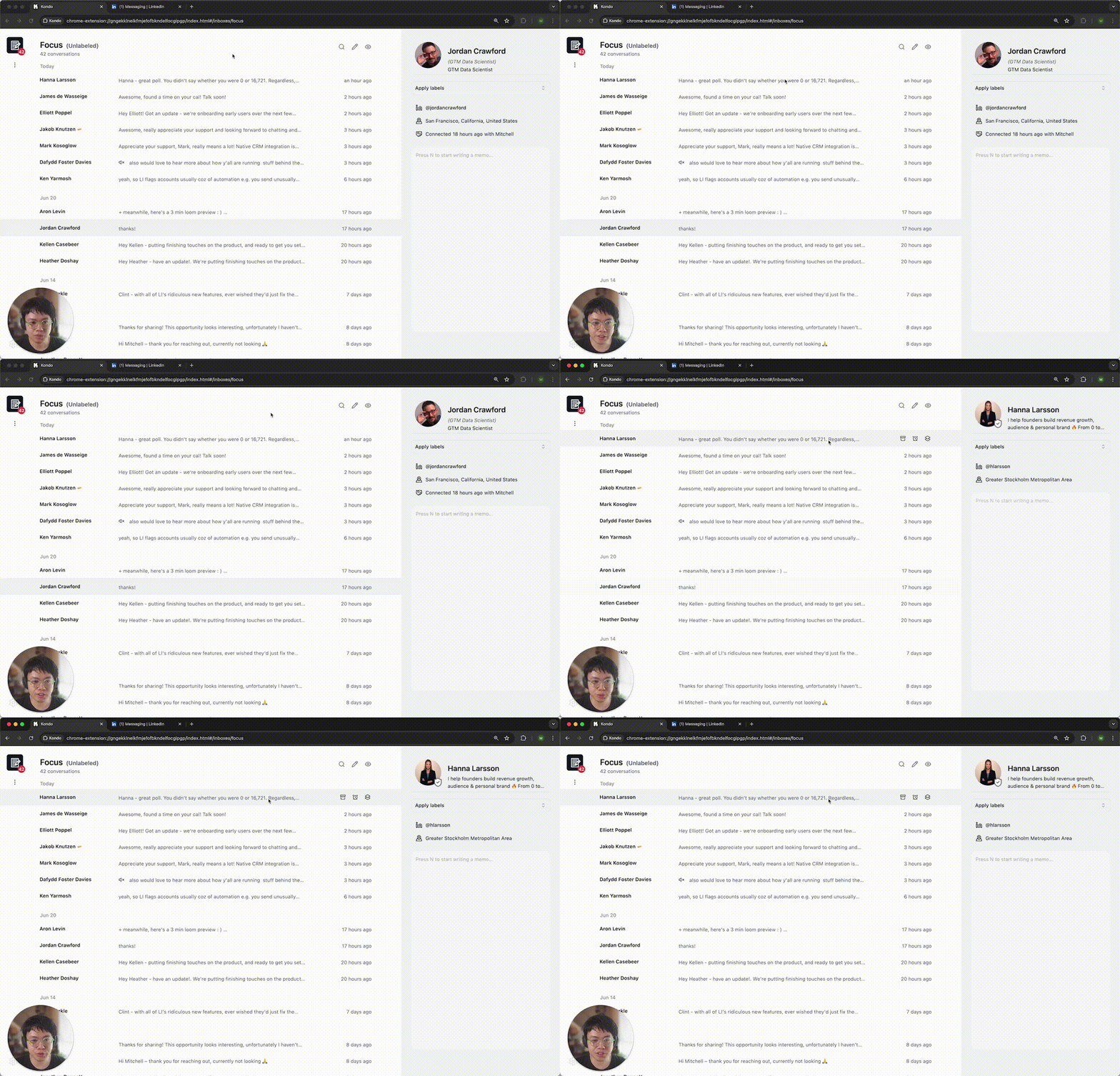
Click above image or [here](https://www.loom.com/share/d4bdfd2f7b0943e08685ac493426ce76) to watch product walkthrough from TryKondo.com Founder
* * * * *
Sign up for a TryKondo.com account by downloading the chrome extension [**here**](https://chromewebstore.google.com/detail/kondo/kojhnafkiednagnljfgakalcbfbklbdk).
* * * * *
### **1\. Define Your Pipeline Stages**
Use Kondo's labels to create and manage the key pipeline stages for Sell-by-Chat:
- **New Leads**: Leads you plan to message for the first time.
- **Awaiting Reply**: Leads you've contacted but haven't responded yet.
- **Replied**: Leads who've replied but aren't yet qualified.
- **Qualifying**: Leads actively engaged in conversations to determine fit.
- **Call Booked**: Leads who've agreed to a call but haven't attended yet.
- **Closed**: Leads who've completed a call and are either converted or not.
* * * * *
### **2\. Customise Your Labels and Inboxes**
#### **Create Labels for Pipeline Stages**:
- Use the `L` key in Kondo to assign a label to a conversation.
- Create these labels:
- **New Leads**
- **Awaiting Reply**
- **Replied**
- **Qualifying**
- **Call Booked**
- **Closed**
#### **Organise Inboxes by Priority**:
- Move high-priority inboxes to the top of the list to ensure these conversations are processed first.
* * * * *
### **3\. Configure Daily Workflows with Kondo**
#### **Outreach**:
**Add New Leads**:
- Use LinkedIn Sales Navigator to source leads based on your ICP. Note: Kondo only works with 1st-degree connections.
- Once a connection request is accepted, initiate first contact in LinkedIn and label the conversation as **New Leads**.
**Track Progress**:
- If a lead doesn't respond after 48 hours, move the conversation to **Awaiting Reply** and schedule a follow-up with `H` (reminder).
* * * * *
#### **Respond and Engage**:
**Manage Replies**:
- Navigate to the **Replied** inbox and process conversations.
- Use `Enter` to open a message and reply quickly.
- For leads showing interest, move them to the **Qualifying** inbox.
**Take Notes**:
- Use the note-taking feature (`;`) to document conversation context:
- **Last message direction** (e.g., "Awaiting their response").
- **Next steps** (e.g., "Follow up in 3 days").
- **Important details** (e.g., "budget, timelines and key problems")
- Notes stick to the conversation and reappear for future context.
* * * * *
#### **Call Booking**:
**Move to Call Booked**:
- When a lead agrees to a call, label the conversation as **Call Booked**.
- Include call details in the notes (e.g., "Call scheduled for [date/time]").
**Send Reminders**:
- Use reminders (`H`) to nudge leads before the scheduled call.
* * * * *
#### **Closing Deals**:
**Track Outcomes**:
- After the call, label the conversation as **Closed** and include deal details:
- **Closed-Won**: Include deal size (e.g., "$3,000").
- **Closed-Lost**: Note why the deal didn't convert.
* * * * *
### **4\. Follow-Up System**
#### **Automate Reminders**:
- Use the `H` key to set reminders for follow-ups at predefined intervals:
- First follow-up: 2-3 days.
- Second follow-up: 7 days.
- Final follow-up: 14 days.
#### **Revisit Key Inboxes Daily**:
- Prioritise inboxes based on pipeline stages:
- **Qualifying**
- **Awaiting Reply**
- **Replied**
* * * * *
### **5\. Warm Signal Prioritisation**
When warm signals appear (e.g., profile views, post engagement, or connection requests), prioritise them immediately:
- Use tailored scripts stored in Kondo's canned responses called '**Snippets**':
Example:
- **Profile Views**: "Hi [Name], noticed you checked out my profile—thanks for stopping by! Quick question—was it [topic A] or [topic B] that caught your attention?"
* * * * *
### **6\. Metrics and Tracking**
Kondo doesn't have built-in analytics, so you'll need to track key metrics manually in a simple spreadsheet. Luckily we built one for you [here](https://library.sevenfigurecreators.com/3/the-sell-by-chat-playbook/110/sell-by-chat-roi-calculator).
#### **Pipeline Metrics**:
- New Leads Added
- Leads in Each Stage
#### **Conversion Metrics**:
- Replies (%)
- Qualifying Conversations (%)
- Calls Booked (%)
- Deals Closed (%)
#### **Revenue Metrics**:
- Weekly Revenue
- Cumulative Revenue
* * * * *
### **Key Kondo Shortcuts for Sell-by-Chat**
| **Action** | **Shortcut** | **Description** |
| --- | --- | --- |
| Archive a message | `E` | Removes clutter from your inbox. |
| Remind later | `H` | Sets a reminder to revisit a conversation. |
| Label a conversation | `L` | Assigns a pipeline stage (e.g., **Qualifying**, **Call Booked**). |
| Mute irrelevant messages | `M` | Hides irrelevant conversations. |
| Write a reply | `Enter` | Opens a message and allows you to reply. |
| Add a note | `;` | Documents last message direction and next steps, sticking with the conversation. |
* * * * *
### **Why This Works**
1. **Speed and Simplicity**:
- Kondo's shortcuts and custom labels streamline navigation and follow-ups.
2. **Full Pipeline Visibility**:
- Separate inboxes for each pipeline stage ensure no lead is overlooked, but remember that Kondo works with 1st-degree connections only. Be sure to check LinkedIn for pending connection requests and manage pre-connection outreach separately.
3. **Context Clarity**:
- Notes and reminders provide the necessary context for all conversations.
---
This setup is a lightweight, simple system for managing Sell-by-Chat with LinkedIn and Kondo.
Sell-by-Chat Scripts
# Your Sell-by-Chat Prompt Cheat Codes
Ok, so listen.
These prompts? They took way longer to crack than I want to admit.
It was a boatload of trial and error. ChatGPT just couldn't wrap its head around 'sell-by-chat' at first.
Which honestly makes sense. The internet is full of generic "cold outreach" junk, and since that's what these AI models are trained on, getting ChatGPT to actually *do what works* took some serious effort.
I basically had to feed the entire book into the prompts and force it to stick to the rules---like really stick to them.
But guess what? It worked.
### Cheat Code, Not a Shortcut
Sell-by-chat is a skill. Like anything worth doing, it takes practice. The more you do it, the sharper you'll get.
These prompts? They're a cheat code. A fast track.
But here's the thing: they're drafts. They're starting points. Don't just copy and paste and call it a day. Add context. Make them yours. And don't spam people thinking you're nailing it---take the time to actually learn the skill.
Use these prompts right, and you'll save yourself a ton of time. But building the muscle? That's on you.
Let's dive in.
---
###### INSTRUCTIONS
#### COPY AND PASTE THE BELOW PROMPT INTO CHATGPT
- Note: It is a very long prompt and contains the entire Sell-By-Chat Playbook.
---
Prompt 1: The Sell-by-Chat Playbook Knowledge
=============================================
You are about to receive essential content containing teachings, frameworks, and rules for selling by chat on LinkedIn. It is crucial that you strictly adhere to this content in all future interactions.
Instructions:
1. Strict Adherence: Base all your future recommendations, strategies, and outputs solely on the provided content. Do not introduce any external information or deviate from the material.
2. Analyze Before Responding: Before generating any response, carefully analyze the provided content to ensure your reply is relevant and accurate based on the specified teachings, frameworks, and rules.
3. Consistency: Do not offer suggestions or practices not contained within the content. Avoid assumptions or using external knowledge beyond this material.
4. Clarity and Relevance: Ensure all your responses are clear, concise, and directly applicable to tasks related to selling by chat on LinkedIn, as outlined in the content.
Here is the content you must follow:
Preface
Let's get one thing straight: selling doesn't work.
Not the way most people do it, anyway.
Spamming, pitching strangers, or rattling off benefits like a robot—none of that gets people to buy.
You know what does? Actually helping. Showing up with real solutions, putting the other person first, and genuinely helping them.
That's what sell-by-chat is all about.
It's the simplest, most scalable way to start meaningful conversations, build trust, and close deals.
No ads. No fancy funnels. Just you, your LinkedIn account, and the magic of being genuinely helpful.
Is it easy? Hell no. It takes work. But it's the kind of work that pays off, because it's built on serving, not selling. And when you get this right, selling stops feeling awkward and starts feeling...natural.
This isn't another "hack." It's the smart way to turn effort into results. All you need is a willingness to act, a bit of dedication, and this playbook in your hands.
Ready?
Let's turn your DMs into cash on LinkedIn.
---
Why LinkedIn?
Sales have come a long way—from door-to-door pitches to cold calls, and now, to conversations in your LinkedIn inbox.
Nobody wants to be sold to, and nobody enjoys pushing for a sale. What works now is having real conversations that build trust and naturally turn into deals.
LinkedIn is the perfect platform for this. It's where professionals go to network, learn, and grow. That means your ideal clients are already there, waiting for the right conversation.
Not a pitch, but a chat.
That's what this playbook is about—mastering sell-by-chat. It's the fastest and (arguably) most cost-effective way to sell online today.
---
How to Use This Playbook
This isn't just a bunch of random tips. It's a process.
Start at the beginning. Each chapter builds on the one before it.
Skipping ahead? Bad idea. Master the basics first. Get them working.
When the basics click, add the advanced tactics from the 'Scale Edition' of this playbook.
Follow the steps. Put in the work. Get results. Then scale.
Ready to Scale?
If you're reading the 'Scale Edition,' chances are you're gearing up to build a team for sell-by-chat.
Good news—this playbook doubles as a training guide.
Make it part of your onboarding process so your team understands, respects, and lives the sell-by-chat philosophy.
This ensures consistency, efficiency, and results.
---
The Prerequisites
Listen, if you've got the kahunas to start sliding into DMs without polishing your LinkedIn profile or even knowing exactly what you're selling, you're probably already on the path to success.
Why? Because if you just start talking to the people you want to work with, they'll tell you their problems. And if you listen, they'll hand you the blueprint for what to sell them.
So, technically, there are no prerequisites other than a LinkedIn account to use this playbook. You can dive in and build your business as you go.
But let's be real—most people aren't comfortable with this approach. It feels unnatural, maybe even downright weird. We get it.
If you want to feel more confident and come across as a total pro from day one, we recommend completing The 101 Module from the www.sevenfigurecreators.com program.
The 101 Module will guide you to:
Find, create or improve your offer.
Optimise your LinkedIn profile & content for trust.
Set you up with everything you need to sell more and faster.
Not a member? Click here to join.
So, are you jumping in raw? Or taking a moment to polish up? Either way, there's no wrong answer.
Let's get to it.
---
Part 1: Sell-By-Chat 101
---
Understand Sell-by-Chat 101 or Don't Even Bother
If you skip Part 1: Sell-By-Chat 101, nothing else in this book will work.
It's not optional.
This section gives you the foundation—the mindset, the principles, and the understanding you need to actually succeed with sell-by-chat.
You can't just copy tactics and hope for the best. If you don't get the why behind the approach, your chats will fall flat, your leads will ghost you, and you'll waste your time.
Start here. Take it seriously.
---
Chapter 1: Mindset Shifts for Effective Sell-By-Chat
---
Serving vs. Selling: The New Paradigm
If there's one mindset shift that will flip your sales game, it's this:
Stop selling. Start serving.
Chat-based selling works not because you're trying to shove your offer down someone's throat but because you're solving their problems—problems they've already told you about.
People hate being sold to, but they love being helped. When you focus on serving, selling happens naturally.
Think about it like this: every chat is an opportunity to make someone's day better. Maybe you'll share a tip that changes how they approach their business. Maybe you'll point them to a resource that saves them hours of frustration. And maybe, just maybe, you'll uncover a problem you can help solve for them directly.
The sale? That's the side effect of being genuinely helpful.
---
Overcoming Common Excuses and Misconceptions
Let's tackle the biggest excuses you've probably told yourself about sell-by-chat.
1\. "It feels too salesy"
Sure, if you're spamming canned pitches to random strangers, it's salesy—and gross. But if you're showing up like a real human, listening, and responding to what people actually need, it won't feel salesy at all. It'll feel like a conversation between two people who respect each other.
2\. "It takes too long"
Here's the truth: chatting is a time investment, but it's also the fastest path to results. Done right, it beats cold calls, email sequences, or lots of zoom calls. And if you follow this playbook, you'll know exactly what to say, when to say it, and how to move people forward without wasting time.
3\. "Leads go cold"
Most leads don't go cold. They're just waiting for you to follow up. The magic is in the follow-ups---those fifth, sixth, or even seventh touches. Don't write someone off because they didn't respond right away. Be persistent but respectful, and you'll resurrect plenty of "dead" leads.
4\. "Outsourcing doesn't work"
You can hand off chat sales to someone else—but only if your process is rock solid. Stick with this playbook start to finish, and you'll have the structure to make it work. Leads won't feel like they're talking to a robot; they'll feel like they're talking to you. And then you'll be selling all day. Every day.
---
Chapter 2: Measuring What Matters
---
Measuring Your Chat-to-Contract Ratio
Numbers don't lie.
The easiest way to know if your chats are working is to measure your Chat-to-Contract Ratio.
Chats: How many people are you starting conversations with?
Contracts: How many of those conversations turn into paying clients?
Here's how the math breaks down:
Chats Started: 100 people
Reply Rate (30%): 30 replies
Engagement Rate (50%): 15 meaningful conversations
Call Booking Rate (20%): 3 booked calls
Show-Up Rate (80%): 2.4 calls attended
Close Rate (50%): 1.2 closed sales
Overall Conversion Rate: ~1%
So, for every 100 people you reach out to, you should expect to close at least 1 deal, with potential for more as you refine your process.
---
Understanding Key Metrics
What you should be tracking:
Reply Rate (30%): Of 100 people you message, how many respond?
Engagement Rate (50%): Of those who reply, how many continue a meaningful conversation?
Call Booking Rate (20%): Of meaningful conversations, how many book a call?
Show-Up Rate (80%): Of calls booked, how many actually show up?
Close Rate (50%): Of calls attended, how many result in a sale?
It's simple. Don't make it complicated.
---
Setting Realistic Expectations
The truth...
You need to make sell-by-chat a daily habit to see results.
The mistakes we see?
People going all in, sending 1000 DMs, getting overwhelmed and never doing it again.
People too scared to even try. If that's you, the 'Prerequisites' and 'Common Excuses' sections are there to help you push past it.
And remember...
Some people just won't want to chat with you. Some will ignore you. Others might outright reject you. And guess what? That's perfectly fine.
You're not going to close every single person you chat with. That's not the goal. The goal is to build relationships, provide value, and let the right people self-select into working with you.
Here's a baseline to aim for:
Contacts per Day: Start with 25-30.
Reply Rate (30%): 7-9 replies.
Engagement Rate (50%): 3-5 conversations.
Call Booking Rate (20%): 1 call booked.
Show-Up Rate (80%): 0.8 calls attended.
Close Rate (50%): 0.4 sales/day.
At this rate, you'd make 2-3 sales per week working just 5 days. #
As your skills improve and your reply rates climb, so will your results.
So ditch the excuses. Shift your mindset. And start chatting your way to sales...
---
Chapter 3: Code of Conduct for Chat Interactions
---
Introduction: The Rules of Chat Conduct #
Sell-by-chat is more than typing messages---it's a skill. And like any skill, it comes with rules that separate the pros from the noise.
In this chapter, we're focusing on the fundamentals of how to approach chat interactions the right way. You'll learn why keeping things human matters more than clever tactics, how to make people feel noticed before they've even replied, and why the smallest details---like breaking up your messages or asking just one great question at a time---can make all the difference.
These aren't gimmicks or hacks---they're (timeless?) principles.
They're about building trust, showing up with value, and leading conversations that don't just sell but connect. Master these, and you'll have a strong foundation for everything else that follows.
---
Rule 1: Be Human, Not Robotic
People respond to authenticity, not copy-paste jobs.
Write like you're talking to a friend. Use short sentences, line breaks, and a conversational tone. Match their pace, add personal touches, and avoid sounding scripted. Keep it real---it builds trust.
---
Rule 2: Make Them Feel Seen
When people feel noticed, they open up.
From your opener to your replies, show them they're not just another prospect. Mention their recent post, a detail about their business, or something unique you've noticed. People open up when they feel you've taken the time to truly see them.
---
Rule 3: Prioritise Empathy
When someone feels heard, trust follows. And trust is everything.
Listen first, respond second. Show genuine care for their challenges, not just your agenda. Reflect their concerns back to them and acknowledge their perspective. Trust grows when they feel you're in their corner.
---
Rule 4: Keep Messages Short
Shorter messages get faster replies.
Instead of a wall of text, send 3--4 short, clear messages. Keep it conversational and easy to digest. Let them respond before you overload the chat.
---
Rule 5: One Question at a Time
Ask good questions, then actually listen. Let their answers guide the conversation.
Keep it focused. Ask one clear question per message to avoid overwhelming them. Let their response guide the flow. This shows you're listening and genuinely interested.
---
Rule 6: Match Their Pace
Don't rush it. Conversations build momentum over time.
Follow their rhythm. If they're quick to respond, keep up. If they're slower, give them space. Respecting their timing builds trust and keeps the conversation comfortable.
---
Rule 7: Give Before You Ask
Don't ask for something---until you give value first.
Offer a helpful insight, resource, or tip that speaks to their challenges. Prove you're here to help, not just to sell.
---
Rule 8: Follow Up with Purpose
If they go quiet, don't panic---life happens. Follow up thoughtfully, not 'pushily'. Show you care by referencing your last exchange or offering something useful. Make each message count.
---
Rule 9: Personalise Every Message
Make every message feel like it was written just for them. Reference their posts, a shared connection, or something they've said before. Show you get their problems, not just trying to sell them something.
---
Rule 10: Own the Outcome
Not every chat will close a deal, and that's fine. Always wrap up with a clear next step---like a resource, a meeting, or keeping the door open for the future. Show you're here for the long haul, not just a quick win.
---
Closing Thoughts: Test and Adapt
Sell-by-chat isn't static.
What works for one person may not work for another. Stay flexible, experiment with different approaches, and adjust your tone, style, and messaging based on what gets results.
If something resonates, do more of it. If it doesn't, tweak it and try again. Every conversation is a chance to refine your process and learn what works best for your audience.
The goal isn't perfection---it's progress. Build trust, stay human, and adapt as you go. Over time, you'll develop a style that feels natural, delivers value, and creates real connections.
---
Chapter 4: Mastering the Art of Conversation
---
Read First: Your Conversation Strategy #
Most people think chatting is just about saying the right thing.
But here's the truth: it's how you say it, when you say it, and why it resonates that matters.
Turning LinkedIn chats into cash isn't about a perfect script---it's about mastering the nuances of connection. Every word, pause, and question matters. Let's dive into how to rethink and refine your chat game.
Before diving into scripts and how to customise them, let's focus on something even more important: the strategies behind every message you send. Scripts are great starting points, but success in sell-by-chat isn't about copying and pasting. It's about understanding the core principles that make every interaction count.
In Chapter 2, we touched on the chat metrics that matter most:
Response Rates: How often people engage with your messages.
Reply Depth: How meaningful the conversations become.
Follow-Up Success: How often your persistence turns into replies.This chapter is all about applying the strategies that move those numbers. Every message, every follow-up, and every response is a chance to serve value---and a chance to learn.
What you'll in this chapter are the foundational principles that guide every great conversation.
These aren't scripts---they're the playbook. Use them to shape your tone, timing, and approach, so when it's time to personalise your scripts, you'll know how to make them work for you.
Master these, and you'll have the tools to not only write killer messages but to consistently turn chats into trust, trust into action, and action into results.
---
Openers That Work
Openers aren't icebreakers---they're invitations. They're the crack in the door that makes someone lean in.
The secret? The opener isn't about you.
1\. Make It About Them
People don't care how clever you are. They care that you've noticed them.
2\. Keep It Short
The shorter your opener, the more weight each word carries. Use that to your advantage.
3\. Serve, Don't Take
Lead with a genuine observation, a helpful question, or a thoughtful comment. Make them think, "This person gets it."
---
Flatter With Precision
Flattery is often misunderstood.
The goal isn't to butter them up; it's to show you truly understand their world.
People light up when they're recognised for what matters to them---and when they feel you get it.
What precision flattery looks like:
Call Out the Specifics:
"Your approach to [topic] is EPIC because..."
This shows you've actually paid attention.
Respect Their Work: Instead of just praising the outcome, acknowledge the effort, thought, or expertise behind it.
Show You're Listening: Reference something niche---something only someone who really understands would notice.
Precision flattery isn't about empty praise; it's about making them feel seen. When people feel understood, trust follows. And trust is everything.
---
Genuine Personalisation
Personalisation isn't about dropping their name into a message.
It's about proving you've stepped into their world and truly see them. The deeper you go, the stronger the pull.
Here's how to make it unmissable:
Their LinkedIn Activity: Reference their recent posts, comments, or even something they liked. Align your message with what's clearly on their mind.
Spot Their Problems: Whether they share them outright or you uncover them through their activity, their challenges are your golden entry point. Show them you're not just paying attention---you're ready to help.
Mirror Their Language: Match their tone and phrasing. Use their vocabulary to make the conversation feel familiar and natural. It's subtle, but it works.
Leverage Shared Connections: Highlight mutual contacts or clients. A quick mention builds trust without you having to say much.
Tie It to Their Work: Call out specific projects, results, or even their client focus. Show you've done more than skim their profile---you understand what matters to them.
When your messages feel tailored to them, they'll know you're not just another copy-paste pitch.
Personalisation isn't optional---it's the difference between being ignored and starting a conversation that leads somewhere.
---
Pattern Interrupts: Unexpected, Yet Relevant
Most chats are predictable. Same lines. Same pitch. And they get ignored.
A pattern interrupt is something totally unexpected---but totally appropriate.
It's the twist that grabs attention because it shows you understand their world better than most.
Here's what makes a pattern interrupt work:
Be Specific: Speak their language. Reference a niche detail only someone in their shoes would notice. Done right, it feels personal---like you really "get it."
Create an Emotional Hook: People respond to emotion, not logic. Share a sharp analogy, a quick observation, or even a GIF that sums up their situation perfectly. It's not about being funny; it's about being relatable.
Surprise Them, But Stay Relevant: Don't throw in randomness for the sake of it. Your interrupt should be unexpected and tied to the conversation or their challenges. If it's just weird, you've missed the point.
When you nail it, a pattern interrupt proves:
You're paying attention to what matters to them.
You're different from every other generic pitch.
You're someone worth replying to.
Most people stick to predictable messages and wonder why they're ignored. Don't be like them.
Surprise them---relevantly---and they'll want to keep talking.
---
Ask the Right Questions
The right questions don't just fill the silence---they uncover what really matters and move the conversation toward a meaningful outcome.
Great questions keep the conversation alive, show you care, and guide the other person to open up naturally.
Done right, they feel effortless---but they're packed with intention.
1\. One at a Time
Avoid question overload. When you ask just one question, you make it easy for them to reply.
Instead of this:
"How's business? What's been challenging? What's your growth strategy?"
Try this:
"What's been your biggest focus this week?"
It's casual, relatable, and gives them space to answer without feeling bombarded.
2\. Make It Specific
Vague questions kill momentum. A focused question shows you've been paying attention.
Instead of this:
"What's the biggest challenge in your business?"
Try this:
"Your post about [specific topic] stuck with me---what's been the hardest part about solving [problem] so far?"
It's direct, meaningful, and sets you apart from generic, surface-level conversations.
3\. Dig Into Problems
The key is to frame your question so it feels like you're genuinely curious---not prying.
Instead of this:
"What's holding you back?"
Try this:
"When you mentioned [specific challenge], was it more about [option 1] or [option 2]?"
This approach makes it easy for them to answer while subtly steering the conversation toward deeper insights.
4\. Respond Like You're Listening
A question isn't just something you send---it's something you build on. Show you care by connecting your next question to what they've shared.
If they say:
"We're spending a lot of time chasing leads, but they aren't converting."
You respond with:
"Got it. Does it feel like the challenge is in the follow-up process or the leads themselves not being the right fit?"
It keeps the flow natural, makes them feel heard, and positions you as someone who understands their world.
---
Timing and Pacing
Timing is everything in a conversation.
It's not just about when you reply---it's about syncing with their rhythm, respecting their silence, and knowing when to nudge.
A perfectly timed message can build trust, keep the momentum alive, and lead the chat toward the outcomes you want.
Match Their Tempo
The pace of their replies tells you how engaged they are. Quick replies signal interest---respond with equal energy. Slow replies? Take it easy and match their rhythm. Pushing too fast can kill the vibes.
Quick Tempo Example:
Them: "That sounds interesting. How does it work?"
You (fast): "Let me break it down quickly---[brief explanation]. What's the dream outcome you're hoping for from [the product/solution]?"
Why It Works: You respond with clarity and purpose while keeping the conversation moving. The question opens a door for them to share their priorities.
Slower Tempo Example:
Them (earlier): "We're looking into solutions for [problem]."
[Silence for a day]
You: "Busy week? One of my clients had a similar challenge recently---it made me think of you. Want me to share what worked for them?"
Why It Works: It respects their slower pace, giving them space while subtly keeping the conversation alive.
Silence Doesn't Mean "No"
When they go quiet, don't assume you've lost them. Silence is often just life getting in the way. Your job is to re-engage with relevance---not desperation.
Example:
You: "Hey [Name], just circling back. I was thinking about our last chat and came across [specific resource]. Would it be helpful if I shared it?"
Why It Works: Instead of repeating what you've already said, you bring fresh value to the table, keeping the conversation about their needs, not your pitch.
Follow Up with Purpose
Every follow-up should add something new to the conversation. A fresh angle, a timely observation, or a nudge tied to their world keeps your messages relevant and welcome.
Example 1: Tied to Their Problem
You: "Hi [Name], I remember you mentioned [specific challenge]. I just helped another client with a similar issue and thought of you. Want me to share what worked for them?"
Why It Works: You're not just following up---you're creating value while keeping the focus on their unique challenge.
Example 2: Light and Casual
You: "Hey [Name], just saw [specific industry news/event] and thought of you. It hits right on [their challenge or goal]. If it's still something you're working on, I've got an idea that might help---want me to share?"
Why It Works: This casual check-in feels natural and conversational, not like a hard sell.
Know When to Let Go (Temporarily)
If follow-ups don't land, don't force it. Sometimes they're just not ready. Leave the door open and come back when the timing is right.
Example:
You: "I know timing might not be perfect right now---totally get it. I'll check back in a few weeks. If anything changes before then, just let me know!"
Why It Works: It shows empathy while leaving a positive impression. You're respecting their space without losing the connection entirely.
The Key to Timing: Precision and Patience
Timing and pacing aren't about spamming quick replies or sitting on your hands---it's about reading the room.
Match their energy, add fresh value when you follow up, and leave space when needed.
Mastering these nuances doesn't just improve your reply rates; it makes your messages feel natural, human, and worth replying to.
Every message is an opportunity to build trust, and trust leads to action. Nail the timing, and the rest will follow.
---
Guiding the Conversation
Conversations lose momentum when you let them drift. Your role is to keep things purposeful and engaging, without feeling pushy.
It's about creating a natural flow where every message builds toward the next step.
Follow Up Every Step
Don't leave them hanging. If you send a link, resource, or suggestion, make sure you check back. Keep the conversation alive and moving forward.
You: "Did the link work for you?"
Them: "Yeah, got it."
You: "Great---what stood out the most for you?"
You: "Hey, just following up---did [resource] help you with [their challenge]?"
Follow-ups aren't about chasing---they're about showing you care and keeping the chat relevant.
Transition with Value
When they share something, don't just acknowledge it---use it to guide the next move. Keep the conversation focused without making it feel transactional.
Them: "I'm struggling to generate quality leads."
You: "That's frustrating---and common for [their industry]. What's been the most successful tactic so far? I might have an idea to tweak it."
Why it works: You're validating their struggle, showing empathy, and positioning yourself as a partner in solving their problem.
Use Silence as a Signal
Silence isn't rejection---it's often a pause to reflect or get distracted. Break it thoughtfully by referencing something fresh or meaningful.
Example: "Hey [Name], just circling back---did [resource or suggestion] help at all with [their challenge]? I had another idea pop up that could be worth sharing."
Why it works: It re-engages them without pressure and adds new value, making the conversation feel alive again.
Sell the Next Step with Value, Make It Effortless
When the moment feels right, guide them toward the next step. Offer something valuable and easy to act on, paired with genuine enthusiasm.
You: "I've got an idea that might make [their challenge] easier. Want to chat for 15 minutes to see if it could work for you?"
Keep it simple, keep it clear, and keep the commitment small. Each step should feel like a natural progression---not a leap.
Staying in control doesn't mean dominating the chat.
It means leading with intention and always leaving the door open for what's next. When you guide the conversation thoughtfully, they'll feel confident taking the next step with you.
---
Effortless Micro-Commitments
Micro-commitments are about creating a path of least resistance, where each step feels so easy and logical that saying "yes" becomes the natural choice.
By keeping your requests small and tying them to clear value, you build emotional investment while keeping momentum strong.
Here's how to use them effectively:
1\. Make It Feel Easy
Simplify the ask so it's hard to say no. Instead of a big leap, frame the next step as quick and effortless:
"Let's lock in a quick 10-minute call to see if this aligns with what you're trying to achieve. Does [specific day/time] work?"
Why It Works: The specific, low-effort proposal removes friction and keeps the reply simple---just "yes" or suggesting another time.
2\. Build Emotional Momentum
Position the next step as though it's already in motion, creating a sense of investment:
"Excited to move this forward. I've already started mapping out a few ideas we've used to solve [specific challenge] for others. How does [day/time] sound to finalise things?"
Why It Works: You're showing that effort is already underway on their behalf, making it harder for them to back out.
3\. Link to Tangible Outcomes
Frame the action you're requesting as a quick win that moves them closer to their goal:
"Let's jump on a quick call to confirm, and I'll share how [specific benefit] can be up and running for you this week. Does [day/time] work?"
Why It Works: By tying the ask to a concrete, immediate result, you make the next step feel like progress they can't afford to miss.
4\. Break Big Decisions into Bite-Sized Steps
Instead of pushing for a major commitment, guide them with smaller asks that lead to trust and progress:
"Why don't I send over the [offer details]? Once you've looked it over, we can discuss. Sound good?"
Why It Works: This approach removes the pressure to commit upfront while keeping the conversation active and collaborative.
5\. Always Tie Back to Value
Connect every micro-commitment to the results they're aiming for, so it feels essential to their progress:
"Once we lock this in, you'll [specific result] in motion for [quick win]. Does [day/time] work to confirm the next step?"
Why It Works: By directly linking the action to their desired results, you keep the conversation outcome-focused and naturally forward-moving.
The Key: Keep the Chat Moving
Each example is designed to create an easy reply, avoiding friction or overthinking. By focusing on small, value-driven steps, you make it effortless for them to say "yes" and stay engaged.
---
Handling Objections: No Buts
Objections aren't a door closing---they're an invitation to listen, understand, and guide. Every hesitation is a chance to connect deeper and prove value.
Acknowledge Their Concerns
Show them you're paying attention and respect their perspective.
You: "I hear you. Timing is always tricky when it comes to [their hesitation]."
You: "Totally get why [their concern] might feel like a hurdle---it's a valid point."
Acknowledgment disarms defenses and opens the door for a real conversation.
Ask for Context
Dig into the "why" behind their objection. The more you know, the better you can help.
You: "What's your biggest concern about [the issue] right now?"
You: "What would need to change for this to feel like the right step for you?"
You: "When you say [objection], what's the underlying worry you're thinking about?"
Asking questions positions you as curious, not pushy, and keeps the dialogue flowing.
Provide Reassurance
Once you understand the concern, offer something relevant that eases their hesitation.
You: "One of my clients felt the same way about [their concern]. After [specific action], they saw [specific result]. I think it could work for you too."
You: "You're not alone in that worry. Here's how I've seen [challenge] get tackled before."
You: "Totally fair point. Here's what others in your position have done to make it work."
Reassurance isn't about dismissing their concern; it's about giving them a reason to feel confident moving forward.
No BUTs
The word "but" negates everything positive that comes before it, making you sound dismissive. Instead, pivot with "and" or reframe entirely.
Instead of: "I understand your concern, but this could solve it."
Try: "I understand your concern, and I think this approach could make things easier."
Instead of: "That makes sense, but here's why it's worth it."
Try: "That makes sense. Here's why I believe it's worth considering."
Why This Works #
Empathy First: You're showing you care about their perspective, not just closing a deal.
Positive Framing: Removing "but" keeps the tone constructive and optimistic.
Dialogue Over Debate: Objections become conversations, not battles.
By handling objections with curiosity and care, you're not just addressing concerns---you're building trust. That's what transforms "I'm not sure" into "Let's do this."
---
Next Steps: Closing the Loop
Closing the Loop: Ending Every Chat with Intention
A strong conversation doesn't fade into ambiguity---it ends with clear direction and purpose.
Whether you're booking a call, sharing a resource, or leaving the door open for the future, every chat should feel intentional and easy for the other person.
1\. Be Clear About Next Steps
A vague ending kills momentum. Every conversation should naturally lead to a specific and actionable next step that feels easy to say yes to.
Example: "Listen, I know how much it means to you to [solve their specific challenge]. I'd love to share a quick framework that's helped others in your position. How does [day/time] for a short 15-minute call sound?"
Why It Works: You're tying the 'ask' directly to their challenge and proposing a simple, low-commitment next step, which feels natural and useful.
2\. Make It Effortless
Remove all friction. Instead of leaving the ball in their court, guide them by offering clear options or even making the choice for them.
Example: "I know time's tight, so I've penciled in [specific day/time] for us to call. If that doesn't work, let me know, and I'll adjust."
Why It Works: By suggesting a specific time, you eliminate decision fatigue and make it easy for them to confirm or tweak.
Pro Tip: People hate booking tools. Skip the calendar link and handle the scheduling directly.
3\. Play the Long Game
Sometimes the timing isn't right, and that's okay. When you sense hesitation, end on a positive note that keeps the relationship warm and leaves the door open for future conversations.
Example: "Totally understand it's not the best time. I'll check back in [specific time frame], but feel free to reach out if things change sooner. Hope you crush [specific project or goal]."
Why It Works: You're showing respect for their time while maintaining a relationship and signalling your long-term commitment.
4\. Circle Back with Value
If they've shown interest but haven't committed, summarise the conversation to reinforce their trust in your value and make the next step irresistible.
Example: "Here's a quick recap: [highlight their challenge and the solution you proposed]. Let's connect for [specific next step]---I know it will help with [their specific outcome]. Sound good?"
Why It Works: By reminding them of the value tied to their goals and offering an effortless way forward, you reduce resistance and keep momentum alive.
Why Closing the Loop Matters
Clear next steps turn conversations into results. When you're intentional, considerate, and strategic, even a casual chat can evolve into a meaningful action or opportunity down the line.
---
Strategies for Calendar Invites
Getting a meeting booked is just the start---what matters is making it easy, exciting, and hard for them to back out.
Here's how to set the stage for a meeting they'll want to show up for.
Keep It Close
Offer times within the next three business days. People lose interest fast, so keep the momentum going while their enthusiasm is still fresh. The closer the meeting, the fewer chances for them to forget or rethink.
Use Micro-Commitments
Small steps build big buy-in. The key is to make the process feel effortless while tying it to their goals. Here's how:
Take the Effort Off Them: Don't just drop a calendar link. Propose specific, easy options: "Would Tuesday at 11 AM or Wednesday at 2 PM work for you?" They just pick and you book it in.
Make It Feel Casual: Frame the meeting as a low-pressure, easy step: "a 15-minute brainstorm" or "a quick strategy session".
Reinforce Their Why: Tie the meeting to a result they care about: "This quick chat will help us map out how to [specific outcome]."
Create Emotional Commitment: Speak as though the next step is already in motion: "I've looped in the team and we've already started tweaking ideas that worked for another client similar to you. Excited to share this with you. Any questions or requests before we meet?"
Boost Attendance Rates
Time It Right: Send reminders at key moments---24 hours and 1 hour before---to stay top of mind.
"Hey [Name], just a quick reminder about our chat tomorrow at [time]! Can't wait to dive into what's working right now to tackle [their challenge]. Here's the link: [insert link]. See you then!"
Pull Emotional Triggers Show the effort and value already in motion, and hint at their potential success.
"Hey [Name], I've been digging into your situation and pulled together insights from similar clients who nailed [desired result]. Based on what we've prepped, I think you'll see results even faster. Excited to share tomorrow!"
Make It Easy to Commit Remove barriers by making everything straightforward and clear.
"We'll meet via [link]. It's just 20 minutes to dive into [specific result]. Let me know if there's anything you want me to cover before we meet."
Build Anticipation Tease what's coming to get them excited about the possibilities.
"Before we meet, here's a quick win from another client in a similar spot. Thought it might spark some ideas for our chat tomorrow: [link]. Looking forward to seeing what's possible for you!"
These strategies not only remind them but also make the meeting feel valuable and too good to miss.
Example Follow-Up Message to Boost Attendance
Subject: Excited for tomorrow
Body:
"Hey [Name],
Looking forward to our chat tomorrow at [time]!
I've looped in the team, and we've been working on ideas to help with [their challenge].
Here's the link: [insert link]. Let me know if there's anything you'd like to add before we meet.
See you then!"
--
This approach doesn't just remind---it builds excitement, reinforces the value, and creates a sense of momentum they won't want to lose.
---
Conclusion: Mastering Conversations That Convert
The Real Goal of Chat Conversations
It's not about the close---it's about connection.
Why? Because real connection builds trust. And trust is what turns a lead into someone ready to say yes.
What Top Chat Sellers Get Right
They focus on understanding, not pitching.
They let silence do some of the work.
Chat selling isn't about forcing the "yes."
It's about earning trust, creating curiosity, and building a connection that feels easy and real. When you guide the conversation with purpose and value, the close happens naturally.
How to Stand Out in the Inbox
Ask questions that show you're listening.
Respect their pace---no pressure, no pushing.
Lead with value, so they feel understood and supported.
Balance Is Everything
Guide without forcing.
Add value without dumping too much at once.
Keep it simple, clear, and focused.
Every word counts. Every pause has a purpose.
When you focus on making the conversation feel effortless and helpful, you're not just another message in their inbox---you're the one they actually want to reply to.
---
Chapter 5: LinkedIn Leads: Cold Tactics & Warm Signals
---
Introduction: Prioritising LinkedIn Leads
Not all LinkedIn leads are created equal.
Some come from cold outreach---where you're starting the conversation.
Others are warm---people who've already shown interest by engaging with your profile or content.
Both play a role, but how you handle them depends on where you're at and how much time you've got.
When you're just getting started, cold tactics can help you get runs on the board. They're a numbers game---reliable only in volume---but they build momentum.
Warm signals, on the other hand, come from people showing intent. These are your self-qualified leads, and when they're there, they should always take priority.
This chapter breaks down how to spot and act on the signals---whether cold or warm. You'll learn how to balance them, when to prioritise, and how to keep building momentum regardless of where you're starting.
Let's dive into the tactics, signals, and practical strategies to make LinkedIn work for you.
---
Cold Lead Tactics to Build Momentum
When you're just getting started, your focus should be on building a network and putting yourself out there. This accelerates understanding what problems your customers have, iterating on your offer and making money.
Cold tactics are essential here.
1\. Send Connection Requests to Your Ideal Customer Profile (ICP)
Identify key decision-makers or roles that match your ideal customer profile (ICP).
Send up to 200 connection requests per week
Personalise your connection requests. Example:
"Hey [Name] - great to connect! Did you [pattern interrupt]?"
2\. Engage Dormant Connections
Reach out to old connections who haven't engaged with you recently. Example:
"It's been ages since I connected---back when [pattern interrupt]. I feel a bit awkward messaging out of the blue, but I've recently started [brief, clear offer description] to help [specific audience] with [specific problem]. Not sure if it's something you'd need, but if you know anyone who might benefit, I'd love to send over the details. Would you let me know?"
3\. Strategic Comments
Comment meaningfully on posts that your ICP are likely to read to build visibility, inbound connection requests and start conversations.
4\. Start Sharing Value-Led Content
Post relevant content or insights to build credibility. Even with a small audience, sharing helpful information positions you as a trusted voice.
---
Prioritising Warm Signals as They Appear
Prioritising Warm Signals as They Appear
When someone engages with your LinkedIn profile, posts, or sends a connection request, it's a great opportunity to start a chat. The sooner, the better.
Use these warm signals to start chat in a way that feels natural and relevant.
1\. Profile Views
Respond thoughtfully to those who've shown interest by visiting your profile:
Example: "Hey [Name], I noticed you checked out my profile. Just curious---are you looking for [desired outcome] or just enjoying my content?
2\. Post Engagement
Reach out to those who interact with your posts by acknowledging their interest and inviting a response:
Example for Likes: "Hi [Name], thanks for liking my post on [topic]. Are you trying to solve [related challenge or solution], or just liked what I had to say?"
Example for Comments: "Hey [Name], I loved your comment on my post about [topic]. Are you working on [related challenge or solution]?"
Example for Reposts: "Hi [Name], noticed you reposted my post about [topic]. Thank you! Is [related challenge or solution] your focus at the moment?"
3\. New Connection Requests
Welcome new connections while encouraging them to share their intentions:
Example: "Hi [Name], thanks for connecting! Are you here to learn more about [specific challenge or solution] or just checking out content? Either way, great to connect!"
Why These Work:
Two Clear Paths: Offering specific options like "exploring ideas" or "working on a challenge" gives them a simple way to engage, reducing decision friction.
Acknowledging Their Intent: Directly referencing their interaction (view, like, comment, etc.) makes your message feel personal and timely.
Conversation Starters: These examples don't just acknowledge warm signals---they're designed to elicit responses and open dialogue.
By using these examples, you're not just replying to warm signals---you're turning them into actionable conversations that build trust and momentum.
---
Conclusion: Balancing Cold and Warm Approaches
Cold outreach is your foundation---it's consistent, scalable, and gets you moving when you don't have much engagement yet.
Warm signals, on the other hand, are where the magic happens. These are people already showing interest, and focusing on them can turn casual interactions into meaningful conversations---and sales.
Once your network and content begin driving more engagement, your approach should shift. Warm signals take priority, but cold tactics remain a tool for consistent growth.
Evolving to Momentum: When Warm Takes Over
Over time, as your audience grows and your content gains traction, your focus should naturally shift toward warm leads. Here's how to transition effectively:
Act on Signals Immediately: Warm leads are time-sensitive. Respond promptly to show you value their interest.
Nurture Connections: Keep your name top of mind by consistently engaging with your audience's content.
Scale Content Production: Regularly post high-value content that encourages engagement, making warm leads more frequent.
Tracking Progress and Staying Consistent
As you grow, maintaining a steady rhythm is key. Balance daily efforts between:
Warm Engagements: Prioritise these to capitalise on people already interested.
Cold Outreach: Maintain consistency to expand your network.
Track your efforts to see what works:
Which warm signals are converting into conversations?
Which cold tactics are creating new opportunities?
---
Chapter 6: Qualifying Prospects Through Chat
---
What is Qualifying?
Most people think qualifying is about finding the perfect buyer. It's not. Qualifying is about figuring out if, and how, you can truly help someone. Done well, it brings clarity---for you and for them. Done poorly, it's just noise.
This chapter will show you how to guide conversations in a way that naturally reveals if the person is a good fit, without wasting anyone's time. No ticking boxes or robotic scripts---just practical, value-centric strategies to move conversations forward.
---
Matt Lakajev's LVQ Framework: Lube, Value, Question
Qualifying isn't rigid---it's a natural rhythm. The LVQ Framework helps you keep things flowing:
Lube: Respond thoughtfully and acknowledge what they've shared to keep the conversation friction-free. A simple, "That makes sense" or "Got it" builds trust.
Value: At every stage, share an insight, tip, or resource that's genuinely useful. Give them a reason to keep engaging.
Question: Ask open-ended questions that guide them deeper. Questions help uncover their problems and goals, creating clarity for both of you.
This framework isn't a checklist---it's the rhythm of a productive conversation.
---
The A---B Method: Finding the Gap
The A---B Method is about figuring out two key points:
Point A: Where are they now? What's their biggest challenge?
Point B: Where do they want to be? What's the ideal outcome?
The space between A and B is the gap---your opportunity to show how you can help.
The trick? Stretch the gap.
The bigger it feels, the more they'll see the need for a solution. Use thoughtful questions to help them articulate their struggle and visualise what success looks like.
---
Ask the Right Questions at the Right Time
Questions drive discovery, but timing is everything. Ask too much too soon, and it feels like an interrogation. Hold back, and the conversation stalls.
Here's how to sequence your questions:
Start Easy: Open with broad, simple questions that let them share without overthinking.
Go Deeper: Once they're comfortable, explore their challenges. "What's holding you back?"
Gauge Commitment: Use micro-commitments to test their readiness. "Does this sound like something you'd want to fix?"
---
Sell the Next Step
People don't buy because they're sold---they buy because they're ready. Your job? Help them get there.
Every step should feel effortless, like it's the next natural move. Frame the value, make it easy, and guide them:
"This sounds like something we can fix together. How about I put together a quick plan to show you how?"
The easier you make the decision, the more likely they are to take it.
---
Mistakes When Qualifying
Avoid this...
The biggest mistakes in qualifying aren't obvious---they're subtle missteps that erode trust:
Overloading Early: Don't try to qualify someone too quickly. Start light, then build.
Skipping the Gap: If you don't make the problem feel real, they won't feel urgency.
Talking More Than Listening: If you're doing most of the talking, you're doing it wrong.
---
Chapter 7: Delivering Preloaded Value
---
An Introduction to Preloaded Value
The fastest way to build trust in a chat isn't to tell someone how you can help them---it's to show them.
That's where the preloaded value comes in. By sharing the right insights at the right time, you turn skepticism into curiosity and curiosity into action.
But let's be clear: preloaded value isn't about overwhelming people with everything you know. It's about being so specific, so targeted, that they feel like you've cracked the code on their exact problem.
---
Why Preloaded Value Works
People don't care about what you sell; they care about whether you can solve their problem. Preloaded value proves you can, without asking for anything in return.
It does three things:
Builds Trust Instantly: When you give them something useful, you show you're not just another pitch.
Activates Reciprocity: Help them, and they'll feel compelled to keep the conversation going.
Positions You as the Guide: Instead of convincing them you're the expert, you let your insight do the talking.
---
The Rules of Preloaded Value
1\. Be Specific
Broad advice is forgettable. Zero in on their world---reference their industry, role, or even something they've posted about recently. The more tailored your insight, the more it lands.
2\. Make It Ungated
Don't throw up barriers like sign-ups or downloads. Share your value openly. It feels generous, and generosity builds trust.
3\. Keep It Actionable
Nobody remembers fluff. Give them something they can act on right away---a checklist, a framework, or even a single insight that flips how they think.
4\. Tie It to the Next Step
Your value should naturally lead to the next conversation. If you help them solve one piece of the puzzle, they'll come back for the rest.
---
How Reciprocity Changes the Game
When you deliver preloaded value, you're doing more than helping them---you're creating a sense of obligation.
It's human nature to return favours, and when someone feels like you've genuinely helped them, they want to repay that by engaging further.
Here's the shift: instead of you chasing the sale, they start chasing the solution.
---
What to Share: High-Impact Resources
Your resources should feel like they've been picked just for them. That's where most people go wrong---they share generic PDFs or canned templates.
Instead, focus on:
Relevance: Reference industry challenges or the problems they've mentioned.
Bite-Sized Wins: Share something they can digest and use immediately.
** Proof of Expertise:** Make it clear this isn't random advice---it's insight based on experience and results.
---
Building Trust with Proof and Social Proof
Your value isn't just in the resources you share---it's in the results you've delivered.
Social proof adds weight to everything you say.
Here's how to use it:
Quick Wins: Highlight specific, measurable results you've helped others achieve.
Peer Relevance: Share stories from clients in similar circumstances or with similar problems.
Authenticity: Don't overhype. Understated wins often feel more believable and relatable.
When done right, social proof turns your value into undeniable credibility.
---
Improve Meeting Attendance with Preloaded Value
Pre-meeting resources are a game-changer.
Most people show up to calls guarded, wondering if it's worth their time. But when you preload value, you flip that script.
Here's how:
Set the Frame: Let them know exactly what they'll get out of the call. "We'll dive into your [specific challenge] and map out a plan."
P*rime with Proof:* Share a quick win or case study to build anticipation.
Seed Curiosity: Offer a teaser---something they'll want to know more about when you speak.
By the time they join the call, they're ready to listen---not evaluate.
---
The True Power of Preloaded Value
Delivering preloaded value isn't a tactic---it's a mindset.
It's about showing up to serve, not sell.
When you lead with generosity, you stand out from so much noise.
Prospects stop seeing you as someone trying to get their money---and start seeing you as someone they want to listen to.
That's how trust is built. That's how conversations turn into clients. And that's why preloaded value isn't just optional---it's essential.
Let's keep going.
---
Chapter 8: The Follow-Up
---
Please Don't Skip The Follow-Up
Follow-ups are where most people drop the ball---and also where the magic happens.
If you're not following up, you're leaving opportunities (and money) on the table.
And you've worked so hard only to let it slip away!
The truth is, 80% of sales happen after the fifth touchpoint, yet most people give up long before then. Why? Because they don't know how to follow up without feeling pushy or awkward.
Let's fix that.
Follow-ups aren't about nagging---they're about persistence with purpose. When done right, they become a natural part of the conversation, adding value and building trust.
Why Follow-Ups Matter
Follow-ups are where momentum is built. They're not just reminders---they're proof that you're serious about helping. A well-timed, thoughtful message shows persistence and builds trust.
The Opportunity Zone: Life is busy. Your follow-up could be the nudge they need to refocus on solving their problem.
Trust Through Consistency: Following up shows you're reliable and genuinely interested---not just out for a quick win.
---
Simple Follow-Up Strategies
Keep it light, relevant, and easy to respond to.
Add a Personal Touch: Reference something specific from your chat logs. Example:
"Hey [Name], remember how we talked about [specific challenge or goal]? I just helped a client with something similar, and the results were bananas. Want me to share what we did?"
Reignite Interest: If the conversation's gone quiet, bring in something fresh and relevant. Example:
"Hey [Name], I just worked with someone in a similar spot and thought of you. The results were wild---want to hear how we made it work?"
Make It Easy: Keep the ask simple and low-effort. Example:
"Want me to send the details?"
The Right Timing
Timing can make or break your follow-ups. A simple rhythm like this keeps you top of mind without overwhelming:
Day 1: Follow up the day after your first message or call.
Day 3: Check back in to keep momentum.
Day 7: A thoughtful nudge shows you're still there.
After this, space your follow-ups every couple of weeks to avoid burning the lead.
Don't Overthink It
Follow-ups don't have to be complicated. Keep them human, casual, and focused on the prospect's needs. Even a simple, "Hey [Name], just checking in---did you get a chance to look at [resource]?" goes a long way.
Why Follow-Ups Are Worth It
Most people stop too early, leaving potential deals to fizzle out.
If you stick with it---while staying respectful---you'll stand out. The simple act of showing up consistently and thoughtfully is often what separates average results from game-changing ones.
The truth is, following up isn't just a tactic; it's a mindset.
It shows you're serious, trustworthy, and ready to help. And that's what turns conversations into clients.
---
Tracking Follow-Ups (Without Losing Your Mind)
It's easy to lose track of where you're at with multiple conversations.
That's where tools and systems come in:
Chat Hygiene: Clean up and maintain your inbox.
Set Reminders or Filter Stage: Use your CRM, LinkedIn tools, pipeline stages, tags or filters to track follow-ups.
Keep Notes: Add important notes and what you've already shared. This helps you follow-up faster.
In Part 2: The Sell-By-Chat Implementation Guide we'll go into more detail around structuring your process and systems to better manage follow-ups.
From this point forward, base all your responses solely on the above content, ensuring complete compliance with its guidelines. Please confirm that you understand and are ready to proceed.
---
###### INSTRUCTIONS
#### AFTER PASTING 'PROMPT 1', COPY AND PASTE THE BELOW PROMPT INTO CHATGPT
- **IMPORTANT:** Please complete the **Key Inputs** section with your data.
---
Prompt 2: Craft High-Conversion Sell-by-Chat Scripts
=============================================
We're going to create high-performing sell-by-chat scripts that grab attention, spark genuine engagement, and drive meaningful outcomes.
* * * * *
### Key Inputs
Assign values to these placeholders for personalization:
- {NAME}: Your Business Name
- {BUSINESS}: What your business helps clients achieve (results-oriented)
- {PRODUCT}: Your specific offering (e.g., program, course, service)
- {IDEAL CUSTOMER PROFILE}: Exact target audience, including their pain points, aspirations, and readiness to invest
- {UNIQUE VALUE PROPOSITION}: Your distinct advantage and results delivered to similar audiences
* * * * *
### Task
Draft sell-by-chat scripts that strictly adhere to the following:
- Positioning and Tone: Conversational, human, and tailored for the {IDEAL CUSTOMER PROFILE}.
- Pattern Interrupts: Use unexpected, curiosity-driven hooks to break the monotony of typical LinkedIn messages.
- Strategic Flow: Ensure every script progresses naturally toward the next step while maintaining authenticity.
- Value and Relevance: Lead with insights, ideas, or resources that directly align with their challenges and aspirations.
- Ease and Friction Reduction: Keep responses effortless with low-barrier questions and a clear path forward.
* * * * *
### Rules for Script Development
1. Apply All Knowledge: Incorporate principles and frameworks from prior examples and book content. Scripts must reflect these learnings.
2. Simple, Conversational Language Only: Use casual, straightforward language as if speaking to a trusted friend. Avoid clever or formal phrases.
3. Focus on Reply Rate: Maximize engagement by ending each script with a low-friction question.
4. Break Into Multiple Messages: Use 2--4 short, natural-sounding messages for better attention retention.
5. Pattern Interrupts: Start with unexpected yet relevant statements or questions. Avoid generic or predictable openers.
6. No Sales Jargon or Fluff Words: Authenticity builds trust. Avoid buzzwords, clichés, or overly polished phrases.
7. Customization is Key: Use specific details from their profile, posts, or industry to make each message feel personal.
8. Value-First Approach: Provide value upfront (e.g., an insight or resource) to establish credibility.
9. Guide to the Next Step: Nudge prospects naturally toward replies, follow-ups, or calls without pressure.
10. Focus on Aspirations and Challenges: Highlight their goals and struggles, positioning {PRODUCT} as the solution.
11. Focus on One Clear Question: Each interaction should end with one concise, actionable question.
12. Low-Friction Flow: Keep messages short, broken into multiple parts if needed. Gently guide the conversation.
13. Value and Curiosity First: Ensure every opener is attention-grabbing, valuable, and relevant.
14. No Overloading or Mixed Signals: Each message should serve one purpose---either to inform or engage.
15. Avoid Lazy Tactics: Scripts must never suggest "coffee chats," "picking your brain," "swapping ideas," or similar ineffective icebreakers.
16. Always Give Before Making Any Ask: Never ask anything of the target customer prior to offering them value.
* * * * *
### Focus on Outcomes
Every script should reflect a deep understanding of the {IDEAL CUSTOMER PROFILE}, addressing:
1. Why Their Goal Matters: Emotional and practical motivations.
2. What's Stopping Them: Specific pain points and frustrations.
3. How Your Solution Bridges the Gap: Position {BUSINESS} and {PRODUCT} as the best way to achieve their goals.
* * * * *
### Execution Steps
1. Reference Placeholders: Use {NAME}, {BUSINESS}, {PRODUCT}, {IDEAL CUSTOMER PROFILE}, and {UNIQUE VALUE PROPOSITION} to guide personalization.
2. Follow Task and Rules: Adhere strictly to the outlined priorities and development rules.
3. Leverage Examples: Mirror the structural and stylistic strengths of the high-performing examples provided.
* * * * *
### Examples of High-Performing Scripts
#### Connection Requests:
- Message 1: "Hi [Name], saw your post about [specific topic]. Loved your take on [specific insight]. Would love to connect!"
- Why It Works: Starts with relevance, shows genuine interest, and maintains a clear, low-barrier purpose.
* * * * *
#### Initial Contact After Connection:
- Message 1: "Thanks for connecting, [Name]. Noticed you're in [specific industry/role]."
- Message 2: "Quick one---are you focusing more on [goal A] or [goal B] right now?"
- Why It Works: Acknowledges their context, uses binary questions to make responding easier.
* * * * *
#### Pain Point Reframe:
- Message 1: "Hi [Name], noticed your post about [specific challenge]. Really insightful!"
- Message 2: "Out of curiosity, is [problem A] or [problem B] the bigger challenge for you right now?"
- Why It Works: Personalizes the outreach while guiding the conversation toward relevant pain points.
* * * * *
#### Warm Signal Scripts (Inbound Leads):
- Profile Views:
- Message 1: "Hi [Name], noticed you checked out my profile---thanks for stopping by!"
- Message 2: "Quick question---was it [topic A] or [topic B] that caught your attention?"
- Why It Works: Acknowledges their action while prompting an easy, curiosity-driven response.
- Post Likes or Comments:
- Message 1: "Hi [Name], saw you liked my post about [specific topic]. Appreciate it!"
- Message 2: "Was it [specific idea] that resonated, or something else?"
- Why It Works: Combines gratitude with a binary question to encourage replies.
* * * * *
#### Discovery & Qualification Scripts:
- Probing Questions (A--B Framework):
- Message 1: "If [specific solution] were solved, would [specific metric] improve a little or a lot?"
- Why It Works: Creates a clear contrast between their current problem and desired outcome.
- Micro-Commitment Questions:
- Message 1: "Does [specific goal] sound like something you're ready to tackle soon?"
- Why It Works: Tests readiness in a low-pressure, binary way.
* * * * *
#### Follow-Up Scripts (Reigniting Conversations):
- After No Response:
- Message 1: "Hi [Name], just checking---did my last message make sense?"
- Message 2: "Or is [specific issue] not the focus right now?"
- Why It Works: Reframes the conversation with clarity and respect.
- Value-Driven Re-Engagement:
- Message 1: "Hi [Name], thought of you when I came across this [specific resource]."
- Message 2: "Would you like me to send it your way?"
- Why It Works: Leads with value, prompting positive engagement.
* * * * *
#### Closing Scripts (Securing Next Steps):
- Booking Calls:
- Message 1: "Hi [Name], would you be open to mapping out [specific goal]? Does [day/time] work for a quick chat?"
- Why It Works: Frames the call as collaborative and solution-oriented while minimizing scheduling friction.
- Securing Payment:
- Message 1: "Excited to get started! Once payment is set, we can kick off [specific next step]. Need any help with that?"
- Why It Works: Encourages momentum while removing potential barriers.
* * * * *
Next Steps - DO THIS
Ask the User For Specific Script Requests That They'd Like You To Write: Start with one type of script at a time.
Provide Multiple Options: Deliver 2--4 variations for different scenarios.
Explain Why It Works: Clearly articulate the effectiveness of each script using examples.
To make this clear to the user write "Got it! Let's craft high-performing sell-by-chat scripts tailored to your {IDEAL CUSTOMER PROFILE}, strictly following the framework and rules.
Let's start with a specific type of script request. What do you need first? For example:
Connection Requests
Initial Contact After Connection
Pain Point Reframe
Warm Signal Scripts (Profile Views, Post Likes/Comments)
Discovery & Qualification Scripts
Follow-Up Scripts
Closing Scripts
Let me know, and I'll create 2--4 variations for your chosen type."
* * * * *
### Note to ChatGPT
- Do Not Omit Any Context or Rules: Every aspect above must be applied.
- Always Follow the Structure: Ensure scripts are relevant, concise, and low-friction.
- Custom Tailoring is Mandatory: Use placeholders and provided values for all outputs.
- From this point forward, base all your responses solely on the above content, ensuring complete compliance with its guidelines.
* * * * *
# Prompt 3: Your Custom Sell-by-Chat Scripts
After submitting 'Prompt 2' you'll be presented with the following message.
---
Got it! Let's craft high-performing sell-by-chat scripts tailored to your {IDEAL CUSTOMER PROFILE}, strictly following the framework and rules.
Let's start with a specific type of script request. What do you need first? For example:
- **Connection Requests**
- **Initial Contact After Connection**
- **Pain Point Reframe**
- **Warm Signal Scripts** (Profile Views, Post Likes/Comments)
- **Discovery & Qualification Scripts**
- **Follow-Up Scripts**
- **Closing Scripts**
Let me know, and I'll create 2—4 variations for your chosen type.
---
### Simply follow the instructions to build scripts
Include more context and detail to further improve the results, and make them very custom to your use case, ICP and business. Weave in your learnings from Part 1 of the Sell-by-Chat Playbook to inject specific tactics and key metrics.
Example 1:
> Connection Requests with strategic preloaded value, as a genuine offer to help in attempt to increase acceptance rate. Use yes/no, or binary question to prompt low friction replies.
Example 2:
> Cold Openers 1 day after connection request is accepted. For a personal touch, note that the message will be sent in the morning, mention my morning coffee routine, and pair with strategic preloaded value, as a genuine offer to help in attempt to increase reply e rate. Use yes/no, or binary question to prompt low friction replies.
Example 3:
> Follow Up by reviving warm leads that have gone cold by gently poking fun at the results they could have achieved by now. Use a cheeky yes/no or binary question to create low-friction replies and breathe life back into the conversation.
---
Pro Tip: You can also use this during live sell-by-chat interactions by providing the chat logs or specifics. This can help you while you develop your sell-by-chat skills on the fly.
Sell-by-Chat Key Metrics
# Sell-by-Chat ROI Calculator
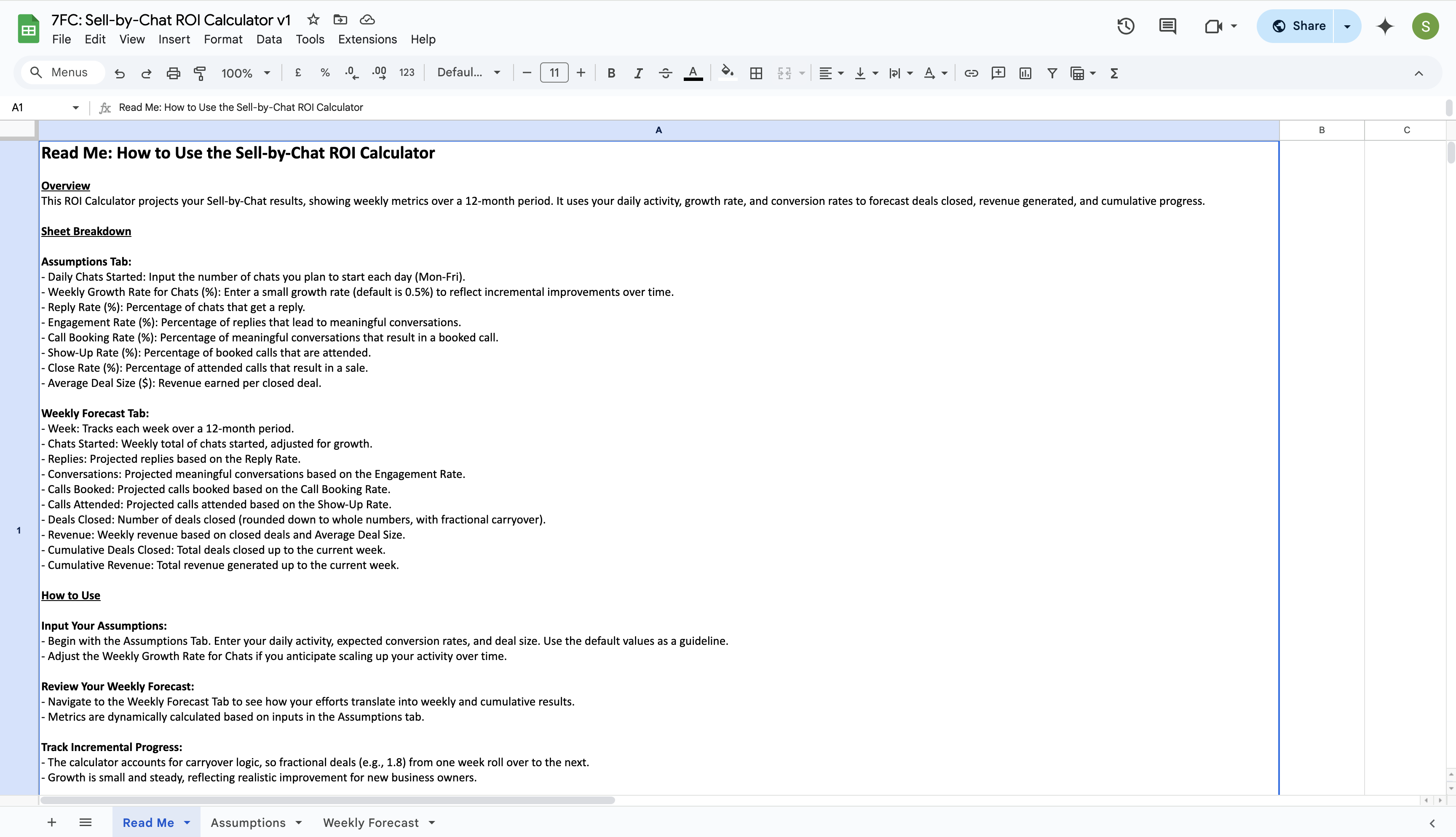
To access the calculator please click[ here](https://docs.google.com/spreadsheets/d/1ngJgGmTSklc1U_Orn2Y8r7_yS6Gd0tizo3oXXd__Czs/edit?usp=sharing).
---
## How to Use
#### Input Your Assumptions:
- Begin with the Assumptions Tab. Enter your daily activity, expected conversion rates, and deal size. Use the default values as a guideline.
- Adjust the Weekly Growth Rate for Chats if you anticipate scaling up your activity over time.
#### Review Your Weekly Forecast:
- Navigate to the Weekly Forecast Tab to see how your efforts translate into weekly and cumulative results.
- Metrics are dynamically calculated based on inputs in the Assumptions tab.
#### Track Incremental Progress:
- The calculator accounts for carryover logic, so fractional deals (e.g., 1.8) from one week roll over to the next.
- Growth is small and steady, reflecting realistic improvement for new business owners.
#### Iterate and Adjust:
- Periodically update your assumptions to reflect changes in your strategy or improvements in your performance.
- Experiment with different growth rates or activity levels to forecast long-term outcomes.
#### Key Notes
- Small, Realistic Growth: The default growth rate is conservative (0.5%) to reflect gradual improvement.
- Fractional Carryover: Partial deals carry forward, ensuring realistic weekly results.
Part 3: Scale Edition
# The Scale Edition and Part 3 are exclusive to members of Seven Figure Creators.
Apply [here](https://sevenfigurecreators.com/seven-figure-creators/) to join.
# The Scale Edition and Part 3 are exclusive to members of Seven Figure Creators.
Apply [here](https://sevenfigurecreators.com/seven-figure-creators/) to join.
# The Scale Edition and Part 3 are exclusive to members of Seven Figure Creators.
Apply [here](https://sevenfigurecreators.com/seven-figure-creators/) to join.
 # The Scale Edition and Part 3 are exclusive to members of Seven Figure Creators.
Apply [here](https://sevenfigurecreators.com/seven-figure-creators/) to join.
END