Nathan Barry had already shared my LinkedIn Masterclass with 47,000 email subscribers before I ever sent him a message.
The DM wasn't the first touch. It was the last.
Who Is Nathan Barry?
So here's who we're talking about.
Nathan Barry is the founder and CEO of Kit - 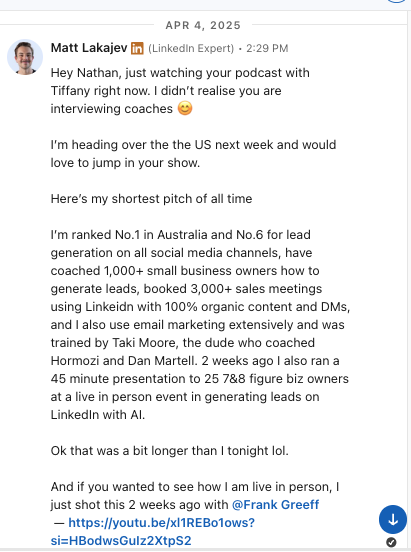
 - you might know it as ConvertKit. He bootstrapped that company from five grand to $45 million a year in annual recurring revenue. 58,000 paying customers. His platform powers the newsletters of Tim Ferriss, Ryan Holiday, Andrew Huberman. Some of the biggest creators on the planet run their entire email operation through his software.
He turned down a Spotify acquisition.
That's the kind of person we're dealing with. Not someone who's going to reply to a cold pitch because you had a nice subject line. Not someone who's sitting in his inbox going "oh wow, a stranger wants to meet for coffee, how exciting." This is a guy who gets pitched constantly and says no to almost everything.
And he said yes to me. In about two minutes.
The Context
Here's what most people don't know about this DM.
I didn't build trust with Nathan in the message. The trust was already there. It had been accumulating for weeks before I typed a single word.
Content That Preceded the DM
Nathan had already consumed my LinkedIn Masterclass -- "How to Make $100k/Month with $0 Ad Spend." Not only consumed it. He'd shared it with his 47,000-plus email subscribers. Two weeks before I ever reached out. My content was already circulating in his world. My work had preceded me.
The Taki Moore Connection
The other piece: Taki Moore. Genuine mutual connection. Taki's a coaching business expert -- someone both Nathan and I have known for years. Nathan had him on his podcast. I'd known Taki for a long time. Real relationship, not a manufactured name-drop.
And here's what makes Taki even more interesting in this context. Taki coached Dan Martell -- the guy who wrote Buy Back Your Time and built SaaS Academy into one of the biggest coaching companies in the tech world. So Taki's not just a mate of Nathan's. He's the coach behind one of the most well-known SaaS founders on the planet. That adds another layer to the trust transfer. When you share a genuine connection with someone who operates at that level, it signals something about who you are without you having to say it.
Real Timing
And the timing was real as well. I was heading to the US the following week. Not "we should connect sometime." Not "I'd love to hop on a Zoom." I was getting on a plane.
The Offer Viability was already validated before I opened LinkedIn. Nathan was interested in LinkedIn -- he'd shared my masterclass to his list. The demand wasn't something I had to create. It was already there. I just needed to show up.
The DM
Hey Nathan, just watching your podcast with Taki. Man, what a G that dude is. I've known Taki for years now.
I'm heading over to the US next week and would love to connect.
Here's my shortest pitch of all time.
I'm currently #1 in Australia and voted #1 for lead generation worldwide on social media. [Details about $3.5M/yr LinkedIn business, 100% organic, coaching founders etc.]
The Result
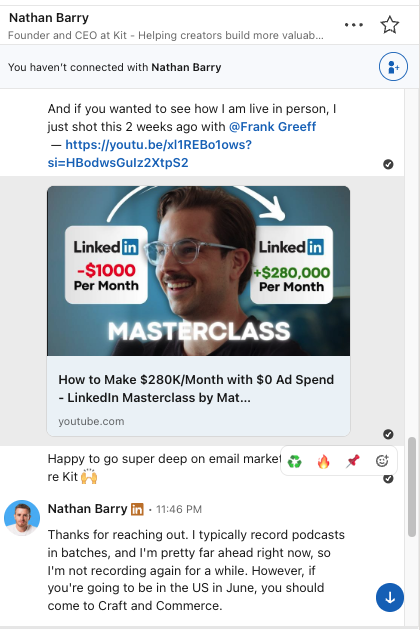
Nathan's reply:
Yep, to go super deep on this stuff
He'd already shared my content to 47,000 people. He didn't need convincing. He didn't need a case study or a testimonial or a three-part email sequence. He'd already done the due diligence himself — two weeks earlier, when he consumed the masterclass and thought it was good enough to send to his entire list.
The DM just gave him permission to act on what he already believed.
The Play-by-Play
"Just Watching Your Podcast with Taki"
"Just watching your podcast with Taki"
Created Serendipity.
Present tense. Not "I watched your podcast." "Just watching." Right now. Happening in this moment. That one word — "just" — makes this feel like a spontaneous thought, not a calculated outreach. Like I was sitting on the couch, watching the episode, and went "oh shit, I should message this guy."
That's the energy. Organic. Real-time. Not rehearsed.
Here's a science drop for you. In 1968, a psychologist named Robert Zajonc published a study in the Journal of Personality and Social Psychology called "Attitudinal Effects of Mere Exposure." What he found was dead simple: the more times someone is exposed to something, the more they like it. Doesn't matter if they don't consciously remember the exposure. Familiarity breeds preference.
They saw your name on a post, then in a comment, then in their inbox — by the third touchpoint, you're not a stranger. You're familiar. And familiar feels safe.
Nathan had already seen my name on a masterclass he shared to 47,000 people. By the time this DM landed, I wasn't some random bloke in his inbox. I was someone his brain had already categorised as "one of us."
"Man, What a G That Dude Is"
"Man, what a G that dude is. I've known Taki for years now."
This line is doing three things at once.
First — genuine appreciation. "What a G" is not "Taki and I are business partners" or "Taki recommended I reach out." It's a real reaction to watching someone you respect. Organic. Not strategic.
Second — trust transfer. Taki is someone Nathan respects. He had him on his podcast. Taki is also someone I've known for years. So the trust Nathan has for Taki partially transfers to me. If Taki trusts Matt, and Nathan trusts Taki, the transitive property of trust kicks in.
Third — consistency signal. "For years" is doing work. Not "I just met Taki at an event." Not "we connected on LinkedIn last month." Years. That signals a real, long-term relationship. Stability. Someone who keeps people in his life.
"I'm Heading Over to the US Next Week"
"I'm heading over to the US next week"
Real timing. Not manufactured. Not "I'd love to grab a coffee sometime when you're free." That's the weakest shit in the world and everyone knows it means never.
"Next week" is specific. It's a real window. I'm getting on a real plane. And it drops the disruption threshold for Nathan — he doesn't have to do anything special. I'm already coming to him. The opportunity is being created through my own action, not his.
International travel is a costly signal as well. You don't fly to another country for a maybe. That confidence transfers.
"Here's My Shortest Pitch of All Time"
"Here's my shortest pitch of all time"
Same energy as Frank Greeff's 170-character DM. Compression equals confidence. The ability to pitch yourself in one sentence signals you understand your value so deeply you don't need a deck or a PDF or a 12-minute Loom to explain it.
And by labelling it as a "pitch," I removed all ambiguity. No hidden agenda. No bait-and-switch. You know exactly what's coming. That's permission physics — safety goes up when people know what to expect.
The Content Had Already Done the Selling
Nathan had already shared my content to 47K people
This is the real move. And it didn't happen in the DM. It happened weeks before.
My LinkedIn Masterclass had already been consumed by Nathan, evaluated by Nathan, and distributed by Nathan to his entire email list. He'd already endorsed my work. The DM landed into a brain that had already processed and validated my value.
The DM didn't build trust from zero. It activated trust that was already accumulating.
That's the compounding effect. My content was the first DM. The actual DM was the last step. Everything in between — Nathan watching the masterclass, deciding it was good enough to share, his audience engaging with it, the positive signal coming back — all of that was doing the selling before I ever hit send.
This is the ultimate proof that content is embedded authority. Your work can precede you into rooms you haven't entered yet. Into inboxes you haven't opened. Into conversations you didn't know were happening.
The Template
The Content Preceded DM.
Use this when your content has already landed in someone's world. The DM is the trigger, not the pitch.
Here's the thing though — this doesn't require 47,000 email subscribers. That's not the principle. That's just what happened in my case.
If someone has liked three of your posts, your content has preceded you. If they commented on something you wrote last month, your content has preceded you. If they shared your article in a Slack channel you'll never see, your content has preceded you.
The variation is simple. Reference the specific post they engaged with. "Hey, saw you liked my post on [topic] — that actually reminded me of something I wanted to run by you." Now you're not cold. You're familiar. You're someone whose work they already consumed and reacted to.
The DM becomes the natural next step in a conversation that was already happening in their head.
When it works best:
- Your content has already reached the person (likes, shares, comments, email forwards — any signal)
- You have a genuine reason to reach out right now (not "sometime")
- You can compress your pitch because your work has already done the explaining
- There's a shared connection or shared world you can reference naturally
The structure:
- Reference something real and current (present tense, serendipity)
- Establish a shared connection or shared world
- Create a specific timing window
- Compress your pitch — your content already did the heavy lifting
The best cold DM is one where your work has already done the trust-building before you hit send.
Next: Chapter 10 — The Mystery DM