Chapter 1: The Lie
Here's a list.
Read it. Be honest.
Mindset coach.
Business coach.
Coaches who coach coaches.
"I help small business owners with marketing."
Leadership development consultant.
Social media manager for SMEs.
Executive coach.
"I help founders scale."
Every person who reads that list does the same thing.
They scan it for themselves.
And either they find themselves -- and feel that little twinge -- or they don't find themselves but they know, somewhere in the back of their head, that there's a version of it with their exact words on it.
I know because I've shown this list to over two thousand people.
Every time, someone goes quiet for a second.
Here's why those niches are on the list.
Not because the words are wrong.
Because they don't describe a world.
They describe a category.
And that distinction -- category vs world -- is the entire problem. It's also the lie at the centre of everything you've been taught about LinkedIn.
The people selling LinkedIn advice are teaching you how to describe a category. When what you actually need is a world.
And those are not the same thing.
LinkedIn is pokies, and it doesn't give a shit whether you win
I was walking Teddy the other morning -- 6:30am, still dark, North Sydney quiet -- and I was turning this thing over in my head.
Why do smart, hardworking people keep getting ignored on LinkedIn?
Not lazy people. Not people who aren't trying. People who are showing up every day, writing good content, doing everything they've been told. And silence. No leads. No calls. Nothing.
Then I'll talk to someone else who barely tries and they're drowning in work.
I've been thinking about this for years and I finally landed on the thing that explains it.
LinkedIn generated around $16 billion in revenue in 2024.
Over five billion of that came from ads.
Ads only work if people stay in the feed. Scrolling. Clicking. Reacting. Spending time.
LinkedIn's entire business model is built on keeping you on the platform. Not helping you get clients. Not helping you book meetings. Not helping you make money. Keeping you scrolling. And giving you just enough little dopamine hits -- the like, the comment, the new connection, the notification -- that you come back tomorrow and do it again.
You know what this is?
It's pokies. Slot machines.
LinkedIn is literally pokies for professionals. The little red notification. The dopamine hit when a post does well. That "this might be the one" feeling when you hit publish on something you worked on for two hours.
You're sitting in front of a machine designed to give you fake currency. Engagement, impressions, follower counts. The house takes the real money. You get the feeling of winning.
And the actually fucked up part?
LinkedIn doesn't even track whether your content is making you money.
They don't know if a post led to a meeting. They can't tell you if your profile converted visitors into buyers. They have zero data on whether those 15,000 impressions turned into a single sales call.
So every piece of advice based on LinkedIn analytics -- every "optimal posting time" study, every viral format breakdown, every course on how to grow your following -- is advice about one thing only.
How to win at pokies.
Not how to get clients.
Those are completely different games.
What I actually found when I tracked both sides
Here's why I can say this with any confidence.
I've worked with over 2,100 clients since July 2023. My clients have tracked over $172 million in revenue. I've personally booked over 5,000 sales calls from LinkedIn -- about 26 messages per call on average, because I actually counted.
And I built a 130,000-word document analysing hundreds of niches. What works, what doesn't, what looks like it's working until you look at the revenue side and it's not.
I call it the Niche Scoring Bible Blueprint. This book is what I pulled out of it.
When I tracked both sides -- the impressions AND the money -- here's what I found.
There is almost no correlation between engagement and clients.
Not a weak correlation. Not "it's more complicated than that."
Almost no correlation.
Let me show you what that actually looks like.
Peter Gaffney. 298 impressions.
Peter is a personal trainer based in the UK who works with New York City law firm partners.
Not "executives." Not "high performers." Law partners. In Manhattan firms. Specifically.
He serves them remotely and when they travel to London -- the point is, he built his entire world around this one type of person. The people doing 70-hour weeks in midtown. Sitting across from boards. Running on adrenaline and bad coffee. Whose physical health is declining at roughly the same rate as their billable hours go up.
Peter knows this world. He's in it. He speaks it fluently.
He posted a transformation post -- one of his clients, a lawyer.
298 impressions.
Three inbound leads came from that post.
Those three leads turned into GBP 28,000.
298 impressions. Three leads. GBP 28,000.
Sit with that.
So what happens with 150,000 followers?
There's a guy I know -- won't name him -- who spent a couple of years posting about AI.
AI cheat sheets. How to use ChatGPT. Productivity hacks. The kind of content that was everywhere in 2023 when everyone was trying to figure out what AI even was.
He built to 150,000 followers.
Genuinely.
Zero dollars from LinkedIn.
Not disappointing. Not "less than expected." Zero.
Because every single post sat in what I call the Noise quadrant. Relevant to everyone. Recognisable to no one. Nobody reading his cheat sheets thought holy shit, that's me. They thought "huh, interesting" and scrolled past.
298 impressions. Three leads. GBP 28,000.
150,000 followers. $0.
The number is not the metric.
Bec. 2,000 followers. A $45K retainer from a company in Europe.
Bec Lindert -- markets to agricultural businesses in rural and regional Australia.
Her profile banner is a photograph of a cotton farm. Wide open landscape, the kind of sky that only exists out past the ranges. And underneath the photo, text that says what she does -- rural and regional businesses. That's it. No hard-sell call to action. No "book a free strategy session." Just the landscape and her positioning.
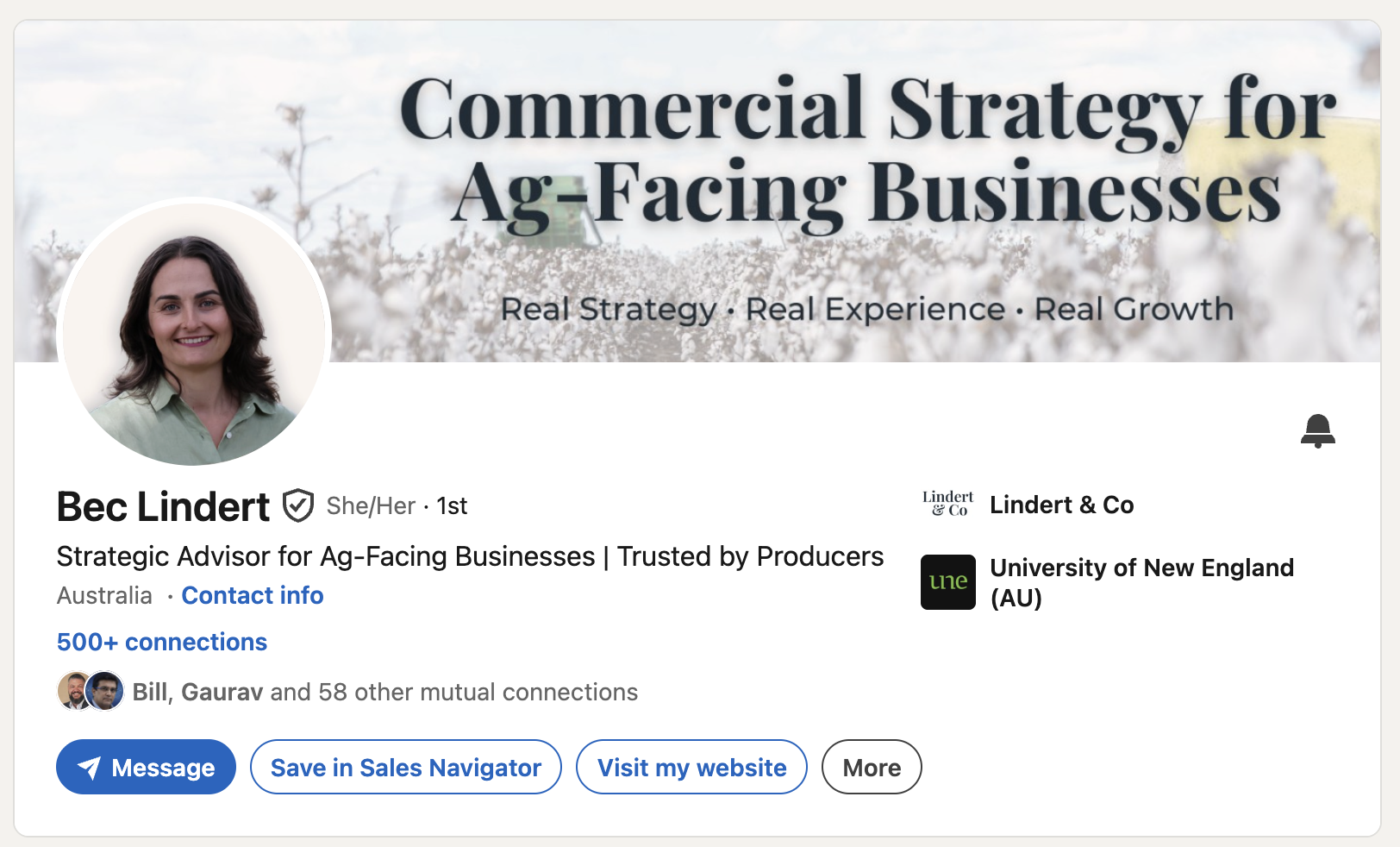
Here's the thing about that banner. The farmers see the landscape and stop before they even read the text. The cotton farm does the work. The recognition fires the moment they see that sky, that flat horizon, those rows. Then the text tells them she's for them. But the stopping happened first. Pre-verbal. Before the words even registered.
She has about 2,000 followers.
She gets ten to twenty inbound leads per post. Every post.
90% cold DM response rate.
And she got a $45,000 retainer inbound from a company in Europe -- they reached out to her -- because she was the only person on LinkedIn who spoke to rural agricultural businesses. They assumed she must be the best.
Because she was the only one who existed in their world.
She doesn't use clever hooks. Her formatting isn't polished. Some of her content would make a content marketer genuinely uncomfortable.
She just speaks a world so specifically that everyone in that world stops when they see it.
And everyone outside it doesn't even notice it exists.
That's the whole game.
Steve. No photo. No banner. Never posted once. $100K in three months.
This is the one that really got me.
Steve is my business partner. Check out his LinkedIn Profile
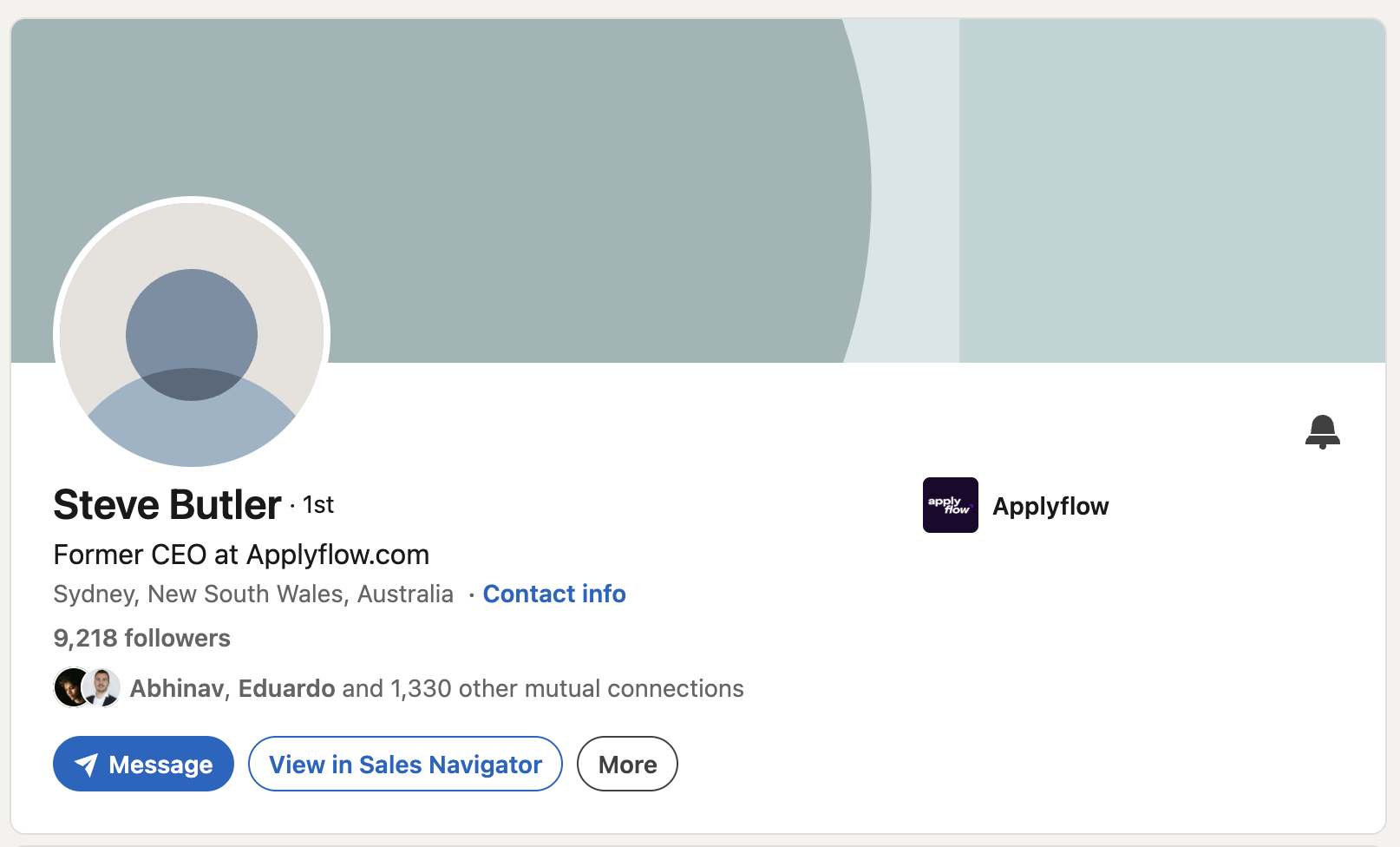
No profile photo.
No banner.
Not a single post. Not in his life.
He closed $100,000 in three months.
Just DMs. No content strategy. No hook framework. No posting schedule. No LinkedIn course. Just specific messages to specific people in specific worlds.
Here's the uncomfortable thing that story forced me to sit with.
The reason most people need content is because they're too scared to just DM people directly.
The content is recognition at scale. It reaches people you can't reach through DMs alone. That's genuinely valuable.
But content is not the main event.
Recognition is the main event.
Content is just how you build recognition at scale.
And Steve -- with no content, no profile, no strategy -- had enough pre-existing recognition in his world that he could skip straight to the conversation.
Most of us can't do that. So we need the content.
But the question isn't "how do I make better content."
The question is: "whose world am I speaking to?"
Sam. 15,000 impressions. 12 likes.
Sam Parsons is in one of my programs. He's Australian, works with businesses in his local market.
One day he posted something in our community channel. He was kind of dumbfounded.
His post had done well by one measure and terribly by another.
15,000 impressions. 12 likes. No leads. No clients.
By every metric the LinkedIn content world uses to judge a post, this was a failure. Terrible engagement rate. The algorithm probably suppressed it. Anyone running the standard playbook would've looked at that engagement rate and felt embarrassed.
But Sam wasn't embarrassed. He was confused. Because 15,000 people had stopped on this thing. That's what impressions mean on LinkedIn -- people hanging on your content. Not scrolling past. Stopping. Fifteen thousand people paused long enough for LinkedIn to count it as an impression.
And only 12 of them liked it.
I opened the post.
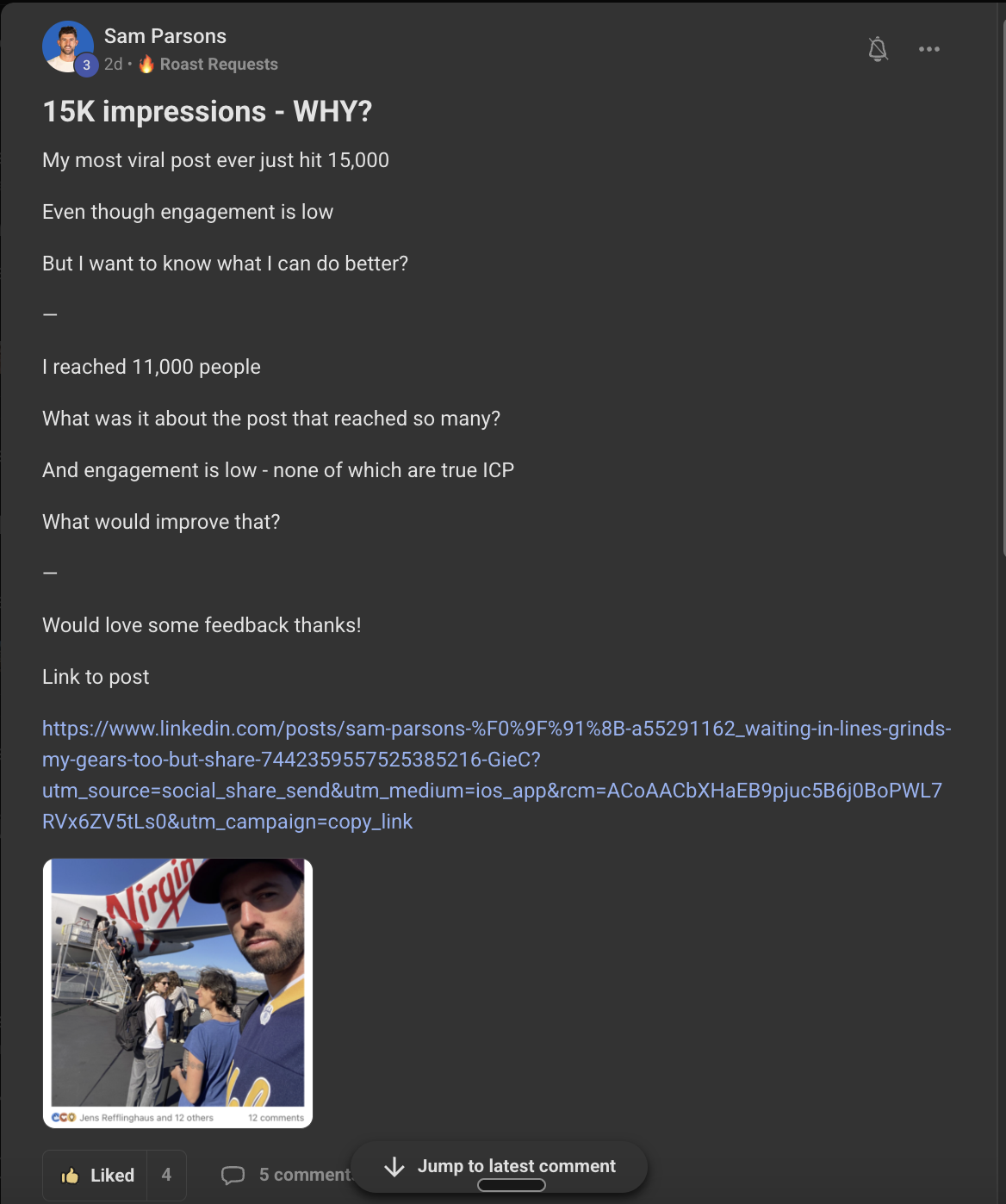
Here is the link to the post - https://www.linkedin.com/posts/sam-parsons-%F0%9F%91%8B-a55291162_waiting-in-lines-grinds-my-gears-too-but-share-7442359557525385216-GieC
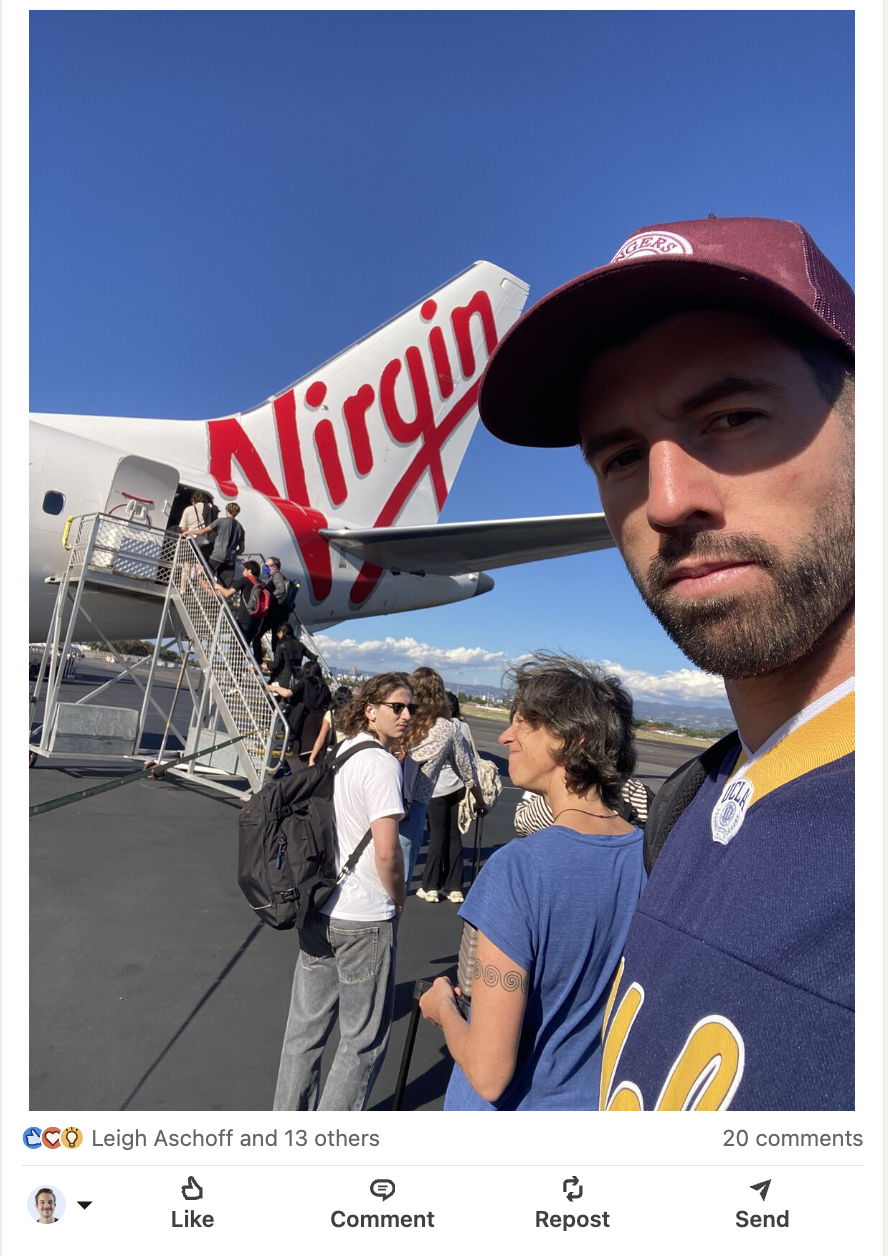
It was a photo. No headline. No hook. No strategy I could detect.
People queuing on the tarmac behind a Virgin Australia domestic flight. Sunny day. That specific slightly chaotic energy of boarding from the rear -- carry-on bags rolling on bitumen, squinting into the sun, shuffling forward in the heat.
I stopped when I saw it.
Because two weeks earlier, I'd been in that exact queue. Flying up to Cairns. Same plane. Same tarmac. Same sun on my face.
Holy shit. That's me.
Not "this is relevant to my professional interests." Just -- that's my life. I've been in that exact queue.
Pre-verbal. Before thought. Recognition.
Now here's what matters about Sam's post. The recognition was real, but it didn't convert. He wasn't getting inbound DMs from it. Nobody was booking calls off the back of a tarmac photo. No leads. No clients. And that's fine. That's not what the post was doing.
What the post was doing was proving that tribal recognition fires whether or not it converts. Fifteen thousand people stopped. The recognition was real. People saw that photo and something in them went -- I know that. I've been there. That's my world.
They didn't engage. They didn't reach out. They just... stopped.
And that stopping -- that involuntary pause -- is the signal. It tells you the tribe exists. It tells you the recognition event is real. It tells you you're speaking to a world, not a category.
Conversion is a different problem. Conversion is about offer, about positioning, about the DM that follows the recognition. We'll get to all of that.
But recognition comes first. Always.
And Sam's tarmac photo -- 15,000 impressions, 12 likes, zero leads, zero clients -- is one of the clearest examples I've ever seen of pure tribal recognition in the wild. The tribe saw itself. That's the thing that matters.
Without recognition, nothing else works.
And then there's Evan
Evan targets Canadian university students who want to land $100K consulting roles, graduating in 2026 or 2027, without a 4.0 GPA.
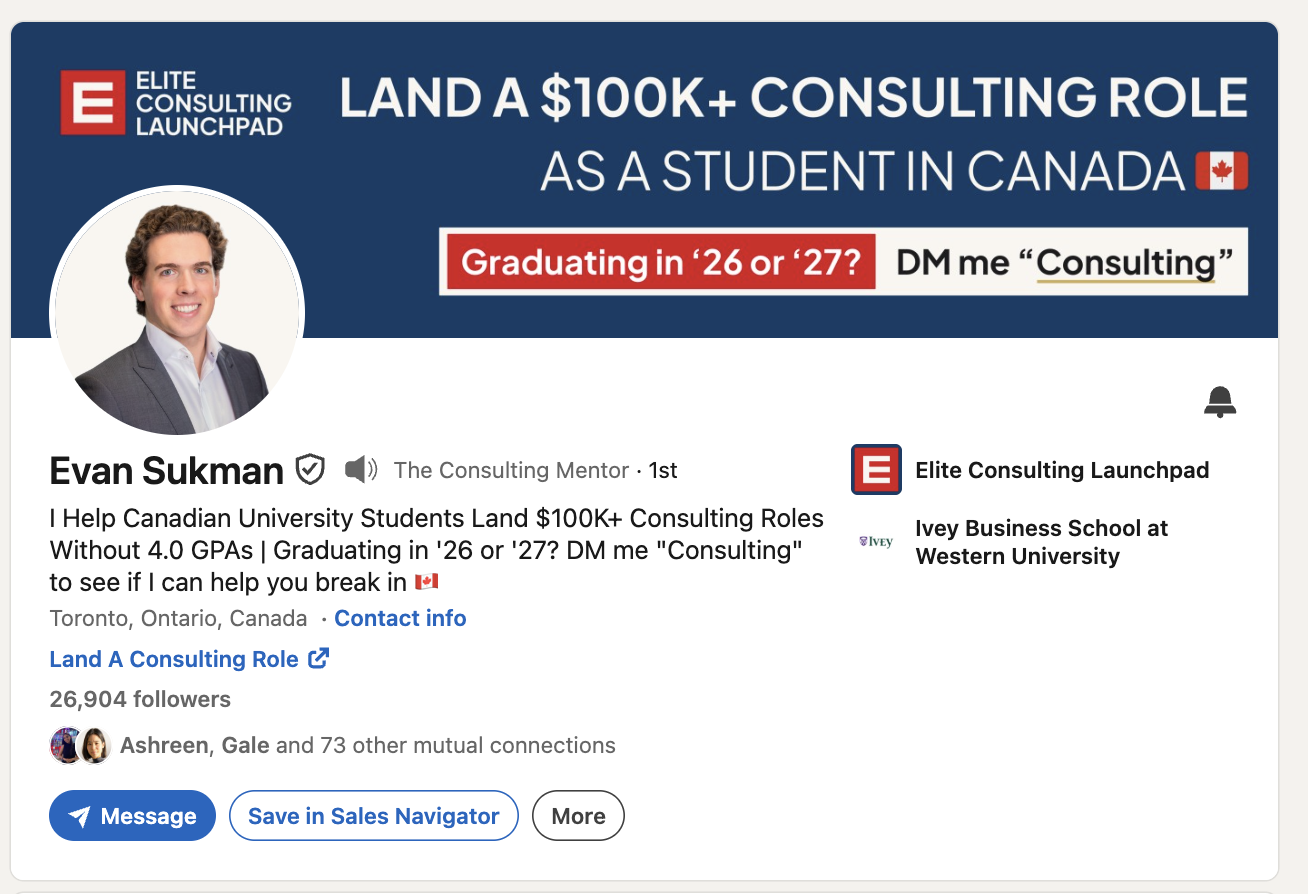
Think about how specific that is.
Not "students." Not "people interested in consulting." Students. In Canada. Consulting. Graduating this year or next. Targeting a specific first-role salary. And specifically the ones who don't have a perfect transcript, right? The ones who need a different path in.
He does a lead magnet post about this and gets a thousand comments.
A thousand.
Because every single person who reads it and lives in that world goes -- that's me. That's exactly me. And they don't scroll. They stop. They comment. They share. They DM.
He's the only person who exists for that specific world.
Alex Hormozi talks about a version of this as well. He had dinner with a lady -- supplement brand, insurance, something like that -- with 5,000 Instagram followers and a 500-person email list.
Does a million dollars a year.
Because every person on that list is exactly who she's for. Zero noise. Maximum recognition.
5,000 people who are genuinely hers beats 500,000 who vaguely follow her.
The number is not the metric. The recognition is the metric.
The formula underneath all of this
I want to give you the structure that explains why the same tactics work for some people and fail completely for others.
PL = OV x RT x TU x T
PL is purchase likelihood. How likely is someone to actually buy from you.
OV is offer viability. Is what you're selling something people actually want?
RT is recognition and trust. Do they recognise themselves in you? Do they trust you?
TU is trust utility. The value-versus-risk calculation. Is this worth it for them?
T is timing. Are they in the market right now?
Here's the thing about this formula.
Every LinkedIn expert is teaching you one or two variables.
Get your offer right -- that's OV. Post at the right time -- that's T. Use the right copy framework -- that's TU.
Almost nobody talks about RT.
Recognition and trust.
Which is the variable that, when it's zero, makes the whole equation zero. You can have the perfect offer, the perfect timing, the perfect value proposition -- and it still doesn't convert. Because the recognition event hasn't happened. The trust hasn't been built. The person read your content and thought "yes, fine" instead of "holy shit, that's me."
RT is what this book is about.
Specifically -- the recognition part of RT. The thing that happens in the first 100 to 200 milliseconds. Either someone reads your content and their nervous system fires this person knows my world -- or it doesn't. And if it doesn't, nothing that follows matters.
What this book actually covers
There are great books on positioning. Great books on offer creation. Great books on sales process.
This book is about the thing that happens before all of that.
The moment when someone reads what you wrote and -- before they've consciously assessed anything -- their brain fires: this person is from my world.
Not "this person seems credible." Not "this content is relevant to me." Just -- my world.
That moment is the beginning of every client relationship.
And it comes from one thing. Speaking to a world, not a category.
Not "founders." A world. Not "executives." A world. Not "small business owners who want to grow." A world.
The rest of this book shows you how to build that. How to find the world your people live in. How to load every word you write with the kind of density that makes the right person stop dead.
We're starting with something that's going to reframe the whole way you think about this.
It's not called niching.
It's called tribes.
Next: Chapter Two -- It's Not Your Niche, It's Your Tribe