Chapter 8: The Meaning Score
"Does anyone know what that means?"
I'm on the 4pm call. I've just put up a LinkedIn post from one of my clients -- Ignaci.
Ignacy helps AEC professionals become BIM coordinators and BIM managers.
The post says:
"A data mistake in a BIM model rarely stays a small problem. It usually becomes a construction problem."
I ask the room: does anyone know what that means?
Silence.
Not one person on the call understood it.
I have no idea what it means either.
And that is exactly the point.
The wrong advice
There's old advice that used to go around about business communication. Your mum should be able to understand what you do. Simplify. Be accessible. Reach people.
And look -- that advice is for consumer-facing brands selling to the general public. Ecommerce, B2C, low-cost stuff where you need to reach the widest possible audience. It's fine for that.
It is absolutely the wrong framework for LinkedIn when you're selling high-ticket services to specific tribes.
Because on LinkedIn, the people who could be your best clients are not your mum. They're Ignaci's AEC professionals. They know exactly what a BIM model is. They know what a data mistake means in that context -- not just technically, but what it feels like when you realise it at the point in a project when it becomes a construction problem rather than a model problem.
They know the specific dread of that. And that dread is the recognition as well.
When Ignaci posts that sentence, every AEC professional in his feed stops.
Not because of the hook. Not because of the structure. Because the sentence is so precisely calibrated to their world that their nervous system fires before they've consciously read it.
Everyone else scrolls past.
That's not a failure. That's the whole point.
When nobody else understands your content but your tribe does -- that's not bad marketing. That IS the marketing.
Ignaci has built a multi-thousand person email list because he's the only person on LinkedIn doing this for BIM professionals. Not one of a few. The only one. And because his content speaks in a language that only his people understand, every AEC professional who finds him thinks this person is inside my world.
MS = TD x BA
Here's how I measure this.
Every word in your content is sitting somewhere on two dimensions.
The first dimension is Tribal Density (TD) -- how much does this word mean to a specific tribe? Scale of zero to ten.
Zero is "business owner." Technically accurate. Completely generic. Nobody stops for it.
Ten is "WHOOP at 34% recovery." If you wear a WHOOP, you know exactly what 34% means. You know the amber screen. You know the feeling in your body when you see that number after a big night. You know you're about to have a shit day and your body's already telling you before your first coffee.
If you don't wear a WHOOP, that sentence means nothing. Good. It wasn't for you.
The second dimension is Brand Alignment (BA) -- zero to one. How much does using this word position YOU as the person who solves that tribe's specific problem?
High Brand Alignment means the word does two jobs at once. It creates tribal recognition AND it positions you as the solution. Someone reads it and thinks that's my world and this person is for me -- in the same moment.
Low Brand Alignment means the word creates recognition but doesn't connect to what you sell. They feel seen. They don't see you as their answer.
The formula:
MS = TD x BA
Meaning Score equals Tribal Density multiplied by Brand Alignment.
Both dimensions must be high simultaneously. That's the "multiplied" part, right? If either one is zero, the whole thing is zero. Doesn't matter how high the other one is.
Let me run it through three quick examples so you can feel it.
"WHOOP at 34% recovery" posted by a sleep performance coach. TD: 10. BA: close to 1. Meaning Score: 10. That content is doing its job. Every word is earning its place. The tribe recognises itself AND the person posting is positioned as the one who fixes the problem the WHOOP score just revealed.
A Warren Buffett quote about patience posted by a LinkedIn coach. TD: maybe a 4. Buffett is recognisable -- but he's recognisable to everyone, which means he's specific to no one. Your mum knows who Warren Buffett is. That's not tribal. That's just famous. BA: 0.2 at best. Unless you're literally a stock market analyst, the quote has nothing to do with you. Meaning Score: 0.8. Noise. Gets likes from people who will never become clients.
"5 ways to scale your consulting practice." TD: 1. Every consultant is technically relevant. Nobody specifically recognises themselves. BA: 0.8 if you actually help consultants. Meaning Score: 0.8 again. Aligned to what you sell, but nobody stops for it. Nobody thinks holy shit, that's me. This is the Invisible Expert -- on-topic, well-structured, completely invisible.
The four quadrants
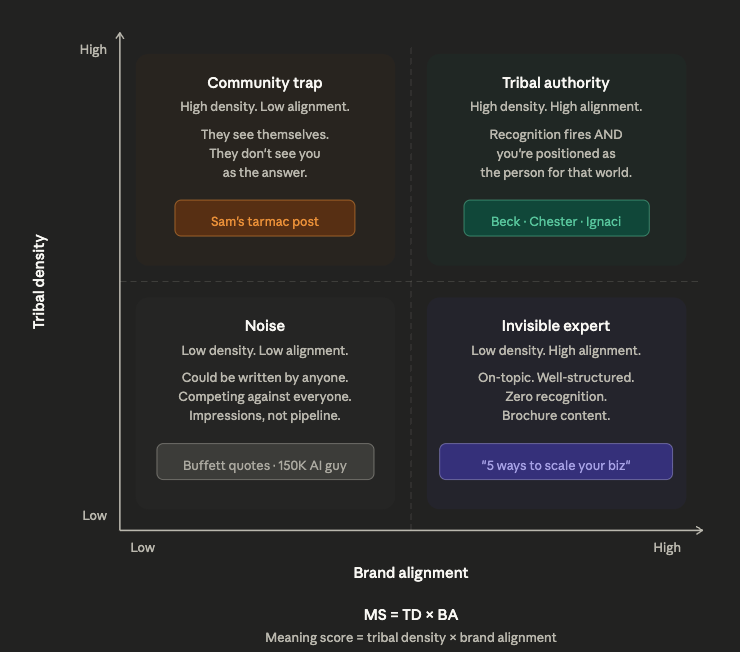
Map these two dimensions against each other and you get four places your content can land. This is the centrepiece of the whole chapter, right? Because once you see where you are on this grid, you can't unsee it.
Top Right -- Tribal Authority
High density. High alignment. This is the goal.
This is where Bec lives. Bec, whose cotton farm banner we covered in Chapter 1 -- she's got about 2,000 followers. 90% cold DM response rate. A $45K retainer from a firm in Europe who found her content and thought this is the only person on LinkedIn who understands our world.
When a rural ag professional sees Bec's content, their recognition fires AND she's positioned as their person. Both dimensions high simultaneously. That's not just engagement. That's not just branding. That's the only quadrant that reliably produces clients.
And Bec didn't need 100K followers. She needed the right 2,000 people to see content that scored a 10 on both dimensions at the same time.
Top Left -- Community Trap
High density. Low alignment. The engagement trap.
Here's the example. Sam Parsons posts a photo from the tarmac -- a behind-the-scenes shot from a Virgin Australia domestic flight. 15,000 impressions. 12 likes. But more importantly -- everyone who flies Virgin domestically stopped. They saw the specific carpet, the specific boarding process, the specific view from the tarmac. Recognition fired.
But Sam doesn't sell anything related to flying. Zero brand alignment. The tribe saw themselves. They didn't see Sam as their solution to anything.
No leads. No clients. Nothing.
This is where a lot of people end up posting personal content that resonates like crazy but doesn't connect to what they sell. Great engagement. Heaps of love in the comments. Community vibes. No pipeline. No revenue.
The Community Trap feels like it's working because the dopamine is real. The likes are real. The comments are real. But when you look at your pipeline, it's empty as well. Because recognition without alignment is just entertainment.
Bottom Right -- Invisible Expert
Low density. High alignment. Technically on-topic. Zero recognition.
"I help founders get more clients on LinkedIn."
Aligned to what you sell? Sure. Does anyone see themselves in it? No. Because "founder" is a category, not a world. A cotton farmer and a SaaS bro are both founders. They share nothing except the word.
This is brochure content. The kind of stuff you'd put on a website. Makes complete sense. Creates no recognition. Reads like a consulting firm's one-pager, not a conversation from inside someone's world.
And here's the thing that should kind of piss you off -- this is where most serious LinkedIn creators are stuck. Not bad content. Not lazy content. Content that's technically right but has zero density. They've been told to "niche down" and they did -- they picked a category. They just never went inside the world. They're standing outside the house describing it to nobody who's listening.
Bottom Left -- Noise
Low density. Low alignment. The wasteland.
Generic insights. Motivational content. Warren Buffett quotes. "Monday mindset." "8 habits of successful leaders." Content that could have been written by anyone, doesn't position you as anything, and is competing against people with bigger platforms and better production.
You're in the LinkedIn casino putting in time and getting fake money out. Dopamine, not revenue. Impressions, not pipeline. The vanity metrics look fine. The bank account doesn't give a shit.
The honest diagnostic
So here's where most people reading this book actually are.
If I'm being straight with you -- and I reckon you'd rather I was -- most of you are sitting in Invisible Expert or Noise and don't know it.
Not because you're bad at this. Because nobody showed you the grid. You've been optimising hooks, tweaking posting schedules, testing carousel formats -- all of which is optimising inside the wrong quadrant. Like rearranging furniture in someone else's house. What a bloody waste of time.
The grid tells you the truth. And the truth is that the quadrant you're in matters more than anything you do inside it.
Chester Maglo -- brand leverage in action
Now I want to show you what it looks like when someone actually executes this. Not theory. Real posts, real numbers, real clients.
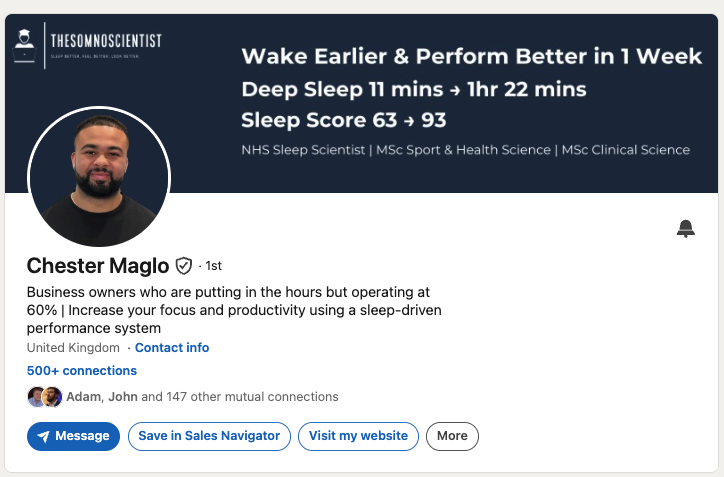
Chester Maglo is a sleep performance coach. His LinkedIn headline: "Business owners who are putting in the hours but operating at 60%." His brand: THESOMNOSCIENTIST.
Here's the context. Chester started LinkedIn in November 2025. Before SFC -- zero. Zero leads. Zero clients. Zero inbound. Nothing. Joined the first four-week challenge in late January 2026. Since then: dozens of calls booked, approximately five clients closed, around 10,000 impressions on his posts.
He found his tribe.
And the way he found them is through three specific brand leverage plays that I want to break down for you. Because Chester isn't doing one thing well. He's doing three things simultaneously, and each one maps to a different dimension of the Meaning Score.
Play 1: Celebrity Contrast Hook -- borrowing fame as the stop mechanism
Chester references famous people, then positions himself as the accessible alternative. He borrows their recognition to get the stop, then redirects to his own positioning.
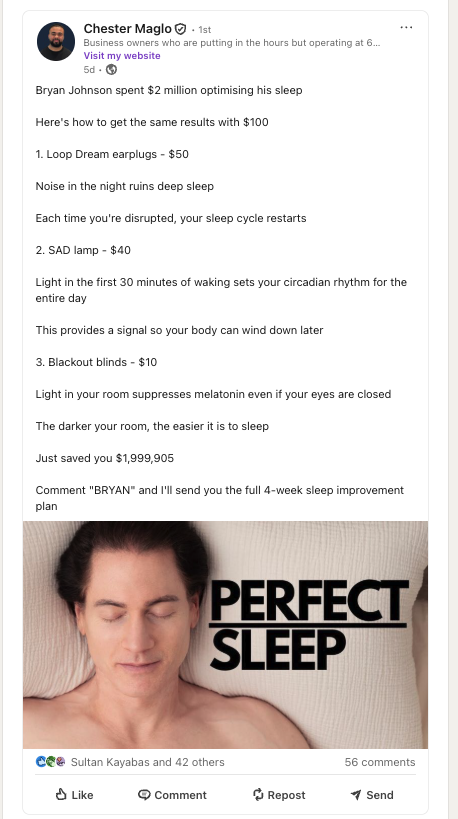
The Bryan Johnson post: "Bryan Johnson spent $2 million optimising his sleep. Here's how to get the same results with $100." Then he lists three items: Loop Dream earplugs ($50), SAD lamp ($40), blackout blinds ($10). "Just saved you $1,999,905." CTA: Comment "BRYAN" for the full plan. 42+ reactions, 56 comments.
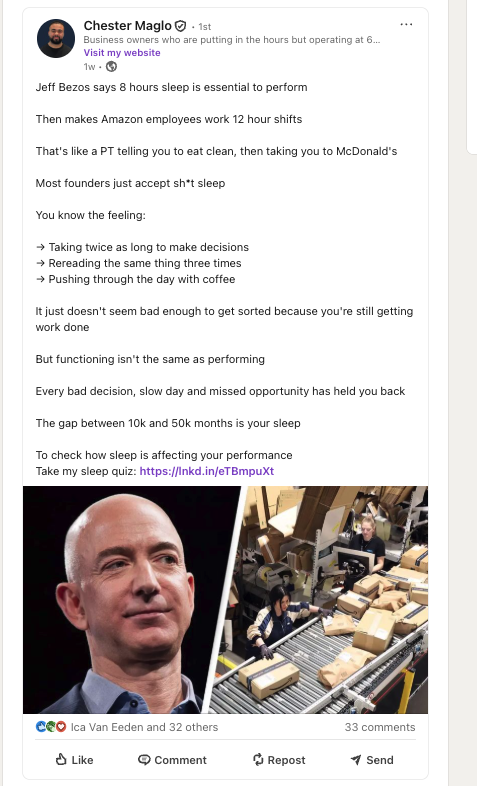
The Jeff Bezos post: "Jeff Bezos says 8 hours sleep is essential to perform. Then makes Amazon employees work 12 hour shifts." "That's like a PT telling you to eat clean, then taking you to McDonald's." Goes into the symptoms: taking twice as long to make decisions, rereading the same thing, pushing through with coffee. "Functioning isn't the same as performing. The gap between 10k and 50k months is your sleep." 32+ reactions, 33 comments.
The Elon Musk post: "Elon Musk spent $5,000 on a mattress cover. What a f*cking joke." "It's like paying 2k for a toilet that automatically flushes. Kinda cool. But it still can't wipe your ass. The Eight Sleep Pod just cools your body temperature. Last time I checked, a fan costs $20." CTA: Comment "SLEEP" for case study. 15+ reactions, 20 comments.
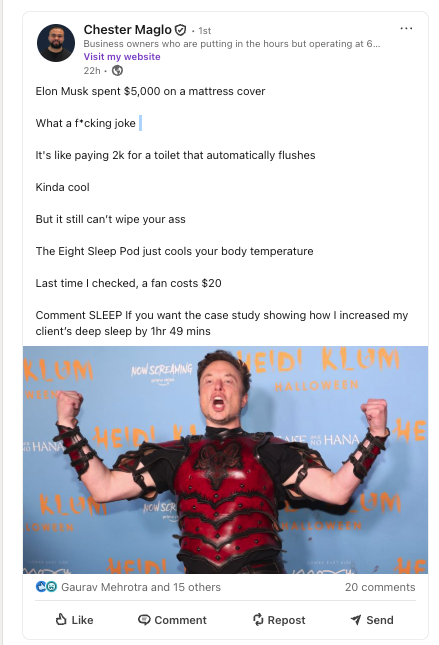
Here's what Chester's doing. Bryan Johnson, Bezos, Musk -- everyone in the performance and sleep world knows these names. Chester doesn't have their following. He doesn't have their budget. But he borrows their recognition and redirects it. The celebrity gets the stop. Chester gets the follow.
That's brand leverage play one. People as brands.
Play 2: Tribal Object Proof -- showing what only insiders understand
Chester uses WHOOP scores, sleep tracking data, and client screenshots as proof. Not testimonials. Not case studies with stock photos. The actual objects that only people inside the tribe would recognise.
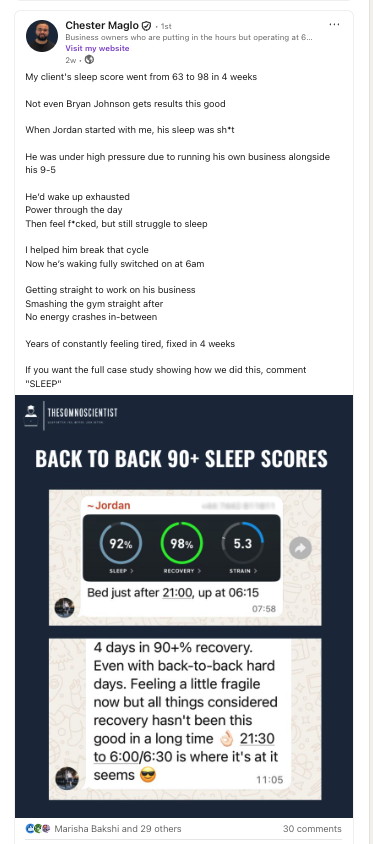
Client Jordan post: "My client's sleep score went from 63 to 98 in 4 weeks. Not even Bryan Johnson gets results this good." Shows the WhatsApp screenshot with WHOOP data: 92% sleep score, 98% recovery, 5.3 strain. "4 days in 90+% recovery." 29+ reactions, 30 comments.
Client Gem post: "Gem's deep sleep increased by 1hr 49 mins in 4 weeks. That's longer than a Game of Thrones episode." WhatsApp screenshot: "Had the best night sleep ever last night. Felt amazing when I woke up, no alarm. 1 hr 50 mins deep sleep." 41+ reactions, 64 comments.
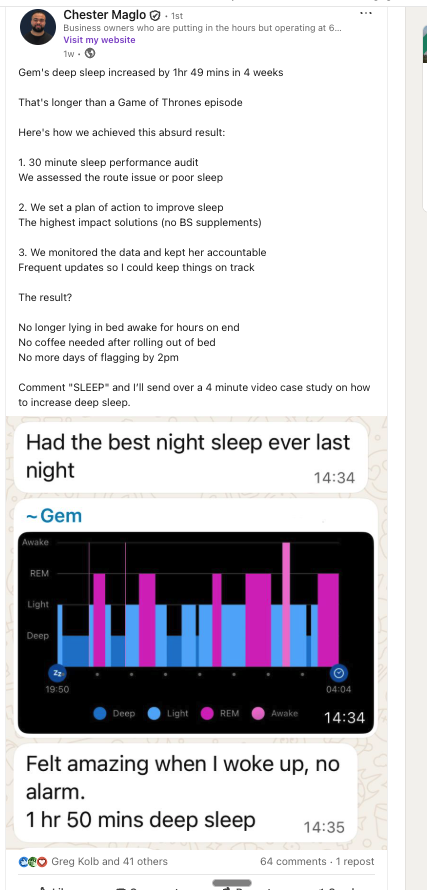
Here's what's happening. WHOOP scores, sleep graphs, recovery percentages -- these are tribal objects. They mean everything to people inside the performance-tracking world and nothing to everyone else.
Chester doesn't explain what a WHOOP score is. He shows it to people who already know. A sleep score of 63 versus 98 means something specific and visceral to anyone who checks their WHOOP every morning. They know what 63 feels like in their body. They know what 98 would feel like. The gap between those numbers isn't data -- it's a lived experience compressed into two digits.
That's brand leverage play two. Objects as brands.
Play 3: Personal Vulnerability as Brand -- Carrier Trust through lived experience
Chester's CPAP mask post: "I couldn't breathe in my sleep for 2 years. That's why I now look like Bane from Batman."
"I stopped breathing 30x/hour in my sleep. The mask stops it. My REM sleep was around 30 minutes every night and my quality of life was terrible." The symptoms: late for work every day, never feeling fully switched on, second-guessing everything. "When I fixed my sleep everything changed. I actually felt alive."
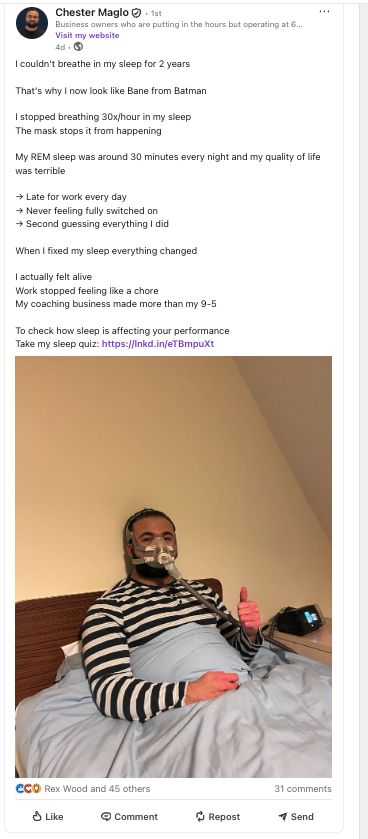
Here's what Chester's doing with this one. Carrier Trust. He didn't just study sleep -- he couldn't breathe in his sleep for two years. He wears a CPAP machine every night. He IS the circumstantial tribe. He's not an expert observing from outside. He's someone who lived through the thing he now helps other people with.
Nobody can fake that. You can't research your way into a CPAP mask selfie. You either lived it or you didn't.
That's brand leverage play three. Your own experience as brand.
The three types of brand leverage
So Chester's showing us something really clean here. Three plays, three types:
People as brands -- Bryan Johnson, Elon Musk, Bezos, Bane from Batman. Figures the tribe knows and has opinions about. You borrow their fame as the stop mechanism.
Objects as brands -- WHOOP, Eight Sleep Pod, Loop Dream earplugs. Tribal objects that carry meaning inside the tribe. You show the thing that only insiders recognise.
Your own experience as brand -- Chester's CPAP, his sleep apnea. Carrier Trust through lived experience. You ARE the proof.
To truly land in that top right quadrant -- Tribal Authority -- you need to understand the objects in their bag, the things on their computer, the brands they use, the videos they watch, the people they look up to. All of that is fuel for brand leverage. And the more specifically you know what your tribe cares about, the more precisely you can borrow, show, and embody it.
Wrong brands -- the cultural penalty
Now here's the flip side. And this matters as much as the leverage itself.
Using the wrong brand doesn't just fail. It marks you as a tourist.
Every tribe has cultural rules. And breaking them doesn't produce a clear error message. It produces a vague but powerful feeling in the tribe member that something is off. They can't always articulate it. They just know you're not one of them.
I call these cultural penalties.
I remember these guys came to my CrossFit gym back in 2015. All they cared about was doing bicep curls, asking where the mirrors are, trying to flex their reps with poor form. They looked big but they didn't match anything culturally. They weren't going to be in the in crowd. Everybody kind of knew it within five minutes. Not because anyone said anything. Just because the signals were wrong.
Same thing happens with content.
If you're in the sleep performance world and you're flexing about grinding and getting no sleep -- like it's some kind of badge of honour -- that's culturally done. You've told the entire tribe you don't understand their values. The whole world of sleep optimisation is built on the premise that more rest equals more output. Bragging about pulling all-nighters is the cultural equivalent of walking into CrossFit and asking for the bicep curl station.
Or take this one. A consultant to CrossFit boxes who mentions "doing cardio on the treadmill." In CrossFit, cardio means the rower or the Assault bike. "Treadmill" signals globo gym. That's a different world. A different culture. A different tribe. And the wrong word, used confidently, is worse than no word at all. Because it tells the tribe you didn't just miss a detail -- you think you know their world and you don't.
Here's one more that kind of blew my mind. My therapist studied Japanese for two years with a personal tutor. Two years. Thought he was pretty good, right? Moved to Japan, started speaking to people, and they couldn't understand him. There are infinite levels of depth within a culture. You can read about it, you can study it, you can practise it in a controlled environment -- but until you're inside it, living it, breathing it, you have no idea how deep it goes.
And this is why the free work thing matters. People ask me all the time -- "I don't have experience in the industry, how do I sell to it?" And the answer is: you offer to work for free. You take people to lunch. You sit with them. You listen to how they talk when they're not performing for an audience. When you meet them, you understand the culture. Not the jargon -- the culture.
A lot of people who've been consultants for 20 years reckon free work is beneath them. But you actually don't know what you're doing yet in a new tribe. You have to earn the cultural knowledge through exposure, not research. You can't Google your way into tribal authority. And at the same time, once you've earned it through exposure, nobody can take it from you.
Three archetypes that always fail
Let me map this back to the grid. Because I see the same three failure modes over and over, and they map perfectly to the quadrants.
The Noise Maker. Bottom left. Competing against bloody Steven Bartlett on generic topics. "Monday mindset." "8 habits of successful leaders." Content that could be a Diary of a CEO clip. Same insight, bigger platform. You lose every time. Not because your content is bad. Because when someone's choosing between your version and his version of the same generic topic, they pick the one with millions of followers. The only way to win is to go somewhere he can't follow.
The Community Trap. Top left. Great engagement, no clients. That's Sam Parsons. 15,000 impressions. 12 likes. No leads. No clients. Personal stories that resonate. Funny observations that get likes. Vulnerable posts that get comments. The love rolls in. But nothing connects to what you sell. You're building a community of fans, not a pipeline of clients. And the gap between those two things is the gap between dopamine and revenue.
The Invisible Expert. Bottom right. Technically correct, zero tribal density. "I help businesses improve operations." Aligned but generic. Reads like a brochure, not a conversation from inside someone's world. You've niched down on paper. You just never went inside the house.
Does that make sense? Most people reading this are one of these three. And the frustrating part is that each one feels like it should be working. The Noise Maker is getting impressions. The Community Trap is getting engagement. The Invisible Expert is saying the right things. But none of them are in the top right quadrant. And the top right is the only one that produces clients. That's the whole damn thing.
The diagnostic
Alright. Here's your homework and it'll take you ten minutes.
Take your last five LinkedIn posts. Pull them up right now. I'm serious -- go get them.
For each one:
1. Plot it on the 2x2 grid. Which quadrant? Be honest. Not where you want it to be. Where it actually is.
2. What's the Tribal Density? Are you using insider words or category descriptions? "Practice management software" is low density. "Best Practice" is high density. "Fitness tracker" is low. "WHOOP" is high. Name the actual things your people use, not the generic description.
3. What's the Brand Alignment? Does the content connect to what you sell? Or is it a great personal story that has nothing to do with your offer?
4. What brands are you using? Objects, people, places? And are they the RIGHT brands? The ones your tribe actually uses, follows, and cares about? Or are you accidentally signalling the wrong culture?
5. If you removed your name, could it have been written by anyone else? If yes -- you're in Noise or Invisible Expert. Tribal Authority content can only come from someone who's been inside the world.
Score each post. Write the quadrant down.
If most of your content is sitting in the bottom half of the grid or the left side, you know what the problem is now. It's not your hooks. It's not your posting frequency. It's not your bloody profile photo.
It's your position on the grid.
Now you know WHERE your content sits. The next chapter is about HOW DEEP it goes. Because even inside Tribal Authority, there are levels -- and most people's content never reaches the threshold where recognition actually fires.
Next: Chapter Nine -- The Director's Cut