Chapter 9: The Director's Cut
My wife booked Gold Class.
Friday night. Hoyts Chatswood -- not the Mandarin Centre one, the other Hoyts.
Justice League. Opening week. And look, I didn't want to go late because going to the movies late ruins my sleep. I always end up wired afterwards and then I'm a mess the next day. But my wife and her brother are the biggest DC fans you've ever met. Like, obsessed. They hate Marvel. It's DC or nothing. My wife has a Superman tattoo. When I met her, she had Tom Welling posters all through her room -- Smallville era. Full walls.
The woman is committed lol.
So we go. I buy the Maltesers -- way too many Maltesers, like I always do. And I forget, as I always do, that the popcorn has a shitload of salt in it. Every single time. And every single time I feel awful afterwards. You'd think I'd learn.
The movie starts.
And it's... terrible.
Like, genuinely bad. Not "oh it wasn't as good as I hoped" bad. Terrible. The pacing is off. The villain looks like he was rendered on a laptop. Half the characters feel like they're in different movies. My wife sitting there and I can see her face just kind of dropping as it goes on. Her brother's the same. These are people who wanted this movie to be incredible more than anyone on earth, and even they couldn't defend it.
We walked out and nobody said much. That's how you know it was bad, right? When the biggest fans in the room don't want to talk about it.
Then, in 2021, the Zack Snyder Director's Cut came out. Released on HBO Max. Four hours long. There was even a black and white version called "Justice is Gray" which was kind of sick. Same cast. Same characters. Same story. Same universe. Same everything. But it was Snyder's actual vision -- the version he would have made if the studio hadn't ripped the thing apart and handed it to someone else.
I remember watching it at home and being like... holy shit. This is actually amazing.
Same actors. Same plot. Same world.
But with one person's actual opinion layered on top of it. Their creative choices. Their perspective. Their specific way of seeing the same material. And it went from one of the worst superhero movies I'd ever seen to one of the fucking best.
That's what happens when you layer your actual opinion into content.
The theatrical release is what most people are putting on LinkedIn. It's technically correct. It's got the right ingredients. But it's got no director. No voice. No perspective that comes from lived experience. It's committee content. Sanitised. Generic. Built to offend nobody and move nobody.
The Director's Cut is what happens when someone who has actually been in the world -- who has opinions because they've earned them -- puts their fingerprint on the same material. The more experience you've had in an industry, the more opinion you've formed. The more opinion, the better your Director's Cut as well. And the better your Director's Cut, the harder people stop. At the same time, the people with zero experience and zero opinion are just making another theatrical release. And LinkedIn has plenty of those already.
This chapter is about the five levels of content depth. Most people are making the theatrical release. The people who are crushing it? They're making the Director's Cut.
The Hook Movie Trailer Framework
Before we get into the levels, I need to give you a framework for how hooks actually work. Because this connects directly to the Director's Cut concept and it's something I teach inside 7FC that kind of changes how people think about their content.
Your LinkedIn post is a full-length movie. The hook is the trailer.
Think about what a movie trailer does. It doesn't show you the whole film. It shows you just enough to make you buy a ticket. And it does that with four specific components. Your hook needs the same four.
1. Cast, Setting, Genre
This is the familiarity layer. Before people care about your content, they need to recognise it.
In movies: cast is the famous actors. Setting is the location. Genre is action, romance, thriller, whatever. You see Brad Pitt in a war zone and you already know roughly what you're getting. That's familiarity. That's what makes you pay attention before a single word of plot has been explained.
In content: cast is brands, public figures, tools, platforms -- named things your tribe already knows. Setting is the industry, the geography, the role. Genre is the type of content -- transformation story, scandal breakdown, success story, failure analysis.
Chester referencing Bryan Johnson or Jeff Bezos in a sleep performance post -- that's cast. His audience already knows those names. They already have opinions about them. The second those names appear, the reader's brain goes "okay, I know this universe." Beck writing about Australian agriculture -- that's setting. A breakdown of why the EU trade deal is bad for producers -- that's genre. Kind of like investigative documentary style, right?
The cast, setting, and genre are what make someone's brain go: okay, this is for me. I recognise this world. Without this layer, you're asking people to care about something they can't even place. It's like a movie trailer with no actors, no location, and no indication of whether it's a comedy or a horror film. You'd skip it. Everyone would.
2. Story
This is the expected value layer. When someone clicks "see more" on your LinkedIn post, they're asking one question: "What am I going to get?"
The hook has to imply insight, a breakdown, a lesson, a reframe -- something. There has to be an implied payoff. Without it, no continuation. They'll read the first two lines, think "cool" and scroll past.
3. Conflict
No tension, no attention.
Contradiction. Juxtaposition. Disagreement. A broken assumption. Something that creates friction in the reader's brain so they can't just nod and move on.
Bec's article: "We're a $100 billion industry. Why is the Australian government making it harder to farm?" That's pure conflict. The two halves of that sentence shouldn't coexist. That's the friction.
Chester's Bezos post: "Jeff Bezos says 8 hours sleep is essential. Then makes Amazon employees work 12 hour shifts." Contradiction. Your brain can't resolve it without reading more.
Conflict creates cognitive friction. And friction creates attention. You know when you're scrolling and something makes you go "wait, that can't be right" -- that's conflict doing its job. Your brain literally can't let it go without investigating. And at the same time, it's pulling you deeper into the post because you need resolution.
4. Director's Cut
This is where most content falls on its face.
YOUR perspective. From YOUR lived experience. Not generic advice. Not aggregated stats from a Google search. Not something AI could produce by summarising industry reports. YOUR opinion, formed from YOUR time in the world.
"After coaching 2,100 business owners..."
"I grew up on my family's third-generation cotton farm..."
"I couldn't breathe in my sleep for 2 years..."
AI can replicate cast. It can replicate story. It can even manufacture conflict -- contradictions are pattern-matchable. But AI cannot replicate the Director's Cut.
Because AI hasn't lived in the world. It hasn't sat at the board table. It hasn't had the anxiety attack. It hasn't woken up at 3am in a farmhouse wondering if the season is going to destroy everything.
The Director's Cut is the irreplaceable human layer.
And here's how it connects to the levels. Levels 1 through 3 have cast and maybe story, but no real conflict and no Director's Cut. Level 4 adds conflict and tribal specificity. Level 5 is the full Director's Cut -- the whole four hours of Zack Snyder's actual vision.
Does that make sense? Good.
The Five Levels -- Reverse-Engineered from Bec
Let me show you what these levels look like using one of my clients.
Beck -- Bec Lindert -- is a strategic advisor for ag-facing businesses in rural Australia. Her company is Lindert & Co. She studied at University of New England. Her headline says "Strategic Advisor for Ag-Facing Businesses | Trusted by Producers." Her banner reads: "Commercial Strategy for Ag-Facing Businesses. Real Strategy. Real Experience. Real Growth."
She's killing it.
But I want to show you what her content would look like if she did a shit job, and then walk you up through the levels to what she actually does.
Because that's the thing -- most people don't know what level they're at. They think they're a 4 when they're a 2. And the gap between 2 and 4 is the gap between getting zero inbound and having 43 meetings booked in a month. Which is what Beck did. With only 2,000 followers.
Let me walk you through it.
Level 1: Label
"I help agricultural businesses grow."
That's Level 1.
Zero sensory detail. Zero recognition. "Agricultural businesses" could be a wheat farmer in WA, a cattle station in Queensland, a vineyard in the Barossa Valley, a mushroom grower in Tasmania, or a cotton operation in St George. It describes millions of people. Literally millions. And when you describe millions of people, you describe none of them.
Nobody reads that and stops. Nobody reads that and thinks "this person gets my world." They might think "okay, agriculture, cool." And then they scroll. Because there is nothing in that sentence that fires recognition. Nothing that makes their brain do anything except register mild relevance and move on.
On the 2x2 grid from Chapter 8: Invisible Expert. High capability, zero tribal density. The worst quadrant to be stuck in, right? You could be the best strategic advisor in the country and nobody would know from that sentence. Because that sentence tells them nothing about you or about them.
Level 2: Stacked Labels
"I help regional Australian ag-facing businesses build trust with producers and win more A-grade clients."
Better. "Regional." "Australian." "Ag-facing." "Producers." There are real words in there now. It's not just "agricultural businesses" -- it's narrowed down a bit.
But it still describes WHAT they are, not what their world FEELS like. There's no sensory detail. No insider language. No named objects from inside the tribe. It's a description that could go on a consulting firm's website and nobody would blink.
This is where most "niching" stops, by the way. The avatar worksheet. The ICP document. The target audience statement. "Who is your ideal client?" And someone writes "regional Australian ag-facing business owner who wants to build trust with producers" and thinks they've done the work.
That's Level 2 thinking. All of it. And it misses the thing that actually creates recognition as well.
On the grid: still Invisible Expert.
Level 3: World Description
"I work with ag-facing suppliers navigating seasonal pressure, rising input costs, and the challenge of earning producer trust in relationship-driven regional markets."
Getting closer. This actually describes conditions. Seasonal pressure. Rising input costs. Relationship-driven regional markets. Someone in the ag world would read that and nod. Yes, those are real things.
But it's generic enough that it could apply to any ag business anywhere in Australia. Actually, kind of anywhere in the world. It sounds like market research. Like someone read an industry report and summarised the key challenges. A consultant could write this after one afternoon of desk research without ever stepping foot on a farm.
That's the tell. Level 3 sounds informed. It sounds like the person knows about the world. But it doesn't sound like they've been INSIDE the world. There's a difference between knowing about agriculture and knowing what it's like to watch a season turn on you.
On the grid: approaching the line but still the wrong side of it. And this is where heaps of people get stuck, by the way. Level 3 feels like it should work. You've done the research. You've identified the challenges. You're saying smart things about the industry. But smart and specific are not the same thing. Smart is knowing the challenges exist. Specific is naming the exact policy, the exact brand, the exact event that your tribe is dealing with right now.
Level 4: Tribal Content -- The Threshold
This is where it starts to matter.
Level 4 is the minimum for recognition to fire. The minimum for someone in the tribe to read your content and think: this person is one of us.
Here's Beck's actual LinkedIn post:
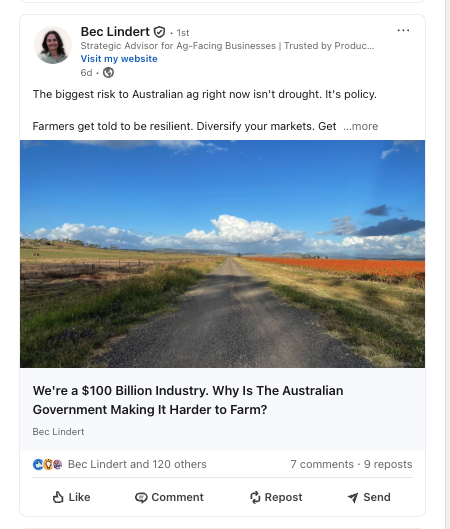
Check the post out HERE.
"The biggest risk to Australian ag right now isn't drought. It's policy."
Then in the body: Farmers have been told to be resilient. Diversify. Get efficient. Get export ready. And they did. Australian agriculture hit $100 billion in revenue. The industry did everything the government asked.
But then policy pulls the rug. The live export ban -- critical revenue, gone overnight. Fuel and fertiliser supply chain with zero sovereign strategy. Water buybacks removing productive capacity. The EU trade deal -- another door closed after producers spent real money getting ready for it.
"You can't tell an industry to diversify and then systematically remove the markets."
THIS is Level 4.
Look at the tribal objects. Live export ban. EU trade deal. Water buybacks. Fuel and fertiliser. Sovereign strategy. These aren't generic industry challenges. These are Kitchen Counter items -- the things sitting right there in the tribe's world RIGHT NOW. Happening this month. Being discussed at every ag conference, every farm gate, every regional pub.
Every Australian producer reading that post thinks: finally, someone is saying what we're all thinking.
That's the recognition event. Not because Bec is a brilliant writer. Because she named the specific things that are in the room. She didn't say "policy challenges facing the agricultural sector." She said live export ban. She said water buybacks. She said EU trade deal. She named names.
The formula: Kitchen Counter item + tribal interpretation + lived experience = Level 4 minimum.
Kitchen Counter, by the way, is exactly what it sounds like. Think about what's sitting on the kitchen counter in your tribe's world right now. Not the stuff in the pantry that's always been there. The stuff that landed this week. The bill that arrived. The letter from the government. The email from the industry body. The thing people are talking about at the pub on Friday. That's Kitchen Counter. And if you're naming those items in your content, you're at Level 4.
That's the threshold. Below this, you're preparation. AT this, you start converting.
On the grid: Tribal Authority.
Level 5: The Director's Cut -- Inside the Tribe
Then Bec published an article.
"We're a $100 Billion Industry. Why Is The Australian Government Making It Harder to Farm?"
Published March 25, 2026. LinkedIn article format -- the long-form kind, not a regular post.
The opening: "Australian agriculture just cracked $100 billion in revenue... So why does it feel like the sector is under siege? Because it is. And the threat isn't drought. It isn't global markets. It's government policy."
The article breaks it down section by section.
"We did what they asked." Government said diversify. Get export ready. Build capability. Invest. Producers did. They spent real money. Real years. And then the government closed the doors it told them to walk through.
Market access: the EU trade deal came back dismal after years of investment from the industry. Live sheep exports banned -- critical revenue stream, gone overnight with no transition support worth a damn. Kangaroo meat exports collapsed under regulatory pressure. China disruptions hit with minimal government support.
Input crisis: no sovereign fuel strategy. No fertiliser security. Diesel runs through every part of the agricultural supply chain and there's zero buffer. None.
Water and red tape: water buybacks removing productive capacity from the system. Growing compliance weight on people who are already managing weather risk, price risk, and now policy risk on top of it all.
And then the contradiction. The government celebrates the $100 billion milestone. Encourages young people into agriculture. Talks about food security. "And then they make it harder to farm. Not easier. Harder."
Beck's closing: "This isn't about handouts. Australian producers have never been about that. What they need is for government to stop being the bottleneck."
Result: 118+ reactions. 7 comments. 9 reposts. For a LinkedIn article -- not a regular post, an article -- that is exceptional.
But here's what really proves it's Level 5. Look at the comments.
Carolyn Suggate, who is a Director at ORICoop, starts talking about COOL recognition -- Country of Origin Labelling -- and protecting domestic markets against inferior imports. That's not a generic comment. That's a tribal member extending the conversation in insider language.
Ellie Corley references Farmers for Climate Action. A tribal organisation. An insider reference.
Craig Duncan talks about Canberra transparency and supply lines.
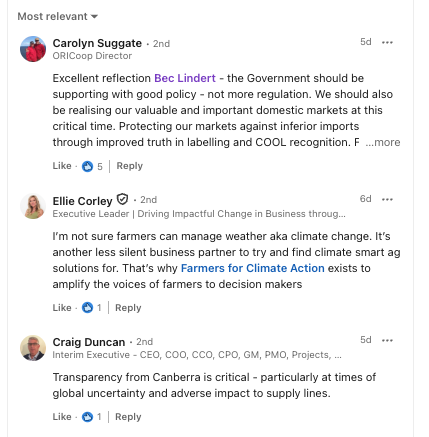
The comments are tribal members responding IN tribal language. They're not saying "great post, Beck!" They're continuing the conversation using insider terminology that nobody outside the tribe would understand.
That's the diagnostic. When the comments extend the conversation in insider language, you're at Level 5. When they say "great post" and a clapping emoji, you're at Level 1-3. I reckon most people have never even looked at their comments through this lens. Go check. Right now. I'll wait.
The comments don't lie. They tell you exactly who you're reaching and how deep your content is going as well.
Why Level 5, Not Just Level 4
Here's the distinction, because it matters.
Level 4 is naming the tribe's world correctly from a position of knowledge.
Level 5 is speaking AS the tribe. From inside it. As someone who has earned the right to be angry on their behalf because they've lived it.
Bec's about section on LinkedIn starts with: "Most ag-facing businesses don't lose deals because of capability -- they lose them because producers don't trust them yet."
And then: "I grew up on my family's third-generation cotton, cattle, and grain operation in St George. I've managed mixed enterprises, built brands including Australian Super Cotton, led commercial strategy, and sat at board tables where decisions carry real consequences."
And: "I've been on both sides of the fence -- producer and supplier."
That's the Director's Cut. Beck isn't describing the tribe's world from the outside. She IS agriculture. She grew up in it. She's been on both sides. Her opinions aren't market research -- they're formed from thirty-something years of actually being in the world.
You can't fake growing up on a cotton farm. You can't fake three generations of cattle and grain. You can't fake knowing what it feels like when the government tells your family to diversify and then removes the markets you diversified into.
That's what makes Level 5 irreplaceable.
And here's the binary that nobody wants to hear.
There are people right now trying to sell to agricultural businesses on LinkedIn who've never even had a conversation with a producer. Not one. They've read some industry reports. Maybe attended a conference. And they're writing Level 2 content about "agricultural challenges" and wondering why nothing happens.
The tribe can smell it. Every time. Not consciously -- they can't point to the specific word that gave it away. But something feels off. The usage isn't native. And when a tribe member detects someone pretending to be an insider, the trust damage is worse than if they'd never bloody tried at all.
Beck doesn't have that problem. Because she's not performing expertise. She IS the expertise. And the tribe knows the fucking difference.
Why You're Still Reading This Book
Here's the thing.
If you're reading this book right now -- chapter nine, still here -- it's because you respect my opinion on LinkedIn. Not because I've got nice graphics. Not because my book has the best formatting. Because I've lived it.
I've booked 5,000 calls. Coached 2,100 business owners. Made $5 million for myself on the platform. My clients, last time we surveyed, were making $172 million a year collectively -- and they've made way more since then. I've had 20,000+ conversations on LinkedIn in three years (crazy right?). I've tested every single thing I'm teaching you in this book.
I have lived experience. That's why you're at this point in the chapter. That's the Director's Cut. That's what Bec has with agriculture. What Chester has with sleep. What Ignacy has with BIM. What Ehsan has with the Indian Aussie IT Migrants.
You've been in circumstances and places as well. You chose the tribe. You're there. You've formed intimate relationships within those tribes. You've got opinions that were formed by being in the room when things happened. Everything from Chapters 3 through 7 stacks into this. The Director's Cut is the sum of all of it -- your chosen tribe identity, your circumstantial experience, your place, your intimate relationships within the tribe. It's the thing that makes your content yours.
And that's what nobody can replicate.
Not AI. Not a ghostwriter who's good with words but hasn't been inside your world. Not someone who's read a few industry reports and watched a couple of YouTube videos. Not even someone who's technically smart and has good writing skills and genuinely wants to help. Because the Director's Cut doesn't come from skill. It comes from time in the world. It comes from sitting in the room. From being on the call. From having the conversation that went sideways. From watching something fail that should have worked. And from being around long enough to have an opinion about why it failed as well.
You either have it or you don't. And if you have it -- and I reckon you do, because you picked up this book for a reason -- everything in here is designed to help you put it on the page. To take the stuff that's in your head and your body and your experience, and turn it into content that makes people in your tribe stop and think holy shit, this person gets it.
That's the whole game.
The Diagnostic
Take your last five LinkedIn posts. I'm serious -- go pull them up. Score each one.
1. Which level?
Be honest. Most people are at Level 2 or 3 and think they're at Level 4. If your post describes your tribe's world using correct-but-generic language that could have come from an industry report, that's Level 3 at best. Level 4 names Kitchen Counter items -- specific things happening right now. Level 5 layers your opinion on top of it from lived experience.
2. Is there a Director's Cut?
Does the post contain YOUR opinion from YOUR lived experience? Or could AI have written it? Seriously. Go read it again. If you swap out your name for anyone else in your industry and the post still works, there's no Director's Cut. It's the theatrical release.
3. Kitchen Counter items?
Are you commenting on what's happening NOW in your tribe's world? The live export ban. The EU trade deal. The water buybacks. The thing everyone in your tribe is talking about this week. Or are you writing timeless generic advice about "building trust" and "scaling your business"? Timeless is another word for forgettable. You need to be current and deep at the same time.
4. Look at your comments.
This is the one most people skip, and it's the most diagnostic. Are the comments in tribal language? Like Beck's commenters talking about COOL recognition, Farmers for Climate Action, Canberra policy transparency. That's Level 4+. If your comments are "great post!" and fire emojis, you're at Level 1-3. The quality of the conversation in your comments tells you exactly where your content sits.
5. The Steven Bartlett test.
We talked about this in Chapter 7. Could your post have been a Diary of a CEO episode? Could Steven Bartlett have put it on his show and it would have fit right in? If yes -- if it's broad enough, generic enough, universally appealing enough for a mainstream podcast with millions of listeners -- you're at Level 1-3. Because that means it's not specific enough to your tribe. Steven Bartlett will never post about live export bans or water buybacks or COOL recognition. That's not his world. And that's exactly why Beck owns that space and he never will. The whole point is to go somewhere he can't follow.
Here's the hard line.
Level 4 is the minimum. Below Level 4 is preparation. It's practice. It's warming up. It's important and it's not wasted time, but it's not where clients come from. Level 4 is where people start reaching out. Where meetings get booked. Where inbound starts.
Beck has 500-odd connections. Five hundred. She booked 43 meetings in a month.
Depth beats audience size. Every single time. I will die on that hill.
Now you know where your content sits on the grid and how deep it goes. You've got the formula -- Cast, Story, Conflict, Director's Cut. You know the threshold is Level 4.
But here's the question nobody asks.
Is your tribe even real?
Because you can write Level 5 content for something that isn't actually a tribe -- it's just a category. And when you do, nothing happens. No recognition. No inbound. No DMs. Not because your content is bad, but because the thing you're writing for doesn't have the density to respond.
The next chapter is about how to tell the difference. If the rooms are full, you have a tribe. If they're empty, you have a category.
Next: Chapter Ten -- What Makes a Tribe Real