Chapter 5: Place Tribes
"What are some words that people in the Bay Area say that nobody else says?"
I'm asking Megan and Isatel on the 9am call. We've just finished the objects exercise. We're moving into tribe types. I want to show the room what place recognition looks like in real time.
Isatel goes first.
She starts talking about the different zones -- what counts as the Bay Area, what's the East Bay, what's the Peninsula. The sub-regions. The City, the East Bay, the Peninsula, the South Bay, the North Bay. Each one has its own identity, its own culture, its own quiet superiority complex. "Where in the Bay are you from?" is a genuine social sorting mechanism out there. The internal debates people have about where the Bay starts and ends. What counts. What doesn't.
I nod along.
Then Megan.
"We call the Golden Gate Bridge just... the bridge."
Just the bridge.
Isatel: "Karl's out today in full force."
Megan: "Oh yeah, Karl -- that's what we call the fog."
I stopped.
Karl. With a K.
I had absolutely no fucking idea what they were talking about.
Neither did most of the room.
Karl the Fog. Karl has his own Twitter account -- or X account, whatever we're calling it now. @KarlTheFog. Hundreds of thousands of followers. The fog rolls in through the Golden Gate strait from the Pacific, sits over the city some mornings, and the people of San Francisco have built an entire personality around it. Karl speaks in the first person online. Witty little posts about rolling in uninvited and ruining everyone's plans for the day. There's a children's book. The whole Bay Area knows Karl.
I asked Megan if that was real.
"No fucking idea," I said. Like, I genuinely didn't know if they were making this up.
They weren't.
But every single person from the Bay Area watching that exchange would have had the exact same reaction.
Karl. Yeah. I know Karl.
Not "I remember that." Not "oh, interesting." Just the immediate, involuntary recognition of something that's been part of your world for years. The fog that rolls in from the Pacific. The way it sits over the Outer Sunset and the Outer Richmond -- the foggiest neighbourhoods in the city. The way people walk out the front door and go "ah fuck, Karl's here."
And here's the thing. If you don't know what Karl is, you're not from the Bay Area. Can't look it up to fake it. It's not the kind of thing you research. It's the kind of thing you just know. Automatically. Because you've lived there. Because Karl has been part of your world since before you knew he had a name.
That's a place tribe.
The B-Line
Then I turned to Edward.
"Edward. The B-Line. What do you think about it?"
He's on the Northern Beaches. I knew already.
"Yeah -- good way to get into the city. Helped us out on the Beaches."
He said it like everyone knew what it was.
So I explained it to the rest of the room.
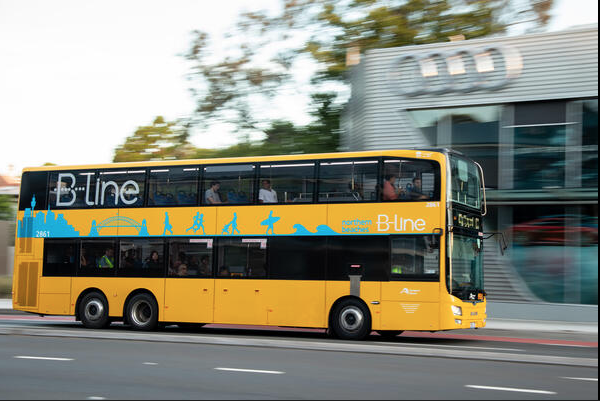
For anyone who doesn't live on the Northern Beaches of Sydney -- the B-Line is a bus. Specifically, the yellow double-decker that runs from Mona Vale to the city along Pittwater Road. Introduced in November 2017 because the Beaches needed a faster way in. Limited stops. High frequency. Runs the one route -- Mona Vale down to Wynyard in the CBD.
And here's the thing you have to understand. There's no train line that reaches the Northern Beaches. Never has been. The Beaches are on a peninsula. You've got limited roads in and out. It's part of Sydney but also kind of not. People call it the Insular Peninsula. That's a real nickname.
So when they finally put in this bright yellow double-decker bus, it became this whole thing. The B-Line. Everyone had an opinion. Everyone noticed when it started. Everyone remembers the view from the upper deck over Narrabeen Lagoon. The specific weird feeling when they first introduced it and everyone thought it was kind of hilarious. A double-decker bus. On the Northern Beaches. The way it became normal.
If you say "B-Line" to someone from the Beaches, they can picture the whole thing. Every stop. The route along Pittwater Road.
One word. An entire local world.
"I took the B-Line in this morning" is a sentence that only makes sense inside a specific geography. And to everyone inside that geography, it paints the whole picture without needing another word.
What a place tribe actually is
A place tribe isn't just "people who live in the same postcode."
That's geography. It's flat. It doesn't mean anything on its own.
A place tribe is where people congregate. It's what happens when a location -- physical or digital, permanent or temporary -- shapes the way you see the world. Gives you a language. Gives you rituals. Gives you references that outsiders just don't have.
Not just where you happen to live. The way the place gets into you. What it makes you care about. What it makes you assume is normal. What its specific texture feels like when you're in it -- the sounds, the rhythms, the things people do on Saturdays and what it means that they do them.
The test is whether the place has given you a language that outsiders don't have.
If yes -- that's a place tribe.
If you just happen to be there but could just as easily be somewhere else and nothing about your content or language would change -- that's a postcode, not a tribe.
And here's what most people miss. A place tribe isn't limited to where you live.
Where you live. The Northern Beaches. Harris Park. Rural Australia. The suburb, the town, the region that shaped the way you see the world. Where you know the streets and the people and the specific sound of the morning.
Where you go. A church. The Vatican. A restaurant. A coffee shop. I traveled to Italy for five weeks with Tanisha. Walked into the Vatican and couldn't believe how fucking large it was. Every inch of that place is adorned -- mosaics, marble, gilt, sculpture. Intricate decoration on every surface you look at. Not painted. That's what people assume. But it's not painted. It's mosaics and marble and gilt and sculpture, crafted into every single inch. And the Sistine Chapel is actually separate -- it's not even part of St Peter's Basilica. People conflate the two. You walk through the Vatican Museums, through corridor after corridor of this insane detail, and then you get to the Sistine Chapel and it's this whole other experience. And the people who've been there -- the people who've stood in St. Peter's Basilica and felt their neck crack looking up -- they share something. A destination you go to can form a tribe the same way a place you live in can.
Online places. World of Warcraft. Discord servers. Slack communities. Reddit subs. LinkedIn itself. I played on the Frostmourne server for years -- Oceanic, Alliance-dominant, PvP. If you know, you know. I'll come back to this.
Temporary gathering places. The 5km at St Leonards Park Run on some Saturday mornings. Baby sensory groups -- my mum took my nephew August when he was about ten months old, she was telling me about the whole thing. A restaurant you go to every week. Only Coffee Roasters in Crows Nest -- number one cafe in Australia, number four in the world. Australian coffee shits on Italian coffee. We all know it. Starbucks tried to crack Australia and failed. We don't do that here. COVID Zoom parties -- my friend Jess invited me to one. A DJ was playing. People were drinking and partying on Zoom. That actually happened. That was 2020. Coachella -- I've been three times. Indio, California. Desert heat, fashion, dust, the Sahara tent at sunset. If you say "Weekend 2" to someone who's been, they know exactly what that means.
Any place where people congregate, develop shared language, and carry the experience with them after.
That's a place tribe.
Newport
Sometimes I stay at my parents' place in Newport, every couple of months. And here's what happens.
My dad gets up every single morning and goes for a swim in the ocean at Newport Beach. I'm sleeping in the downstairs room. Teddy's on my bed. I hear the garage door open -- and I'm like, oh fuck, Dad's up. Usually I've gone to my parents' because I want to chill out. But I end up waking up at six anyway.
Mum always decides to bake something when I come over. Always. So the night before I've usually smashed four brownies and I'm lying in bed with a stomach ache and can't fall asleep. Fall asleep at midnight, wake up at six to go swimming with Dad.
We walk Teddy and Jack -- my parents' dog, he's 15 years old -- through the streets. There's a particular smell in Newport in the morning. If you're from there you know exactly what I'm talking about. We walk along, cross over a part of the road where you've got to look because some cars speed through there. Walk past a bunch of people my dad knows, he says hi to all of them. He says hi to everyone. That's what he does.
Then we get to the beach and there's all these people who know Jack. He's been going there for 15 years. They all know him.
The swimmers all meet at the beach at sunrise. We tie the dogs up. Teddy's freaking out as I jump in the water. I can see the sunrise happening at Newport Beach. My dad and the serious swimmers already have their flippers on because they love body surfing. We get in -- the water was actually warm when I was there in February. And there's this feeling. The ocean. The sunrise. This kind of freedom and reflection on my childhood. Growing up here. Coming back to it.
We get out, say hello to everyone, people give treats to Teddy and Jack. Then me and Dad walk to The Woods cafe. He used to get a pastry but I've turned him to the dark side of eating healthy, so no more pastries. I order him a mocha and I get myself a three-quarter flat white. We sit there with the dogs, locals come up and chat. Dad knows all of them. Then we walk home, Mum's up, Dad heads off to work.
Now here's what I want you to understand about that.
Every single one of those details -- the garage door, Jack, the swimmers at sunrise, the flippers for body surfing, The Woods, the three-quarter flat white, the particular smell of Newport in the morning, the road where you've got to look -- only means something to people who know Newport.
If you're from Newport and you just read that, you felt something. You know the walk. You know the beach. You might know Jack. You've probably been to The Woods. You know the sunrise over the headland.
If you're not from Newport, it was a nice story about a guy visiting his parents.
That's the difference.
That's a place tribe.
And every one of those details is a vocabulary asset. Every reference is a word that fires a whole world in someone's head -- but only if they're from that world.
The Northern Beaches
Let me give you the texture of a real place tribe at a broader level.
The Northern Beaches isn't just geography. It's a whole way of being.
Saturday morning. Surf. Coffee. Nothing. That's the whole schedule. That's the whole point. The no-shoes-to-the-shops thing. The surf culture that runs underneath everything even when you're not surfing. Four Pines in Manly. The specific anti-CBD identity that sits over the whole peninsula.
The Beaches are simultaneously part of Sydney and not part of Sydney. The Insular Peninsula. People genuinely build their entire lives without leaving. Everything they need is there. The ocean. The community. The coffee.
Someone from Parramatta doesn't have those references.
Someone from the CBD is almost a different species.
And someone from the Northern Beaches -- when they see that content -- knows immediately. Not "this seems relevant to my demographic." Just: that's my world.
South of the bridge -- and which bridge
Here's where place tribe language gets really specific.
On the Northern Beaches, there's a thing people say.
I don't go south of the bridge.
Now here's what most people don't know. There are two bridges. And which one someone means tells you exactly where they sit in the Northern Beaches hierarchy.
If you live in the lower Beaches -- Manly, Dee Why, Curl Curl -- "the bridge" means the Spit Bridge. The one that crosses Middle Harbour, connects Seaforth and Mosman across to Manly Vale. The Spit Bridge opens for boats. It's a notorious bottleneck. Traffic backs up in both directions while a yacht passes through. If you live down that end, the Spit Bridge is the thing standing between you and the rest of Sydney.
If you live in the upper Beaches -- Avalon, Newport, Mona Vale -- "the bridge" means the Narrabeen Bridge. The crossing at Narrabeen Lagoon. That's the informal dividing line between upper and lower Beaches.
Two different bridges. Two different sub-tribes within the same tribe.
Which bridge you mean when you say "south of the bridge" reveals where you sit in the Northern Beaches hierarchy. It's a tribal sorting mechanism that outsiders would never even notice. Right?
Tribes within the tribe.
And "I don't go south of the bridge" -- whichever bridge you mean -- captures something real about the identity of people who've been on the Beaches long enough to mean it. The specific insularity. The specific pride. The specific way of relating to Sydney-proper that makes you simultaneously part of it and not.
Say that phrase to someone from the Beaches. Watch what happens.
They either laugh and say "yeah, that's me" -- or they say "oh, I go to the city heaps, I don't really have that."
Both responses tell you something about how deeply they're inside the place tribe.
Bec. Again.
Bec, whose cotton farm banner we covered in Chapter 1 -- 2,000 followers, $45K retainer from Europe.
I want to come back to her here, because what Beck did isn't just tribal positioning.
It's specifically place tribal positioning.
Her LinkedIn banner is a photograph of a cotton farm. It's got text on it as well -- rural and regional, what she does. But there's no call to action. No hard sell. Just the landscape photo and her positioning.
And the image -- that specific Australian agricultural landscape, the flat horizon, the cotton fields -- does something to a certain kind of person that a headline never could.
Rural and regional Australian farmers don't just live in that landscape. They're from it. The way the light falls. The seasonal rhythm that runs your financial year. The specific relationship to weather that most of Australia watches on the news but that actually determines whether your family has a good year or a bad one. The city-versus-country identity tension that sits underneath everything -- the feeling that people in Sydney look at your world and don't really see it.
Bec's banner doesn't say any of that.
But it shows it.
And every agricultural business owner in rural and regional Australia who scrolls past it stops. Farmers see the landscape and stop before they even read the text. Before the bio. Before any content.
I know that world.
Here's something that made me laugh when I found out.
Bec got a $45,000 retainer from a company in Europe.
They reached out to her.
She'd never heard of them.
They found her because she was -- in their words -- the only person on LinkedIn who spoke to rural agricultural businesses. They assumed she must be the best in the world because she was the only person who existed in that world.
She wasn't the only one.
She was just the only one who used the language correctly.
They were from Europe. They didn't know Australian ag. But they knew she was their person because the place tribe recognition in her content telegraphed: this person is from inside that world.
You don't have to be in the same city as your ideal client for place tribe content to work.
You just have to write from inside a place so specifically that anyone who belongs to it -- anywhere in the world -- can feel that you're one of them.
Sam's tarmac post
We covered Sam's post in Chapter 1 as well.
15,000 impressions. 12 likes. No leads. No clients. Sam was dumbfounded. He came to me going "why did this get so many impressions?"
I want to look at it now through the place tribe lens -- because it's a perfect illustration of place recognition at work, even when it doesn't convert.
The post was a photo. People queuing on the tarmac behind a Virgin Australia domestic flight. Sunny day. The specific slightly chaotic energy of boarding from the rear -- carry-on bags on bitumen, squinting into the sun, shuffling forward in the heat.
Here's what I told him. Impressions on LinkedIn are views -- people stopping on your post. 15,000 people stopped on your photo. They were looking at it.
That photo encoded a very specific domestic Australian flight experience. The Virgin terminal. The tarmac boarding that Virgin does at regional airports and during peak times. The specific quality of Australian sunshine on an airport runway. The fact that you're slightly underdressed because it's warm but also slightly overdressed because the plane is going to be cold. The stairs at the back of the plane. Walking across the tarmac.
I personally stopped dead when I saw Sam's photo. Because two weeks before, I'd flown to Cairns via Virgin and got on the back of the plane on the tarmac. I saw myself in that place. Literally.
I was in that queue two weeks ago.
12 people liked it. 15,000 people stopped on it. But it didn't turn into leads.
That's important to understand. Sam's post is an illustration of how powerful place recognition is at the visual level. People stopped because they recognised themselves in that photo. The impressions tell you the recognition mechanism is real. The lack of conversion tells you that recognition alone isn't enough to close business.
Sam got recognition. He didn't get clients. The attention was real but it didn't convert. That gap -- between recognition and revenue -- is a different chapter.
Place recognition gets attention. What you do with that attention matters.
But the mechanism is real. Sam's content said -- without a single word -- I know your world. I've stood where you stand.
And 15,000 people agreed.
Dennis
I want to tell you about Dennis. German LinkedIn Coach I've Coached (Well that has a ring to it lol)
Here's the thing about LinkedIn in the German-speaking world. There are all these German single-person consultants consuming English content -- people like me, other English-speaking coaches -- and thinking "yeah, but they don't even know me." They're watching from the outside. The content is good, the frameworks make sense, but it's all in English, from an English-speaking world, aimed at an English-speaking audience.
Dennis writes in German. To German consultants. From inside the German business world.
First month in my program: 60,000 euros. 300 meetings in 6 months.
Because the German consultants on LinkedIn who saw Dennis's content didn't just see a consultant. They saw one of them. Someone who understood their specific world -- the German consulting landscape, the way Germans do business, the specific challenges of being a solo consultant in Germany. The language. The culture. The references.
Dennis operated from inside a place tribe that most English-speaking LinkedIn coaches can't even access. The German-speaking professional world on a platform dominated by English content.
"You're way better than Matt."
That's what his audience thinks. And honestly? For them, he kind of is. Because Dennis is FROM their place. He writes from inside it. I can teach the frameworks. I can explain the strategy. But I can't write in German to German consultants from inside the German consulting world with the cultural fluency that Dennis has.
That's place tribe recognition on a platform level. The language barrier isn't a limitation. It's the moat.
Digital places are real places
Here's something worth saying directly.
You don't have to be from a physical location for place tribes to apply to you.
Digital places are real tribes.
And I don't mean that in a soft, philosophical way. I mean it literally. If you've spent genuine time in a digital place -- if it shaped how you think, gave you language, connected you to people -- it's a place tribe. Same mechanism.
I played World of Warcraft for years. Oceanic server. Frostmourne. Alliance side. PvP. If you know, you know. Frostmourne was THE Oceanic PvP server. Heavily Alliance-dominant. "Frostmourne" is also the Lich King's legendary runeblade in the game lore, which is kind of a whole thing.
That server was a place. Not a building. Not a postcode. But a place where thousands of people congregated, developed shared language, had shared experiences, knew each other by their character names. If I said "Frostmourne Alliance" to another Oceanic WoW player from that era, their whole world fires. The battlegrounds. The server culture. The specific people who were known on that server. The queue times. The absolute dominance of Alliance in Alterac Valley.
Nobody outside that world has any idea what I'm talking about.
Same test. Same result. Place tribe.
The specific Discord server that your tribe lives in. The Slack community they joined three years ago and still check most days. The Reddit subreddit that's become part of their daily information diet. The specific corner of Twitter that a certain professional community has claimed as its informal gathering point.
These places have their own language. Their own inside references. Their own running jokes and shared history and objects. They have their own culture that genuinely shaped you and gave you insider language that you carry with you.
LinkedIn itself is a digital place tribe. Think about it. The people who are genuinely active on LinkedIn -- not just have a profile, but actually spend time there, post, comment, engage -- they have shared language. They know what "engagement pods" means. They know the algorithm debates. They know the specific culture of LinkedIn that's different from Twitter or Instagram or TikTok. "LinkedIn famous" is a thing. "Broetry" is a thing. The humble brag post format. The "I'm delighted to announce" opener.
If you spend enough time in a digital place, it gets into you the same way a physical place does. And when you reference it, the recognition is the same.
I'm in that world too.
The thing about place that's different
Here's what separates place tribes from chosen and circumstantial ones.
Place tribes fire at the visual level before words even engage.
An image works. Sometimes better than words.
Beck's cotton farm banner. Sam's tarmac photo. A photo of Harris Park. A shot of the B-Line from the upper deck. A sunrise over Newport Beach.
Place recognition happens at the image level before the verbal level has even kicked in. Someone scrolls past a photo and stops. Not because of a headline. Not because of a caption. Because of the image itself. Their nervous system recognises the place before their brain has processed what it's looking at.
But it's not just images. Place tribe recognition is also the cultural stuff. The rituals. The objects people carry. The Newport sunrise swim. The B-Line route. The three-quarter flat white. Karl the Fog. "South of the bridge." The specific smell of a specific street in the morning. The swimmers and their flippers. The dog that everyone at the beach knows by name.
Images are the fastest trigger. But the depth of place tribe recognition goes all the way through the language, the rituals, and the shared experience of being in that place over time.
This is why the banner on your LinkedIn profile is not a branding decision.
It's a tribe declaration.
The question isn't "what looks professional." The question is: who is going to scroll past this and stop before they've thought about why?
If your banner is a stock image of a city skyline or a corporate headshot or a generic gradient with your name on it -- you've used your most pre-verbal piece of real estate to say nothing tribal at all.
Beck put a cotton farm there.
Nobody from outside her tribe noticed.
Every agricultural business owner in rural Australia stopped.
One of them was from Europe and paid her $45,000.
Your exercise
Same structure.
Write down every place tribe you belong to.
Start with physical places. Where did you grow up? Where have you lived for long enough that it shaped you? What's the specific language of those places -- the local names, the references, the things that only people from there understand?
Then places you congregate. parkrun on a Saturday morning. A gym. A church. A coffee shop you go to every week. A restaurant. A surf club. Baby sensory groups. Bowling night. Any place where you show up regularly and know the people and the rhythms.
Then temporary experiences. Festivals you've been to. Coachella. Conferences. Events. A destination you visited that genuinely changed you. A COVID Zoom party. Anywhere you congregated with other people and came away with shared recognition.
Then digital places. What online communities have you been genuinely shaped by? Discord servers. Slack communities. Reddit subs. A specific World of Warcraft server. A specific corner of Twitter. LinkedIn itself. What corners of the internet have given you a language that outsiders don't have?
For each one -- ten words or references that only members of that place tribe would know.
Not the city name. The insider shorthand. Not "Sydney" -- "B-Line." Not "San Francisco" -- "Karl." Not "rural Australia" -- "cotton at evokeAG." Not "Coachella" -- "Weekend 2, Sahara tent." Not "parkrun" -- "barcode, PB, post-run coffee." Not "Newport" -- "The Woods, three-quarter flat white, Jack."
Then apply the tests.
Say one word. Does a tribe member's whole world fire in their head?
Would someone actually use that word to describe themselves?
The ones that pass are your place vocabulary assets.
They've been sitting in your lived geography -- physical, digital, and everywhere in between -- this whole time.
Chapter Six is about something smaller.
Not a geography. Not a shared experience.
A foxhole.
Next: Chapter Six -- Intimate Tribes