Chapter 2: It's Not Your Niche, It's Your Tribe
So I'm on a Zoom call the other morning. Forty-something people. I love these calls, man. You've got a personal trainer who works exclusively with Fortune 500 women execs. A guy helping career coaches get clients on LinkedIn. A mortgage broker from Perth. A recruiter from Tulsa who places geotechnical engineers.
Real people. Real worlds. All trying to figure out why their LinkedIn isn't working.
And instead of explaining anything, I just reached down behind my desk and picked something up.
The five objects
I hold up a small white tub. Powder inside. Micronized creatine monohydrate.
"Who knows what this is?"
Ceyhun unmutes before anyone else has even processed the question.
"Man, it's creatine -- you take it before workouts, you increase your workout performance like 20%, it's so common in the gym community."
He practically jumped out of his chair. Didn't just identify it. Got excited. Because that object lives in his world. Training, recovery, the gym community, conversations with mates about it. He sees a white tub and his whole nervous system lights up.
Half the room had no idea. They saw a tub of white powder. A couple of people looked genuinely concerned.
Ceyhun saw his world.
I put the creatine down and grabbed the next thing -- a jar of cardamon pods and a jar of black tea leaves. Indian chai mix.
"What is this?"
Now here's the thing. This was the 9am call. India was about 2am at that point. So there were no Indian clients on this call. Nobody knew what it was.
Heather looks at it carefully and goes, "Oh -- they look like cardamom pods and chia seeds to me. Maybe something you grind up and add to your creatine mix?"
The room laughed.
Nobody could see chai. They saw spices. Generic, unrecognisable, just a bag of stuff.
But here's where it gets interesting. I ran the same exercise on the 4pm call that afternoon.
Same objects, different room. And on the 4pm call, there were heaps of clients from India.
The moment I held up that bag, Anamika knew what it was straight away. She was elated. She started talking about how her grandmother used to make it, the specific way you toast the spices, the smell of it in the morning. Her whole world fired.
Same bag. Same spices. Two different rooms. Completely different reactions.
That IS the point. An object doesn't carry meaning on its own. The meaning lives in the person looking at it. And when someone is inside that world, the recognition is instant and involuntary.
I put the chai down and grabbed the third thing off my kitchen bench. I'd found it that morning -- someone left it at our place after a dinner party about six weeks earlier. Still hadn't come back to collect it.
I picked it up, googled it because I genuinely had no idea what it was, and what I found kind of blew my mind. It's a water bottle. Nice looking. Stainless steel. Distinctive shape.
I hold it up.
Ehsan looks at it. "No, I don't have this brand -- but it looks like it keeps hot as well. It's got the thermal stuff in it."
Technically correct. Completely misses the point.
Then Megan.
"It's a Stanley. It's kind of like the status symbol of water bottles."
Status symbol.
An expensive water bottle. In certain communities -- the wellness world, the lifestyle space, certain corners of the internet -- a Stanley isn't a water bottle. It's a signal. It says something specific about who you are and what you value. People talk about them the way they talk about certain sneakers.
I had zero idea. I just thought it was a nice water bottle someone left at my house.
Megan saw it straight away. She knew what it was before she'd finished looking at it.
Fourth object. I pull out a wide blue belt, thick.
Someone I can't remember: "A weird belt?"
Alvin: "That's an Olympic weightlifting belt. Different from a powerlifting belt, different from a gym belt."
And started chatting about using a lifting belt during Crossfit sessions and when you'd use it.
Last one. A small hard light blue rubber ball. I hold it up and the guesses start rolling in. Yoga ball. Massage ball. Tennis ball that lost its fuzz.
Alvin: "Lacrosse ball."
Just straight away. Didn't hesitate. And he knew exactly what you use it for.
"Soft tissue. After a rough one."
One object. One person who lives in that world. Everything else is just a ball.
Here's what just happened
Same objects. Completely different meaning -- depending on who's looking.
Ceyhun and the creatine. Anamika and the chai. Megan and the Stanley. Alvin with the weightlifting belt + lacrosse ball.
Each one of them didn't just identify the object. Their nervous system fired. They knew what it was before they'd consciously processed it -- because the object carries meaning that's stored in years of lived experience in that world.
Here's what I said to the room after that:
"The thing about tribes is that tribes are a lot of the time pre-verbal. Before you even see the object, or think about words for the object, you already know what it is -- because the object itself has meaning."
Pre-verbal.
That word matters a lot.
Before language. Before thought. Before conscious processing. You just know.
And research backs this up -- tribal recognition fires in about 100 to 200 milliseconds. Before you've read a full sentence. Before you've assessed credibility or relevance or any of that.
Either your nervous system fires -- that's my world -- or it doesn't.
And that's the whole game on LinkedIn.
Not hooks. Not posting times. Not follower count.
Does the right person see your content and feel, before they can even help it, holy shit -- that's me?
The problem with "niche"
Everyone calls it niching.
Pick a job title. Pick an industry. Fill out the avatar worksheet.
"I help founders."
"I help small business owners."
"I help senior executives in financial services."
Here's what's wrong with all of those.
They describe a category. Not a world.
Two founders can share absolutely nothing except the word "founder." A cotton farmer in regional Victoria and a SaaS founder in San Francisco. Same word on the avatar worksheet. Completely different worlds, different objects, different language, different frustrations, different inside jokes, different reference points.
The word puts them in the same box.
Their lives are completely separate.
When you post content aimed at "founders" -- at the category -- you're writing for both of them at once, which means you're writing for neither of them specifically. The cotton farmer doesn't see herself. The SaaS guy doesn't see himself. They both scroll past.
Because the brain doesn't recognise categories.
The brain recognises worlds.
Three things that sound the same but aren't
I want to separate three concepts that people constantly mix up.
A niche is a category.
Who someone is on paper. Job title, industry, demographic. "Founders." "SME owners." "Marketing managers." This is administrative. It's how you'd describe someone to a recruiter. It's fine. It's not enough.
An ICP is a segment.
More specific. Adds detail. "Series A SaaS founders in North America, 10-50 employees, currently hiring their first sales team." Much more specific than a niche. Still describes a segment. Still a more detailed category. Still not a world.
A tribe is a self-recognition event.
A tribe exists when someone reads your content and -- before they've consciously processed it -- their nervous system fires: holy shit, that's me.
Not "this is relevant to me." Not "I fall into this target demographic." Just recognition. Involuntary. Pre-verbal. About 100 milliseconds.
A niche describes who they are.
A tribe describes what it feels like to be them.
That's the whole distinction.
And here's the bit most people miss: a tribe is not something you define. A tribe already exists. You're not building one. You're not inventing one. You're choosing segments where people already self-identify. The tribe was there before you showed up. Your job is to discover it, not to create it.
"I work with high performers" -- that's not a tribe. That's a label you decided to put on a group of people who don't call themselves that to each other. "I work with CrossFit box owners who want to get past 150 members" -- that's a tribe that already exists. Those people are already in Facebook groups together. They already share language. They already know each other's problems.
And that distinction -- across 2,100 clients and $172 million in tracked revenue -- is the difference between 0 and 100's of inbound leads. That's it.
The tribe definition guardrail
So here's where people get into trouble.
A guy in my program recently said his tribe was "online coaches who do email marketing."
And I get it. It sounds specific. It's got a job title. It's got a function. It's two layers deep.
But it's not a tribe.
And the current problem is that AI -- and even the scoring system I built -- will pattern-match and call anything a tribe. "Email marketers? They say sequence, opt-in rate, deliverability -- tribe confirmed!" The words look insider. The words look exclusive.
But they're not.
They leak.
Here's what I mean by that. Take any word this group uses. Could someone in an adjacent field understand it without explanation? "Sequence" -- a SaaS founder uses that word. "Opt-in rate" -- every digital marketer knows what that means. "Deliverability" -- any Shopify store owner sending emails knows that word. These words spill across dozens of adjacent worlds. They're jargon, not tribal vocabulary.
The Leakage Test: Take any word this group supposedly owns. Could someone in an adjacent field understand it without needing it explained? If yes -- it's jargon. If no -- it's tribal.
When a CrossFitter says "Fran," nobody outside CrossFit has any idea what that means. It doesn't leak. When a BJJ person says "rolling," the general population thinks of bread. It doesn't leak. When a PE says "putting my stamp on it," only engineers know what that actually means legally.
"Sequence" leaks everywhere. "Open rate" leaks everywhere. "Funnel" leaks everywhere.
Jargon that leaks is not tribal vocabulary. It's shared professional language that feels insider but isn't.
The Five-Word Test: Can you name five words that pass the leakage test? Five words that ONLY people in this group would understand without explanation?
Real tribes don't stop at five. They go 20, 30, 50 words deep. CrossFit? Fran, WOD, AMRAP, Rx, kipping, The Open, Murph, box, chalk bucket, Rogue, whiteboard, no rep, double-unders, EMOM, metcon, hero WOD, Assault bike, wall balls, C2B, muscle-up. I could keep going. That's tribal vocabulary. It's exclusive. It doesn't leak.
"Online coaches who do email marketing" -- try it. You'll run out at two or three words. Maybe "welcome sequence" gets you somewhere. Maybe "lead magnet." But a SaaS marketer uses those exact same words. They're not exclusive. There's no depth.
If your tribe can't survive the five-word test, stop. You don't have a tribe yet.
Here's the other thing. A real tribe has a cost to join. Anyone can call themselves an "online coach" tomorrow. There is zero cost. You just change your LinkedIn headline and you're an online coach. You can't do that with CrossFit -- you have to actually go to the gym. You can't say "I'm a PE" without passing the exam. You can't claim you're a BJJ blue belt without someone actually tying that belt around your waist after hundreds of hours on the mat.
The cost creates the boundary. The boundary creates the language. The language creates the recognition.
No cost, no boundary, no recognition.
An online coach who specialises in CrossFit box owners -- NOW you've got something. Because "CrossFit box owner" has initiation cost, has exclusive vocabulary, has cultural rules, has objects, has a real world underneath it. You've narrowed from a label to a tribe.
We'll go deeper on the different types of tribes and what makes each one work in Chapters 3 through 6. But this is the gate. Before you go any further in this book, run the leakage test and the five-word test on whatever you currently call your tribe. If it doesn't pass, everything after this chapter will give you the tools to find one that does.
The Meaning Score
Here's how I started measuring this.
Every word in your content is sitting somewhere on two dimensions.
The first dimension is Tribal Density -- how much does this word mean to the specific tribe you're trying to reach? Scale of zero to ten.
Zero is "business owner." Technically accurate. Completely generic. Nobody stops for it.
Ten is WHOOP at 2% recovery after you had a massive night out, sank 8 beers, thought you were gonna die because your resting heart rate was 72 while sleeping, woke up to that little red screen and it just says 2% and you're sitting there in bed going "yeah, fair enough." If you wear a WHOOP, that's a 10. You've lived it. You know the exact dread of that red screen. You know what your HRV looks like after a big night. You know the shame spiral of seeing single digits.
Contrast that with: "I got a low sleep score from my fitness tracker." That's a 3. Generic. No density. Could be any device, any person, any morning. Nobody's nervous system fires for that.
Zero density words describe the category. Ten density words describe the world.
The second dimension is Brand Alignment -- zero to one. How much does using this word position you as the person who solves that tribe's specific problem?
High Brand Alignment means the word does two jobs at once. It creates tribal recognition AND it positions you as the solution. Someone reads it and thinks that's my world and this person is for me -- in the same moment.
Low Brand Alignment means the word creates recognition but doesn't connect to what you do. They feel seen. They don't see you as their person.
The formula is:
MS = TD x BA
Meaning Score equals Tribal Density multiplied by Brand Alignment.
Let me run it through a few examples so you can feel it.
Chester and the WHOOP.
Chester Maglo is a sleep performance coach -- A sleep scientist at the NHS. He started on LinkedIn in November 2025, had zero before 7FC. Joined our January 2026 challenge and since then he's been getting dozens of calls, about five clients, roughly 10,000 impressions per post. The guy wears a CPAP mask and looks like Bane from Batman. I reckon that's part of why people stop for him as well.
For Chester, posting about WHOOP recovery scores is kind of perfect. Tribal Density: 10 for the people who wear WHOOPs and obsess over their data. Brand Alignment: close to 1 -- because Chester's entire thing is optimising sleep and recovery. The WHOOP recovery score is literally the metric his clients live and die by.
Meaning Score: 10.
That content is doing its job. Every word is earning its place.
Now take a random LinkedIn coach posting about their WHOOP score. Cool, you wear a WHOOP. The people who also wear WHOOPs think "nice, me too." But it doesn't connect to what you sell. It builds your personal brand a bit. Tribal Density might still be high -- maybe an 8. But Brand Alignment? 0.2 at best. Because your WHOOP score has nothing to do with why someone would hire you.
Meaning Score: 1.6. Engagement, maybe. Clients, no.
The Warren Buffett problem.
You know those stupid billboard-style quote posts? Someone grabs an image of Warren Buffett and slaps "The stock market is a device for transferring money from the impatient to the patient" across it in white text. Posts it. Gets 200 likes.
Tribal Density: maybe a 4. People recognise Buffett. He's famous. But that's the problem -- he's recognisable to everyone, which means he's specific to no one. Your mum knows who Warren Buffett is. That's not tribal. That's just famous.
Brand Alignment: 0.2 for most people posting it. Unless you're literally a stock market analyst, a Buffett quote has nothing to do with you. It doesn't position you. It doesn't connect to your offer. It's just noise that makes your feed look like everyone else's feed.
Meaning Score: 0.8. This post is noise. It gets likes from people who will never become clients. It feels like engagement. It produces no recognition.
This is where most "thought leadership" content on LinkedIn lives. The motivational quotes. The Buffett references. The "8 habits of successful leaders." High impressions sometimes. Zero clients always.
Sam's contrast.
Remember Sam Parsons from Chapter One? 15,000 impressions, 12 likes, no leads, no clients. The recognition was real but it didn't convert. Let me show you why the Meaning Score explains this.
"5 ways to scale your consulting practice."
Tribal Density: 1. Every consultant is technically relevant. Nobody specifically recognises themselves. It describes a category. A management consultant, a tax consultant, a beauty consultant, a sleep consultant -- they all technically fit. Which means none of them stop.
Brand Alignment: 0.8 if you're actually a business consultant.
Meaning Score: 0.8.
The content is aligned to what you sell. Nobody stops for it. Nobody thinks holy shit, that's me. It's on-topic, well-structured, and completely invisible. This is where most serious LinkedIn users are stuck -- their content is technically right, it's just got no density.
Now take the same format, same person, and add tribal language.
"5 ways to get 20 more members a month to your CrossFit box using this Facebook ad strategy that already worked for [specific gym name who they know is their competitor]."
Tribal Density: 9. "Members." "Box." A specific number tied to a specific growth challenge that every box owner thinks about. A named gym that people in the community might actually know. Every CrossFit box owner reading that stops dead.
Brand Alignment: 0.9 if you actually help box owners grow.
Meaning Score: 8.1.
Same format. Same five-tips structure. Ten times the recognition. Because the words changed. Not the structure, not the hook, not the posting time. The words.
And Bec -- whose cotton farm banner we covered in Chapter One.
The photos of rural Australian landscape. The content about the specific challenges of ag businesses in regional Australia.
Tribal Density: 10 for her specific world. When someone in rural ag sees that cotton farm, the recognition fires before the words arrive.
Brand Alignment: close to 1. She is the person for rural ag businesses in Australia. There is no one else.
Meaning Score: 10. Every time.
Which is how you get a 90% cold DM response rate with 2,000 followers.
The four quadrants
Map these two dimensions against each other and you get four places your content can land.
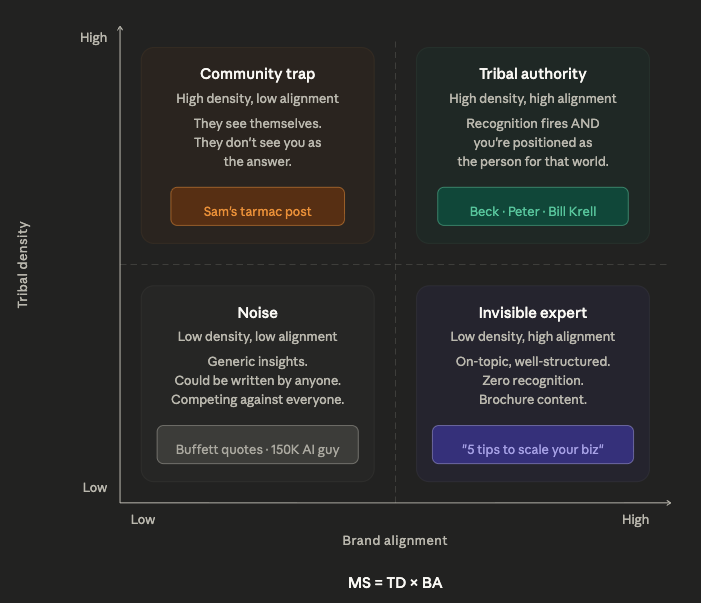
Top right -- Tribal Authority.
High density. High alignment. This is the goal. This is where Beck lives. Where Peter Gaffney's 298-impression post lived that generated GBP 28,000. Where Bill Krell sits -- booked out weeks in advance from inbound, because every structural PE on LinkedIn sees his content and their nervous system fires before they've finished reading the first sentence. Tribal recognition that simultaneously positions you as the person for that world. The only quadrant that reliably produces clients.
Top left -- Community Trap.
High density. Low alignment. This is the engagement trap. Your content creates strong recognition -- people see themselves, they like it, they comment. But it doesn't connect to what you sell. You're posting personal stories that resonate with your tribe but don't position you as the solution to their problem. Community love. No clients. Sam's tarmac photo from Chapter One is kind of a pure example of this -- 15,000 impressions, the recognition was absolutely real, but it didn't connect to what he does. He was dumbfounded why it got that many impressions. A CrossFit coach posting about their own Fran time and getting 50 comments from other CrossFitters -- but none of those comments are from box owners who want help growing their membership. The tribe sees you. They just don't see you as their answer.
Bottom right -- Invisible Expert.
Low density. High alignment. Technically on-topic. Zero recognition. Category language with good intent. Your content describes what you do for people without making those people see themselves in it. "5 tips for growing your business." "How to improve your marketing strategy." Makes complete sense. Creates no recognition. This is where most of my clients start. Not bad content. Brochure content. The kind of stuff you'd put on a website. It passes the "is this relevant?" test but it never passes the "holy shit, that's me" test.
Bottom left -- Noise.
Low density. Low alignment. Generic insights. Motivational content. Warren Buffett quotes. "Monday mindset." Content that could have been written by anyone, doesn't position you as anything, and is competing against people with bigger platforms and better production budgets.
The AI guy from Chapter One with 150,000 followers and zero revenue? Every post sat here. Massive reach. Zero recognition. Zero clients.
The AI gap -- and why it's actually your advantage
Here's something worth sitting with.
ChatGPT can write you a LinkedIn post in 15 seconds. Polished, coherent, well-structured. Sounds professional.
And it will land in the bottom left quadrant. Every time. If you just prompt it with "write a LinkedIn post for my niche."
Because AI can generate category language. It can describe what you do. It can write "I help founders scale their operations" a thousand different ways. It can produce content that passes the "is this relevant?" test.
What it can't do -- on its own -- is write from inside a world.
It can't write the specific misery of the Garmin telling you minus four after a run you worked hard for on a 6:30am pitch-black Sydney morning before daylight savings ends.
It can't write what the cotton farm smells like in harvest season.
It can't write what it felt like the first time Megan saw a Stanley water bottle and understood its cultural weight.
But here's the nuance. AI CAN write tribal content -- if someone who lived it feeds the details. AI is the pen, not the eyes. If you tell it about the Garmin at minus four, the 6:30am darkness, the specific route you run along Narrabeen Lagoon, the way your breath fogs up and your fingers are numb on the wrist buttons -- it can use all of that. It can structure it, polish it, amplify it. But it can't generate those details from nothing. It can't see what it hasn't lived.
If you prompt "write a LinkedIn post for my niche" -- you get category language. Zero density. Bottom left.
If you prompt "write a LinkedIn post using these specific tribal details I'm about to give you" and then feed it the objects, the language, the moments from inside the world -- it becomes a force multiplier. You provide the meaning. AI provides the reach.
That gap -- between what AI generates from a generic prompt and what it produces when fed lived tribal details -- that gap is the entire recognition event.
Your unfair advantage isn't working harder than AI. It's the fact that you've lived inside a world that AI can only describe from the outside. Unless you let it inside.
Three types of tribes -- and the cost gate
Before we go deep on each type in the coming chapters, let me sketch the map.
Tribes aren't all the same kind of thing. They form differently. They create different types of recognition. And the way you speak to them is slightly different.
There are three main types.
Chosen Tribes -- the ones you paid to join or trained to enter. CrossFit. Brazilian jiu-jitsu. The mortgage broker world. You made a decision, voluntarily, to enter this world. The language is specific and earned. Outsiders don't know it. Insiders recognise it before you finish the sentence.
And the key thing about chosen tribes: there's a cost. You can't just claim membership. You had to train, certify, practise, fail, show up, and keep showing up. That cost is what creates the language barrier. The language barrier is what creates the recognition.
Circumstantial Tribes -- the ones life handed you. Not a choice. A condition. Growing up as a migrant. Going through redundancy. Being a new parent. Navigating a visa system in a country that wasn't built for you. The recognition that comes from circumstantial tribes is faster and more visceral than almost anything else -- because the tribe formed around a shared experience of being put into something, not choosing it.
Circumstantial tribes have cost too -- just not voluntary cost. You didn't choose to be made redundant. You didn't choose to be a first-generation immigrant navigating a system designed for someone else. The cost was imposed. And that involuntary cost creates some of the deepest identity formation there is.
Place Tribes -- the ones that come from geography. Not just "I'm from Sydney." The specific texture of a place -- the local landmarks, the slang, the things only people who actually live there know. The B-Line bus -- the yellow double-decker that runs from Mona Vale to the city along Pittwater Road, introduced November 2017. Carl the fog in the Bay Area. Beck's cotton country. Place tribes shaped you whether you chose them or not.
And then the bonus: Intimate Tribes. The micro-communities formed by extraordinary shared circumstances. YC batches. Founding teams. Military units. These operate by their own rules and we'll cover them separately.
Now here's where the cost gate connects back to the guardrail from earlier.
"Online coach" has no cost. Anyone can claim it tomorrow. No initiation. No exam. No suffering. No before-and-after identity transformation. Which is why it fails the five-word test.
"CrossFit box owner" has massive cost. Years of training. The L1 certification. Opening a box. Managing members. Dealing with equipment. That cost created a world with dense, exclusive language and genuine tribal recognition.
When you're evaluating whether you've found a tribe or just a label, the cost gate is one of the fastest checks you can run. Did it cost something real -- time, money, suffering, reputation -- to become a member of this group? If yes, you're probably looking at a tribe. If no, you're probably looking at a category.
Ehsan -- who works with the Indian Origin Aussie IT Workers, the Parle-G biscuits crowd -- is a great example of what happens when you stack tribes correctly. He doesn't just work with "business owners." He works with specific tribes, layered. We'll go deep on his tribe stack in Chapter 7 when we cover tribe stacking, but he's proof that this isn't just theory. The stacking produces compounding recognition. Every layer you add that passes the five-word test multiplies the density of the layer before it.
Your person is a member of multiple tribes simultaneously.
Chosen tribes. Circumstantial tribes. Place tribes.
And every single one of those is a source of language -- words, objects, images, references -- that can create pre-verbal recognition when you use it correctly.
The game is to understand the full map of your person's world.
And then write content that reflects that map back at them.
Your diagnostic
Take your last five LinkedIn posts.
For each one, ask this: could AI have generated this from a prompt that just says "write a LinkedIn post for [your niche]"?
Not "is it as good as AI." Not "could AI have helped write it." Just -- if someone typed that one-line prompt into ChatGPT, could what came out look basically like what you posted?
If yes -- it's category language. No density. Nobody stops. Nobody thinks that's me. You're in the bottom quadrants and no amount of posting frequency or hook stuff is going to fix it.
If no -- if the content is so specific to a particular world, a particular set of objects and frustrations and references that a generic prompt couldn't access it -- you're in the right territory.
That specificity. That's the whole thing.
Everything after this chapter is about how to build it.
Next: Chapter Three -- Chosen Tribes