Chapter 3: Chosen Tribes
Look, I'm going to admit something pretty embarrassing here.
I used to be a hardcore gamer. I'm talking like I had 50 actual real-world days clocked up on World of Warcraft. Fifty. Days.
There used to be a thing at the top of your computer which showed how many days you played it, and all throughout university -- which I didn't even finish -- I would skip uni multiple days a week to go to an internet cafe in Chatswood called City Hunter.
At that time I changed games and would literally sit there and play League of Legends for 12 hours straight. It was wild.
I'm going to start this chapter with a language you probably don't speak.
Lee Sin Jungle. Flash R. Cho'Gath mid. One shot. Kick them back into my tower.
If you have no idea what any of that means, that's kind of the whole point.
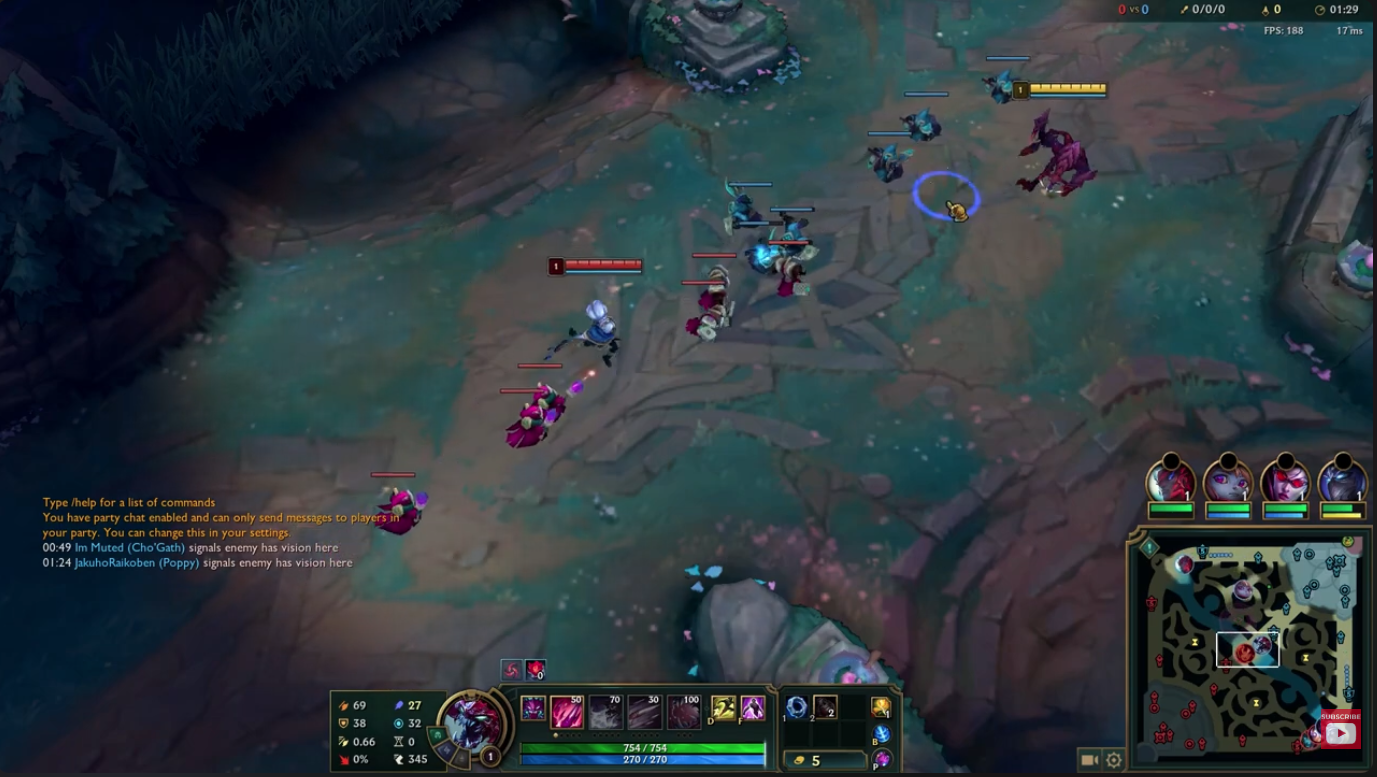
League of Legends is one of the most played games on the planet. Over 150 million monthly players. The esports scene is massive -- look up Worlds on YouTube, the tournament gets tens of millions of viewers. And Faker -- Lee Sang-hyeok -- is my favourite player of all time for anyone who knows. Four-time World Champion. 2013, 2015, 2016, 2023. Plays for T1. Universally considered the greatest League of Legends player to ever live. The GOAT. If you know, you know.
When I was running a live challenge recently, I ended up in a conversation with Ceyhun -- who'd been playing League for years -- and we just went off.
"Mine was Lee Sin. I was playing Jungle."
"Lee Sin Jungle -- and I was Cho'Gath mid, and I would queue, hopefully hit them, then you can queue, and we'll both flash R, and we'll kill them."
"Exactly yeah, one shot."
"Or you can kick them back into my tower, that'd be great."
Now for anyone still reading this going "what the fuck is any of this" -- let me translate.
Lee Sin is a champion in the game, right? He's famous for this move called the InSec kick where you dash to an enemy, ward-hop behind them, and then use your ultimate to kick them back into your team. It's one of the flashiest plays you can make. Cho'Gath is this massive void creature champion who can one-shot people with his ultimate. Flash is a summoner spell -- basically a short-range teleport on a five-minute cooldown. R is your ultimate ability, the most powerful move your champion has.
So when Ceyhun and I said "Flash R, one shot, kick them back into my tower" -- we communicated an entire coordinated play. Two champions. Specific roles on the map. A specific moment in a teamfight where two players execute someone. The exact sequence. The whole thing.
The whole call just watched.
Nobody else had any idea what we were talking about.
And that's exactly the point.
The calluses thing
Here's something else.
I do CrossFit. Have for years now. And if you've done CrossFit for long enough -- specifically if you do kipping pull-ups and muscle-ups -- you develop calluses on your palms.
Not light ones. Actual thick skin. Tears sometimes. Chalk and blood on the bar on a hard session.
I showed my hands on the call that morning and every CrossFitter in the room knew immediately what caused those.
Nobody else did.
That's a tribal object. It communicates world, practice, commitment, and identity before a single word is spoken.
The calluses don't need a caption.
That's the point of this chapter. We're talking about chosen tribes -- things you've voluntarily decided to be a part of. But they're not just things you joined. They cost something to join. That cost is what creates the language. And the language is what creates the recognition.
Why some tribes actually work -- and most don't
But here's where people get confused.
Being an employee is technically a choice. You applied for the job. You accepted the offer.
But "employee at a company" is a shit chosen tribe. And I need to be specific about why, because it's not that being an employee is easy. Getting jobs is hard. Interviews suck. Office politics are a nightmare. There's definitely bonding that happens around working from home culture, the commute, dealing with management, all of that. You can absolutely relate to another employee on those things.
But here's the problem -- the relatability across different employees is super low. Like, what does a marketing coordinator at a tech startup in Sydney actually have in common with a logistics manager at a mining company in Perth? They're both employees. That's about it. There's no generally accepted exclusive language. No insider vocabulary that all employees share. It's too broad. It fails as a tribe.
Nobody leads their introduction at a party with "I'm an employee."
It fails the test. And I'll get to the test in a minute.
Real chosen tribes have initiation cost. The cost is what creates the language barrier. And the language barrier is what creates the recognition.
Here's what that initiation cost can look like.
Formal and credentialed. You sat a certification. You passed a licensing exam. You did the course, passed the test, got the qualification. CrossFit L1. CeMAP for mortgage brokers. The PE licence for engineers. The bar exam. BCBA certification. There's a before and after. You either have it or you don't.
Experiential and milestone-based. You did the thing for long enough that something changed. Your first CrossFit competition. Your first harvest season in a farming operation. Your first year in business. Your first tournament in BJJ. The milestone is real -- not assigned by an institution, but earned through time in the world.
Ordeal-based. You survived something. Military service. Medical residency. An apprenticeship. The kind of initiation that demands you suffer before you belong. The suffering is the cost. And the cost is what makes the language mean something.
Public identification. You declared it. You joined the community. You showed up at the box, the tournament, the meetup. You put yourself in front of other members and said, by your presence, I'm one of these people.
The higher the initiation cost across these four dimensions, the more exclusive the language. The more exclusive the language, the more powerful the recognition event when you use it.
This is the psychological mechanism underneath all of it. When you pay a significant cost to enter something, your brain can't easily conclude it wasn't worth it. I went through all of that, therefore this matters. The higher the cost, the stronger the identity commitment.
This is why CrossFitters don't casually mention CrossFit.
They announce it.
The "I am a ___" test
Here's the main diagnostic of this chapter.
Simple question: would someone actually say this about themselves at a party?
Not in a LinkedIn bio. Not in a board deck. At a party. Introduced to someone they've just met.
"I'm a CrossFitter." Yes. People say that.
"I'm a BJJ blue belt." Absolutely. They lead with it.
"I'm a mortgage broker." Yes.
"I'm a structural PE." Yes, in the right conversation.
"I'm a high performer." No. Nobody says that. It's a label you apply to yourself in a bio. It's not a self-concept. It's an aspiration dressed as an identity.
"I'm a mid-market executive." Nobody. Nobody ever says that at a party. Or anywhere.
"I'm a founder." Sort of. Some people identify strongly with this. But most people who technically are founders don't lead with it. It's become so broad that it barely qualifies anymore.
"I'm a CEO." No. People say what their company does or what they personally work on. "I run a consulting business that works with..." CEO is a title, not a tribe.
Here's why this matters.
When you build your ICP document in AI and ask it to characterise your ideal client, it generates labels nobody actually uses.
"Growth-oriented mid-market executive with revenue responsibility of $5M-$50M."
Sounds specific. Looks like proper targeting. Nobody calls themselves that. Nobody recognises themselves in it.
AI does this because it pattern-matches to professional language. It finds the words that sound like what a consultant or marketer would write, and it serves them back to you looking credible.
But real tribal language doesn't come from pattern-matching. It comes from being in the world long enough to know what people actually call themselves.
The chosen tribe passes the "I am a ___" test when members actively self-identify as the word.
That's entitativity -- the technical term from the Niche Scoring Bible for how strongly group-consciousness operates in a tribe. But you don't need to know the word. Just ask: would someone actually say this about themselves?
If yes -- that's a tribe.
If no -- that's a label.
The one-word test
Here's the other diagnostic. Simpler.
Say one word to someone inside a tribe. Watch what happens.
Say "Fran" to a CrossFitter.
They don't think about it. Before they've processed the word, something fires. They know the 21-15-9. They know the thrusters at 95lbs. They know what their lungs feel like at rep 15 of the second set, when the bar starts to feel impossible and the pull-up bar is right there taunting you. They know the specific discomfort of their first Fran. They know their current Fran time. They know whether they've Rx'd it or scaled it and what that means about where they're at.
One word. An entire lived world with memories and suffering and benchmarks and identity attached.
Say "fitness tracker" to the same person.
Nothing. Generic. Could mean anything.
Say "Garmin" to a runner.
On the 4pm call, I asked David if he wore a Garmin. He did.
"What's specific about it -- like what does the Garmin do that's unique to you?"
"Yeah, pace ranging is very important to it. VO2 max. Intervals. Hills progressions."
"Do you hate when you go for a run and it does your performance condition thing, and it comes back minus four, and you're like -- what have I even been training for?"
"Yeah, big time."
That conversation -- that specific moment of the Garmin telling you that the run you just worked hard for actually degraded your fitness -- that is only legible to people inside the Garmin running world. Anyone outside it just sees a watch.
One word. One world. That's the test.
Directional meaning
Here's something that I reckon is one of the most important ideas in this whole book, and most people completely miss it.
The same word fires different worlds depending on which tribe hears it.
Take the word "plank."
A tradie from the Northern Beaches hears "plank" and thinks of a plank of wood. Something you'd pick up at Bunnings. A CrossFitter hears "plank" and immediately goes "what's your plank time?" -- because plank hold is a thing, and your time is kind of a status marker. A pirate from the 1600s hears "plank" and thinks "walk the plank."
Same word. Three completely different meanings. And the meaning that fires depends entirely on which tribe that person belongs to.
Here's another one. "MacBook."
A developer hears "MacBook" and thinks terminal, VS Code, running builds. A graphic designer hears "MacBook" and thinks Canva, Photoshop, creative work. Someone who hates their job hears "MacBook" and their stomach drops -- it's the thing they dread opening every morning. Same object. Completely different emotional reaction. The tribe determines the direction.
Or think about political figures. Say the name of any political leader -- doesn't matter which country, doesn't matter which leader -- and people on the left react one way, people on the right react the exact opposite. Same word. Opposite meaning. The tribe determines the direction.
Now here's why this actually matters for your niche.
If you go too broad with your tribe, you don't even know what DIRECTION the meaning points. You're trying to use words that have meaning, but you can't predict what that meaning IS for each person. That's why broad niches fail. It's not just that the words have less meaning -- it's that the meaning becomes unpredictable. You say a word and you have no idea how it's going to land, because the person could be in any of fifteen different tribes, and the word means something different in every single one.
When you narrow to a specific chosen tribe, the direction locks in. You know exactly what fires when you say the word. You know where it lands. You know what it triggers.
And there's another layer to this as well. Tribal objects.
Say "Matt Fraser" to a CrossFitter. They light up. Five-time CrossFit Games champion, 2016 to 2020. GOAT status. Retired at the top. Say "Tia-Clair Toomey" -- she's Australian as well, won six CrossFit Games from 2017 to 2022, most decorated champion ever. Say those names to a CrossFitter and their whole world fires. The Games footage, the iconic moments, the dominance. Say those same names to someone outside CrossFit and you get nothing. Just a blank face.
The direction of meaning is associated based on the tribe someone's in. The word doesn't carry the meaning. The tribe carries the meaning. The word just activates it.
Does that make sense?
That's why this matters. That's why specificity isn't just "nice to have." It's the difference between your words landing with precision and your words landing like a coin toss.
Five chosen tribes -- and what makes them work
Let me walk you through five of them, just so you can feel the density difference.
CrossFit.
This is the benchmark. If you want to understand what a real chosen tribe looks like at the ceiling of tribal density, this is it.
WOD -- workout of the day. The whiteboard where the coach writes it up and everyone walks in and immediately starts either getting excited or dreading their life. Fran time -- 21-15-9 thrusters and pull-ups, and your Fran time is basically your tribal business card. RX versus scaled. Box, not gym -- you call it a gym and people look at you sideways. AMRAP -- as many rounds as possible. EMOM -- every minute on the minute.
The Open is the annual worldwide qualifier. Hundreds of thousands of people doing the same workouts in the same week, posting scores, comparing globally. "I scaled the Open" requires zero explanation to any CrossFitter on the planet.
Murph. Named after Navy Lieutenant Michael Murphy, Medal of Honor recipient. Performed on Memorial Day. One-mile run, 100 pull-ups, 200 push-ups, 300 squats, one-mile run. With a 20-pound vest. People train for Murph specifically. They dread Murph. They post their Murph time like it's a badge of honour. It's a communal suffering ritual, and every CrossFitter knows exactly what you went through when you say "I did Murph this year."
The kipping pull-up controversy is a genuine tribal boundary marker as well. People outside CrossFit look at a kipping pull-up and go "that's not a real pull-up." People inside CrossFit will explain the difference between strict and kipping and why both have their place and then get into a thirty-minute debate about it. That debate IS the tribe. The fact that you even have an opinion on kipping means you're inside.
"No rep" -- the gut-wrenching call from a judge in competition. Rogue equipment. Chalk bucket. Calluses. "What's your Fran?" fires the same way a secret handshake does. In four words you've communicated that you're in the world, that you benchmark yourself, and that you're asking about a specific and painful reference point. Nobody outside the tribe even knows Fran is a workout.
CrossFit scores at the ceiling of tribal density in my scoring system.
Brazilian jiu-jitsu.
Belt system -- white, blue, purple, brown, black. Takes eight to twelve-plus years to get a black belt. And the specific fact that blue belt is where most people quit. Every BJJ person knows this. The blue belt dropout is THE tribal marker. You mention it and everyone either laughs knowingly or gets a bit quiet because they've seen it happen to training partners. Or they were the one who almost quit at blue belt.
Gi versus no-gi is a genuine ideological divide inside the community. Like, people have strong opinions on this. It's not a casual preference -- it's almost a philosophical stance.
Rolling -- that's what they call sparring. "I rolled with a brown belt today and survived" communicates a whole world of meaning. Tapping is sacred. When someone taps, you release immediately. No questions. No hesitation. That's the code.
The Gracie family is the founding mythology. Every BJJ person knows who the Gracies are. Royce Gracie winning UFC 1, 2, and 4 in the early 90s -- that's the event that put BJJ on the map globally. A skinny Brazilian submitting guys twice his size. That's origin-story-level tribal knowledge.
ADCC -- the Abu Dhabi Combat Club. It's basically the Olympics of submission grappling, held every two years. Gordon Ryan is the most dominant no-gi grappler alive. Say those names inside a BJJ academy and everyone has an opinion. Say them outside it and nothing.
One of the highest entitativity scores I've measured. Members lead with their belt colour in introductions.
Garmin runners.
This is actually a great example of the directional meaning thing I was talking about before.
The Garmin isn't just a watch to a runner. It's kind of like the centre of their whole training universe. Performance Condition showing -4 mid-run -- that means you're underperforming based on your data, and it's this gut-punch feeling where you're like "I've been training for weeks and my body is telling me I'm going backwards." VO2 max tracking is obsessive. People check it like they check their bank account.
BQ -- Boston Qualifier. This is the big one. Boston is the only major marathon that requires qualifying times. Sub-3:00 for men 18-34. That's fast. "I BQ'd at Chicago" communicates world, timeline, identity, and achievement in four words. Everything about that sentence is insider language -- BQ as a concept, Chicago as a specific qualifying race, the cultural weight of Boston as the goal that runners orient their entire training around.
Taper madness is a real thing. Two to three weeks before a race, you reduce your training volume. And every runner goes absolutely mental during taper. You start getting phantom injuries. You're convinced all your fitness has disappeared. You feel sluggish. You feel slow. You feel like you've forgotten how to run. It's universal and every runner knows it and every runner still panics through it every single time.
Mile 20 is the wall. Marathon runners know this. The race starts at mile 20. Everything before that is just the warm-up.
The carbon plate debate -- Nike's carbon-plated super shoes. "Technological doping" some people call it. About 4% energy return. Eliud Kipchoge wore a Nike prototype from the AlphaFly line for his sub-2-hour marathon. And there's this genuine divide in the running community about whether they should be allowed, whether they change the integrity of the sport, whether you're a "real" runner if your shoe is doing 4% of the work for you.
"If it's not on Strava, it didn't happen." Every runner knows that line.
WHOOP wearers.
Recovery score. HRV. Strain coach. The specific anxiety of waking up to a 34% recovery score when you've got something important on. These people chose to wear a specific device, pay a subscription for it, and orient their behaviour around its data. That's a committed chosen tribe.
Wing foiling.
This one's for Edward, who's in my program.
Most of you reading this probably don't know what wing foiling is, so let me actually explain it. It's a water sport where you stand on a board that has a hydrofoil underneath it -- kind of like a fin that goes down into the water with a wing shape -- and you hold an inflatable wing in your hands to catch the wind. Once you get enough speed, the hydrofoil lifts the board completely out of the water and you're basically flying above the surface. It became mainstream around 2019-2020 and it's kind of exploded since then.
Edward works with businesses on the Northern Beaches in Sydney, and wing foiling is his world. It's popular up here -- Narrabeen Lagoon, Long Reef, Palm Beach. You see them out there all the time.
Key terms: downwinder -- riding with the wind over long distances, basically a point-to-point run. Dock start -- starting from a dock or pontoon instead of from the water, which is actually harder than it sounds. Jibe -- turning downwind while maintaining speed on the foil. The learning curve is steep initially. Like, seriously steep. You're going to fall a lot. You're going to feel stupid. But once it clicks, once you get that first foil and you're just gliding above the water, it's kind of addictive.
I said to Edward on the call: "If I posted -- the five mindset hacks you need to actually start wing foiling and stand up and ride for 30 seconds straight in three months -- you stop dead."
He does.
Because it's his world. The specific challenge of clearing the water for the first time. The technical difficulty of the wing. The Northern Beaches conditions. One reference and his whole identity is in it.
Nobody else on that call knew what wing foiling was.
Edward would read that post and feel it in his body before he'd thought about it.
The segue that most people miss
Here's where it gets interesting for LinkedIn.
You might be thinking: this is great, Matt, but I'm not marketing to CrossFitters or BJJ people. I'm a B2B service provider. I work with businesses.
And my answer is: the people running those businesses are members of chosen tribes.
The structural engineer is a member of the geotechnical and structural PE tribe.
The mortgage broker is a member of the CeMAP, trail-book, BDM-relationships tribe.
The recruiter is a member of the retained-versus-contingency, PSA, placement-fee-structure tribe.
The accountant is a member of a tribe with its own dense language -- tax treatments, entity structures, software ecosystems, compliance obligations, professional bodies.
These are chosen tribes. They have formal initiation. They have certification costs. They have real before-and-after identity transformation. They have language that's invisible to outsiders and instantly legible to insiders.
And here's the thing: most people serving these tribes are writing generic content about "helping business owners" or "serving professionals."
Nobody in those tribes stops for that.
But if you write like you're actually in their world -- like you know the language from the inside -- they stop immediately.
Bill Krell. Booked out weeks in advance.
I've done an in-person workshop with 35 recruiters. I've done a talk at an event with 100 recruiters. Pretty much none of them believed you can get clients through content on LinkedIn. And honestly, 99.9% of recruiters have junk-ass content. It sucks. It's all the same generic career advice that could have been written by any recruiter, in any industry, for any professional. "5 tips for advancing your career." "The job market is changing -- here's what to do." "Your resume is the first impression."
It's terrible. And they wonder why it doesn't work.
Bill Krell is a recruiter in Tulsa, Oklahoma.
He's not a recruiter for executives. Not a recruiter for "professionals." He recruits for geotechnical and structural engineers. Specifically licensed PEs -- professional engineers.
His LinkedIn headline: Engineers are underpaid (except for mine).
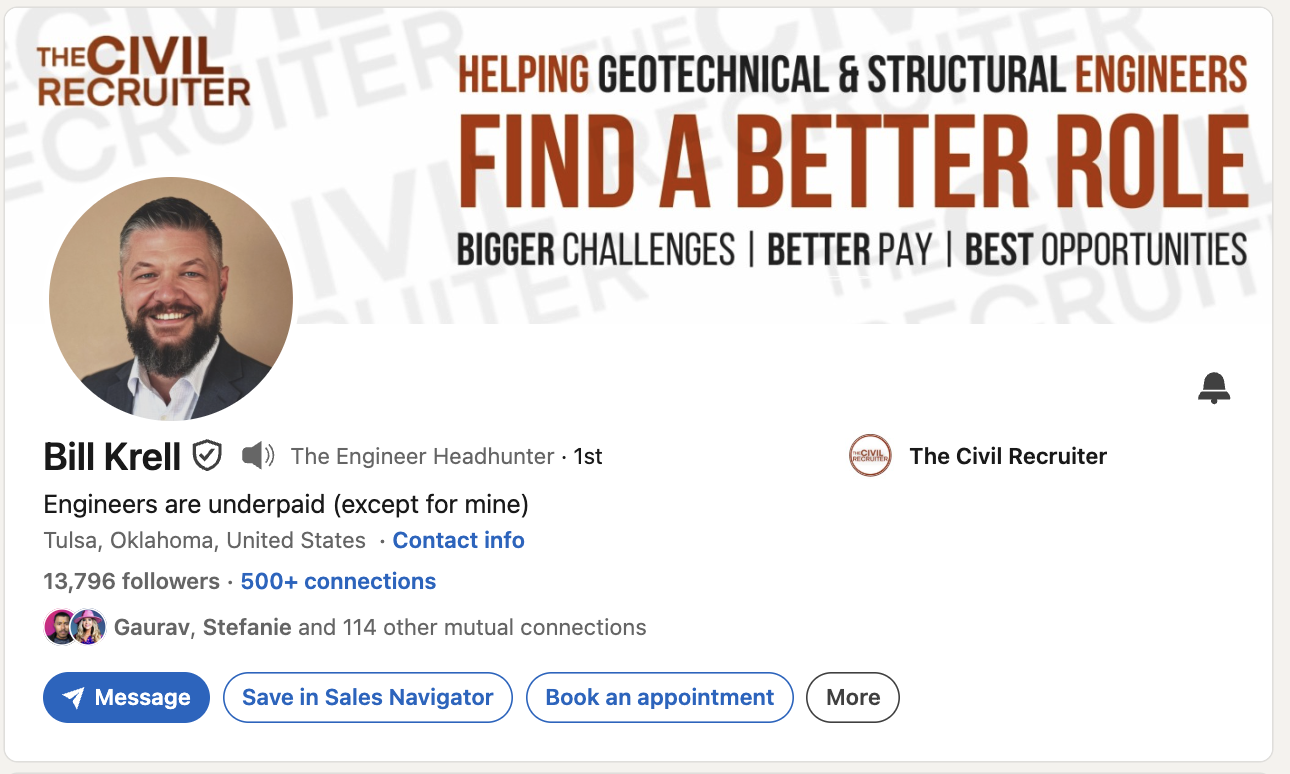
Bill writes from inside the PE world.
"I talked to a civil PE a week ago with 8 years experience. Licensed in 5 states."
Outsiders read that and move on. Nothing stops them.
But every structural and geotechnical PE reading that sentence stops.
Because "civil PE" isn't just a job title to them. It's a designation that took years to earn. You start by passing the FE exam -- the Fundamentals of Engineering exam. Then you're an EIT -- Engineer in Training. That's the intermediate stage. You accumulate supervised experience under a licensed PE. Then you sit the PE exam itself. The whole process takes years. "Licensed in 5 states" means something specific about that person's career, their mobility, their value -- because PEs can get licensed in multiple states through comity and reciprocity agreements, and each additional state is more paperwork, more verification, more proof of competence.
Bill doesn't explain any of this. He doesn't need to.
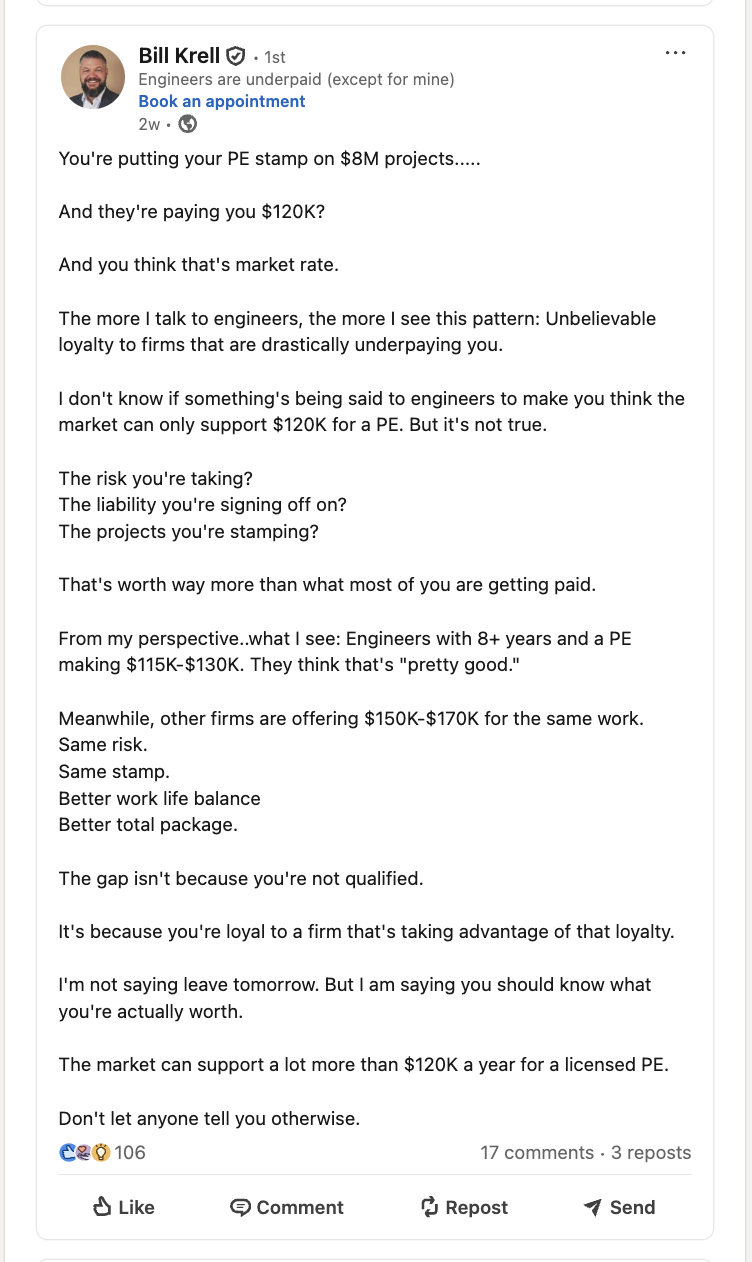
And then:
"You're putting your PE stamp on $8M projects. And they're paying you $120K? And you think that's market rate."
That post got 106 reactions.
106 reactions from a recruiter in Tulsa is enormous. Because every reaction is from someone inside the tribe.
The PE stamp. That phrase. Only people who hold a PE licence know what it means to put your stamp on a project. It's not just a signature -- it's a legal declaration of professional responsibility. You are personally liable for that stamp. $8M projects, your signature, your licence on the line.
$120K.
And you think that's what it's worth.
Bill doesn't need to explain the emotional punch of that. The people in his tribe feel it immediately.
He writes about EIT versus PE -- the distinction between an Engineer in Training and a licensed Professional Engineer. He writes about W2 versus 1099 structures for engineers -- employee versus independent contractor, and what each tax structure means for take-home pay and career flexibility. He writes about billable hours percentages and overhead ratios and what they mean for engineer compensation.
None of this is comprehensible to anyone outside the structural and geotechnical engineering world.
To everyone inside it, it's their Tuesday.
Bill is booked out weeks in advance. Inbound from engineers he's never reached out to. Because when a structural PE scrolls LinkedIn and sees his content, the recognition fires before the thought arrives.
This guy is one of us. This guy knows our world.
Most recruiters using LinkedIn are writing for everyone.
Bill writes for civil PEs. And civil PEs come to him.
Your exercise
Here's what I want you to do.
Write down every chosen tribe you actually belong to. Try and get three.
You're probably part of heaps of chosen tribes. If you sat down for a long time, you could think of dozens that pass the I AM test. CrossFit, BJJ, running, a specific sport, a professional certification, an industry you've been in for years, a hobby that has its own language. Go broad at first -- include personal ones, professional ones, and anything where you've spent enough time that you know the language from the inside.
For each one, write ten words or phrases that only members would know.
Not the category word -- the insider word. Not "weightlifting" -- "Fran time." Not "running" -- "BQ'd at Chicago." Not "mortgage" -- "trail book." Not "engineering" -- "PE stamp on an $8M project."
Then run each word through both tests.
The "I am a ___" test: would someone actually say this about themselves?
The one-word test: if you said this word to a tribe member, would their whole world fire in their head?
And here's the other thing to think about. Remember the directional meaning concept from earlier in this chapter? For someone who actually loves their job, if you say "MacBook" in relation to their work, they light up. If someone hates their job and you say "MacBook," they're like "I fucking dread looking at that thing." The same object, completely different meaning, based on someone's relationship to the tribe. So when you're writing your ten words, make sure the words you're choosing have a clear directional meaning for your specific tribe. If the word could mean five different things to five different people, it's not tribal enough.
The words that pass both tests -- those are your tribal vocabulary assets. They've been sitting in your experience this whole time. You've just been leaving them out of your content.
Selling from vs selling to
Sometimes you're selling FROM a chosen tribe. You are the CrossFitter who coaches performance. You are the PE who now consults to engineering firms. The tribe you belong to is the tribe you serve. The language is yours and theirs simultaneously.
Sometimes you're selling TO a chosen tribe. You're a 50-year-old mortgage broker in Australia, and you're selling to new families in their 30s buying their first home. You've got Australia in common, but you need to bridge that gap and understand these people more. You don't have to be in the tribe to sell to them. AI makes this easier as well -- and we'll get to that in Chapter 11.
In both cases, the vocabulary assets you just mapped are the same thing: words that land with density.
Words that make someone stop before they've thought about it.
Words that make them feel -- this person is from my world.
Chapter Four is about a completely different kind of tribe.
Not the ones you chose. The ones you didn't.
Next: Chapter Four -- Circumstantial Tribes